
Care Requirements
Adult Size
3.1" (8cm)
Min Tank
40 gal
Temperature
75-82°F
pH Range
6-7.5
Lifespan
10 years
Min Group
6+ fish
Diet
Carnivore
Swim Level
Middle
Bioload
3/10
Hardness
2-15 dGH
About Amazon Puffer
The Amazon Puffer breaks the mold of typical puffer keeping — this is a genuinely social species that does best in groups rather than as solitary specimens. While most puffers are territorial loners that barely tolerate conspecifics, Amazon Puffers actively school together, creating dynamic displays unusual in the puffer world.
Entirely freshwater, Amazon Puffers come from the vast river systems of South America. They inhabit open water rather than the structured territories typical of most puffers, which explains their unusual social nature. In the wild, they school for protection in relatively exposed habitats.
Their activity level is remarkable — these are fast, active swimmers that cruise constantly rather than hovering like many puffers. A group of Amazon Puffers in motion is genuinely impressive. This activity comes with space requirements; they need room to swim and don't do well in cramped tanks.
One significant challenge is their dental needs. Amazon Puffer teeth grow exceptionally fast, requiring more frequent hard-shelled foods than many puffers. Without consistent snail and shellfish feeding, teeth quickly overgrow and prevent eating. This isn't optional maintenance — it's essential for survival.
Natural Habitat & Origin
Amazon Puffers inhabit the main channels and tributaries of the Amazon River basin throughout South America. Unlike many puffers that occupy structured habitats with territories, Amazon Puffers school in open water — a behavior that makes them unique among commonly kept puffers.
Their native waters are warm, soft, and acidic — typical Amazonian blackwater and clearwater conditions. They're found in both fast-flowing main channels and slower tributaries, demonstrating adaptability to various flow conditions.
This open-water, schooling lifestyle shapes their aquarium needs: groups are important for natural behavior, swimming space is essential, and they don't rely on complex rockwork territories.
Native Region
Amazon River basin, South America
Habitat Type
Main river channels and tributaries, open water
Wild Water Conditions
Soft, acidic (pH 6.0-7.5), warm, variable flow
Appearance & Varieties
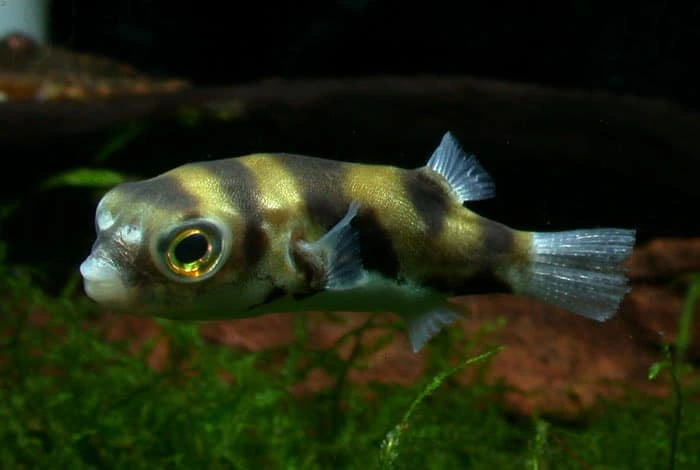
Amazon Puffers have an elongated body compared to rounder puffer species — adapted for active swimming rather than hovering. Their coloration is yellowish-green on top fading to white below, with distinctive dark bands running vertically along the body.
Adults reach about 3 inches (8cm), making them medium-sized among commonly kept puffers. Their streamlined shape and constant motion make them appear different from the more globular puffers many keepers are familiar with.
Sexing is difficult with no reliable external differences between males and females.
Popular Varieties
| Variety | Description | Rarity |
|---|---|---|
| Standard/Wild-Type | Yellowish-green body with dark vertical bands and lateral stripe. White underside. The only available form. | Uncommon |
Tank Setup & Requirements
Quick Requirements Summary
Tank Size
Minimum Tank Size
40 gallons
Recommended Tank Size
55 gallons
Amazon Puffer tanks should prioritize swimming space over complex decoration. Their active, schooling nature requires room to move. While they appreciate some structure, open swimming areas are more important than territories.
Water Parameters
Fully freshwater — no salt needed. They prefer soft, slightly acidic water (pH 6.0-7.5, 2-15 dGH) matching their Amazonian origins but adapt to moderate hardness. Temperature 24-28°C (75-82°F). Stability matters more than hitting exact numbers.
Substrate
Soft substrate is appropriate. Sand is most natural for South American setup aesthetics. They don't interact with substrate heavily but shouldn't have sharp materials.
Plants & Decorations
Balance is key — provide some driftwood and plants for security without cluttering swimming space. They don't need complex territories like solitary puffers. Open areas for schooling are more important than hiding spots. Tall background plants with open foreground work well.
Filtration & Water Flow
Active swimmers that don't mind moderate current — unlike some puffers that prefer still water. Strong filtration handles their carnivore waste production. Canister filters work well. Aim for good turnover.
Lighting
Standard aquarium lighting is fine. They're active during the day and don't require special lighting considerations.
Diet & Feeding Guide
Diet Type
carnivore
Feeding Frequency
Daily feeding with snails/shellfish 3-4 times weekly minimum
Portion Size
Moderate amounts consumed within a few minutes. Feed the group ensuring all individuals eat. Their activity level means they burn calories quickly.
Amazon Puffers are carnivores with particularly fast-growing teeth. Their dental needs exceed most puffers — teeth can overgrow within weeks without consistent hard foods. Snails and shellfish aren't occasional treats; they're essential multiple-times-weekly requirements.
Best Foods for Amazon Puffer
- Snails (multiple times weekly — essential) — Critical for dental health. Amazon Puffer teeth grow faster than most puffers, requiring snails 3-4 times per week minimum. A dedicated snail breeding colony is almost mandatory.
- Shellfish (clams, mussels, cockles) — Excellent for tooth wear and nutrition. Frozen or fresh, chopped appropriately.
- Frozen bloodworms — Accepted readily and good nutrition. Standard diet component but cannot replace hard-shelled foods.
- Frozen shrimp (whole with shell) — Provides both nutrition and some dental maintenance from shell material.
- Krill — Frozen or freeze-dried. Shell provides some dental benefit. Good for variety.
Foods to Avoid
- Flakes and pellets — Generally ignored. They're carnivores requiring meaty frozen and live foods.
- Soft-only diets — Leads rapidly to overgrown teeth. Their fast dental growth makes hard foods essential, not optional.
Their teeth grow exceptionally fast — faster than most puffers. Snails 3-4 times weekly is the minimum for dental health. A dedicated snail colony is almost mandatory.
Behavior & Temperament
Amazon Puffers display unique social behavior among puffers — they actively school together, swimming in coordinated groups through open water. This schooling instinct makes them fascinating to watch and distinguishes them from the territorial solitary behavior typical of most puffers.
They're constantly active, cruising through the tank rather than hovering in place. This high activity level is energetically demanding, explaining their substantial appetites.
Despite their social nature with conspecifics, they remain semi-aggressive toward other species. Fin-nipping occurs, and they may harass slow tankmates. Their social behavior extends to their own kind, not necessarily to other fish.
Individual personality still exists within the group — some specimens are bolder feeders, others more hesitant.
Tank Mates: Compatibility Guide
Compatible Tank Mates
Other Amazon Puffers
They're social and should be kept in groups of 6+. This is their primary 'tankmate.'
Large, fast fish (with caution)
Some keepers have success with larger, fast-moving species that can avoid nipping. Not guaranteed.
Large snails (as cleanup)
Nerite snails and large mystery snails may survive if too large to eat easily.
Tank Mates to Avoid
Small or slow fish
Will be nipped and harassed. Their social nature with conspecifics doesn't extend to other species.
Long-finned fish
Fin-nipping targets. Flowing fins trigger puffer aggression.
Shrimp
Will be hunted and eaten. Puffers are predators.
Bottom-dwelling fish in small tanks
May be bothered during puffer exploration. Larger tanks with separation work better.
Common Pairing Questions
Can I keep one Amazon Puffer?
Not recommended. They're social fish that become stressed alone. Keep in groups of 6+.
Can Amazon Puffers live with other fish?
Risky. They're social with their own kind but may nip other species. Species-only groups are safest.
Amazon Puffer breeding is rarely documented in aquariums. They're egg scatterers that don't provide parental care. Their social nature may require group dynamics for breeding triggers. Little is known about specific breeding conditions, though optimal water quality, heavy feeding, and mature conditioned fish are likely requirements. Most specimens in the trade are wild-caught.
Health Issues & Disease Prevention
Amazon Puffers are reasonably hardy when their specific needs are met. Their most significant health challenge is dental — teeth grow faster than most puffers, requiring diligent feeding of hard-shelled foods.
Common Diseases
| Disease | Symptoms | Treatment |
|---|---|---|
| Overgrown Teeth | Difficulty eating, visible beak overgrowth. Progresses rapidly — teeth can overgrow within weeks without hard foods. | Prevention is critical — snails 3-4 times weekly minimum. Severe cases require manual trimming, which is stressful and risky. |
| Internal Parasites | Weight loss despite eating, white stringy feces. Common in wild-caught specimens. | Treat with Praziquantel. Quarantine and deworm all new arrivals. |
| Ich (White Spot Disease) | Small white spots on body and fins, flashing against objects. | Raise temperature gradually to 30°C. Commercial ich medications at standard doses. |
| Stress from Isolation | Lethargy, color loss, hiding, refusal to eat in single or paired specimens. | Add more conspecifics — they need groups of 6+ for proper social wellbeing. |
Signs of a Healthy Amazon Puffer
- Active schooling behavior
- Good body condition
- Bright coloration
- Strong feeding response
- Normal teeth — mouth closes properly
- Swimming with the group
Prevention Tips
- Feed snails at least 3-4 times weekly for dental health
- Keep in groups of 6+ for social wellbeing
- Provide adequate swimming space
- Maintain excellent water quality
- Quarantine and deworm new specimens
Frequently Asked Questions
Yes — they're one of the only commonly kept puffers that actively school. Groups swim together in coordinated movements, creating dynamic displays unusual among puffers.
Minimum of 6, preferably more. They're genuinely social fish that become stressed in small numbers or alone. A group of 8-10 in a large tank creates impressive displays.
Yes — fully freshwater from the Amazon River basin. No salt is needed. They prefer soft, slightly acidic water but adapt to moderate hardness.
More often than most puffers — at least 3-4 times weekly. Their teeth grow particularly fast, and dental overgrowth is their most common health issue.
Semi-aggressive — peaceful with their own species but may nip fins of other fish. They're not the best community fish despite their social nature with conspecifics.
Not recommended. They're social fish that become stressed alone. Unlike most puffers that do fine solitary, Amazon Puffers need conspecifics for normal behavior and wellbeing.
Tips for Keeping Amazon Puffer
Pro Tips
- ✓Start your snail colony before getting the puffers — their fast-growing teeth require snails 3-4 times weekly
- ✓Tank length over height — a 55-gallon long (4 feet) is better than a tall 55-gallon for schooling
- ✓Buy the group together — adding individuals to established groups can cause integration problems
- ✓Watch for individual feeding — ensure all fish eat, particularly during snail feeding
Common Mistakes to Avoid
- ✗Keeping singly or in small groups — they need groups of 6+ for social wellbeing
- ✗Underfeeding hard foods — their dental needs exceed most puffers
- ✗Insufficient swimming space — active schoolers need room to move
- ✗Assuming they're peaceful because they're social — social with own kind doesn't mean peaceful with other species
Sources
- FishBase — Accepted scientific name, maximum size and native range for Amazon Puffer.
Related Species You Might Like
View All Fish →
Angelfish
Pterophyllum scalare
Figure 8 Puffer
Dichotomyctere ocellatus
African Butterfly Fish
Pantodon buchholzi

Blood Parrot Cichlid
Amphilophus hybrid

Calvus
Altolamprologus calvus

Compressiceps
Altolamprologus compressiceps

Electric Blue Acara
Andinoacara pulcher hybrid

Firemouth Cichlid
Thorichthys meeki
Ready to Add Amazon Puffer to Your Tank?
Use our free stocking calculator to check compatibility, bioload, and get personalized recommendations.