

Care Requirements
Adult Size
5.9" (15cm)
Min Tank
40 gal
Temperature
75-81°F
pH Range
7.8-9
Lifespan
8-10 years
Min Group
Can be kept alone
Diet
Carnivore
Swim Level
Bottom-middle
Bioload
5.5/10
Hardness
10-25 dGH
About Compressiceps
The Compressiceps (Altolamprologus compressiceps) is the close cousin of the Calvus, sharing the same extraordinary laterally compressed body plan evolved for hunting in the tight rock crevices of Lake Tanganyika. While structurally similar, the Compressiceps has a broader, more sloping head profile and a slightly stockier build compared to the Calvus's steeper forehead. The species is famous for its Gold Head or 'Goldhead' variety — a stunning form where the head and face are bright golden yellow, transitioning to darker barred flanks. This color morph has made the Compressiceps one of the most sought-after Tanganyikan cichlids. Like the Calvus, Compressiceps are patient ambush predators that slide into impossibly narrow rock gaps to hunt fry and invertebrates. They share the same agonizingly slow growth rate — 2-3 years to full size — but reward patient keepers with one of the most unique and beautiful cichlids in the hobby.
Natural Habitat & Origin
Altolamprologus compressiceps is found throughout Lake Tanganyika, with a wider distribution than its Calvus relative. It inhabits rocky shorelines from shallow water to moderate depths, using the same crevice-hunting strategy as the Calvus. Different geographical populations exhibit distinct color forms — the famous Gold Head form comes from the Kasanga area of Tanzania. Lake Tanganyika's water is characteristically hard, alkaline, and remarkably stable — the lake's massive volume buffers against chemical fluctuations.
Native Region
Lake Tanganyika, East Africa — rocky shorelines throughout the lake, with notable populations in Zambia, Tanzania, and DR Congo
Habitat Type
Deep alkaline rift lake with rocky boulder fields and crevice structures
Wild Water Conditions
pH 7.8–9.0, very hard water (10–25 dGH), temperature 75–80°F (24–27°C)
Appearance & Varieties
The Compressiceps shares the Calvus's extreme lateral compression — a body shaped like a blade that can slip through impossibly narrow rock crevices. The head is broader and more gently sloped than the Calvus, with a wider mouth. The most popular variety, the Gold Head, features a brilliant golden-yellow face and head that transitions to dark-barred flanks — this color combination is genuinely striking. Dark varieties show brown-to-black coloration with pearl spotting similar to the Black Calvus. Males reach about 6 inches and are noticeably larger than females (about 4 inches). Like Calvus, growth is extremely slow — patience is a prerequisite for keeping this species.
Popular Varieties
| Variety | Description | Rarity |
|---|---|---|
| Gold Head (Kasanga) | Bright golden-yellow head with dark barred flanks — the most popular and striking variety | Common |
| Black/Dark | Dark brown-to-black with white pearl spotting — similar to Black Calvus | Common |
| Red Fin | Dark body with reddish-orange fin margins | Uncommon |
| Sumbu Shell | Dwarf variant from Sumbu that breeds in shells — smaller than typical Compressiceps | Rare |
Tank Setup & Requirements
Quick Requirements Summary
Tank Size
Minimum Tank Size
40 gallons
Recommended Tank Size
55 gallons
Tank requirements mirror the Calvus — 40 gallons minimum for a pair, 55+ for a group or community. The focus should be on creating a richly structured rock environment with plenty of narrow crevices and small caves. These fish need vertical rock faces with tight gaps to feel secure and display their natural crevice-hunting behavior.
Water Parameters
pH 7.8–9.0, hardness 10–25 dGH. Buffer with crushed coral, aragonite, or limestone. Temperature 75–80°F. Tanganyikan conditions — harder and more alkaline than Malawi.
Substrate
Fine sand or crushed coral. Compressiceps don't dig significantly. Aragonite sand helps maintain pH buffer. Light-colored sand contrasts beautifully with Gold Head specimens.
Plants & Decorations
Heavily stacked rockwork with narrow vertical crevices is essential. Create gaps barely wider than the fish's body — watching them navigate these is the highlight of keeping Compressiceps. Anubias on rocks works well for greenery.
Filtration & Water Flow
Standard canister or HOB filtration. Compressiceps are clean fish with moderate bioload. Weekly 20-25% water changes. Stable parameters are more important than perfect numbers.
Lighting
Moderate lighting. Gold Head varieties look spectacular under warm-spectrum LEDs that enhance the golden coloration. Dark varieties benefit from slightly subdued lighting.
Diet & Feeding Guide
Diet Type
carnivore
Feeding Frequency
Once or twice daily — small, deliberate portions
Portion Size
Small portions consumed in 1-2 minutes — slow, methodical feeders
Compressiceps are micro-predators identical in diet to Calvus — they eat small fish fry, invertebrates, and crustaceans extracted from rock crevices in the wild. Feed a protein-rich diet of appropriately sized foods. They're slow feeders that need targeted feeding in community settings.
Best Foods for Compressiceps
- Frozen mysis shrimp — Ideal staple — perfect size and high protein
- Frozen brine shrimp — Good variety food, readily accepted
- Small carnivore pellets (slow-sinking) — Quality small pellets that drift near their territory
- Frozen cyclops — Excellent for younger specimens
- Live baby brine shrimp — Triggers natural hunting instincts — great enrichment
Foods to Avoid
- Large pellets — Compressiceps have relatively small mouths — food must be appropriately sized
- Mammalian proteins — Beef heart and similar cause fatty liver disease
- Herbivore foods as sole diet — Compressiceps are carnivores that need protein-rich foods
Like Calvus, Compressiceps are deliberate, slow feeders that won't compete with fast-moving tankmates. Target-feed near their rock territory using feeding tongs or a turkey baster to deliver frozen foods directly. In community tanks, ensure food reaches them before more aggressive species consume everything.
Behavior & Temperament
Compressiceps behavior closely mirrors the Calvus — they're patient, methodical ambush predators that spend much of their time hovering near rock crevices, occasionally slipping sideways into narrow gaps to investigate potential prey. They're slightly bolder than Calvus in many keepers' experience, spending more time in open water and being more visible overall. Males are territorial around their chosen rock structure and will display laterally to rivals — spreading fins and showing their compressed profile at maximum intimidation. Despite being predatory, they're not aggressive toward fish their own size. The Gold Head variety in particular is a showstopper — the golden face emerging from a dark rock crevice is one of the most memorable sights in Tanganyikan fishkeeping.
Tank Mates: Compatibility Guide
Compatible Tank Mates
Close relative — the classic Altolamprologus pairing
Excellent Tanganyikan companion in large setups
Different niche — shell dwellers on the bottom, Compressiceps in the rocks
Tanganyikan catfish — great bottom companion
Works in larger Tanganyikan community tanks
Tank Mates to Avoid
Malawi mbuna
Wrong lake — too aggressive and different water chemistry emphasis
Small community fish
Wrong parameters entirely, and small fish may become prey
Fast aggressive cichlids
Will outcompete Compressiceps for food due to their slow feeding style
Betta
Incompatible in every way — different continent, parameters, and temperament
Common Pairing Questions
Can Compressiceps and Calvus live together?
Yes — they're close relatives that occupy the same niche. In a well-rock-scaped tank with enough territories, they coexist peacefully and may even cross-breed. This is one of the most popular Tanganyikan combinations.
Will Compressiceps eat shell dwellers?
Adult multi shell dwellers are generally safe, but Compressiceps will eat shell dweller fry if they can reach them. The shell dwellers' shells provide protection, but any fry venturing too far from shells are at risk. This is natural Tanganyikan predator-prey dynamic.
Compressiceps breed similarly to Calvus — they're cave spawners that use narrow rock crevices. The female enters a crevice too narrow for the larger male to fully access, deposits eggs on the inner wall, and the male fertilizes from the entrance. The female guards eggs and fry within the crevice for several weeks. Clutch sizes are moderate (30-60 eggs). The Gold Head Sumbu Shell variant uniquely breeds in large snail shells rather than rock crevices. Fry growth is very slow, mirroring the adult growth rate.
Health Issues & Disease Prevention
Compressiceps are robust, long-lived cichlids when maintained in proper Tanganyikan conditions. They have fewer health issues than many cichlids due to their clean feeding habits and moderate bioload. The main threats are water quality deterioration and stress from inappropriate tankmates.
Common Diseases
| Disease | Symptoms | Treatment |
|---|---|---|
| Ich (White Spot Disease) | White spots on body, flashing against rocks | Raise temperature to 82-84°F gradually. Use half-dose medication initially — Tanganyikan species can be medication-sensitive. |
| Bacterial infections | Cloudy eyes, fin erosion, lethargy | Improve water quality first. Treat with antibiotics if condition doesn't improve within a few days. |
| Internal parasites | Weight loss, white stringy feces, lethargy | Praziquantel or metronidazole. More common in wild-caught specimens. |
Signs of a Healthy Compressiceps
- Clear, well-defined body pattern and coloration
- Active crevice exploration
- Steady feeding response
- Clear eyes and intact fins
- Alert posture near rock structures
Prevention Tips
- Maintain stable, hard, alkaline water — consistency is key for Tanganyikan species
- Weekly 20-25% water changes with buffered replacement water
- Avoid overly aggressive tankmates that cause chronic stress
- Feed appropriately sized, high-quality foods
- Quarantine all new fish before adding to established Tanganyikan setups
Frequently Asked Questions
Both are Altolamprologus with compressed bodies, but Compressiceps have a broader, more sloping head and stockier build, while Calvus have a steeper forehead and more elongated profile. Compressiceps tend to be slightly bolder and more visible in the aquarium. The Gold Head Compressiceps variety has no Calvus equivalent.
The Gold Head is a geographic color variant from the Kasanga area of Tanzania. It features a brilliant golden-yellow head and face contrasting with darker barred flanks. It's the most popular and sought-after variety of Compressiceps, and one of the most beautiful Tanganyikan cichlids.
Very slowly — like Calvus, expect 2-3 years to reach full adult size of about 6 inches. This is one of the slowest-growing cichlids in the hobby. Patience and consistent quality care are essential.
Not recommended. While water chemistry has some overlap, Malawi mbuna are too aggressive and fast for the deliberate, slow-paced Compressiceps. Stick to Tanganyikan tankmates for the best results.
No — Compressiceps are predators that evolved to eat small invertebrates in rock crevices. They will hunt and eat ornamental shrimp. They are not shrimp-safe.
Tips for Keeping Compressiceps
Pro Tips
- ✓The Gold Head variety is worth the premium — the golden face emerging from dark crevices is one of the most stunning sights in Tanganyikan fishkeeping.
- ✓Create narrow vertical gaps in your rockwork — Compressiceps slipping sideways into these crevices is their most fascinating natural behavior.
- ✓Target-feed with frozen mysis near their rock territory — don't rely on them competing with faster tankmates.
- ✓Light-colored sand substrate contrasts beautifully with both Gold Head and dark varieties.
Common Mistakes to Avoid
- ✗Expecting fast growth — 2-3 years to full size is normal; plan accordingly.
- ✗Insufficient rockwork — they need narrow crevices, not just open caves.
- ✗Housing with aggressive species that steal their food and stress them.
- ✗Mixing Tanganyikan and Malawi species — different lake, different requirements, different temperaments.
- ✗Buying only based on juvenile color — Gold Heads develop their full golden face coloration as they mature.
Sources
- FishBase — Accepted scientific name, maximum size and native range for Compressiceps.
Related Species You Might Like
View All Fish →
Congo Tetra
Phenacogrammus interruptus

Calvus
Altolamprologus calvus
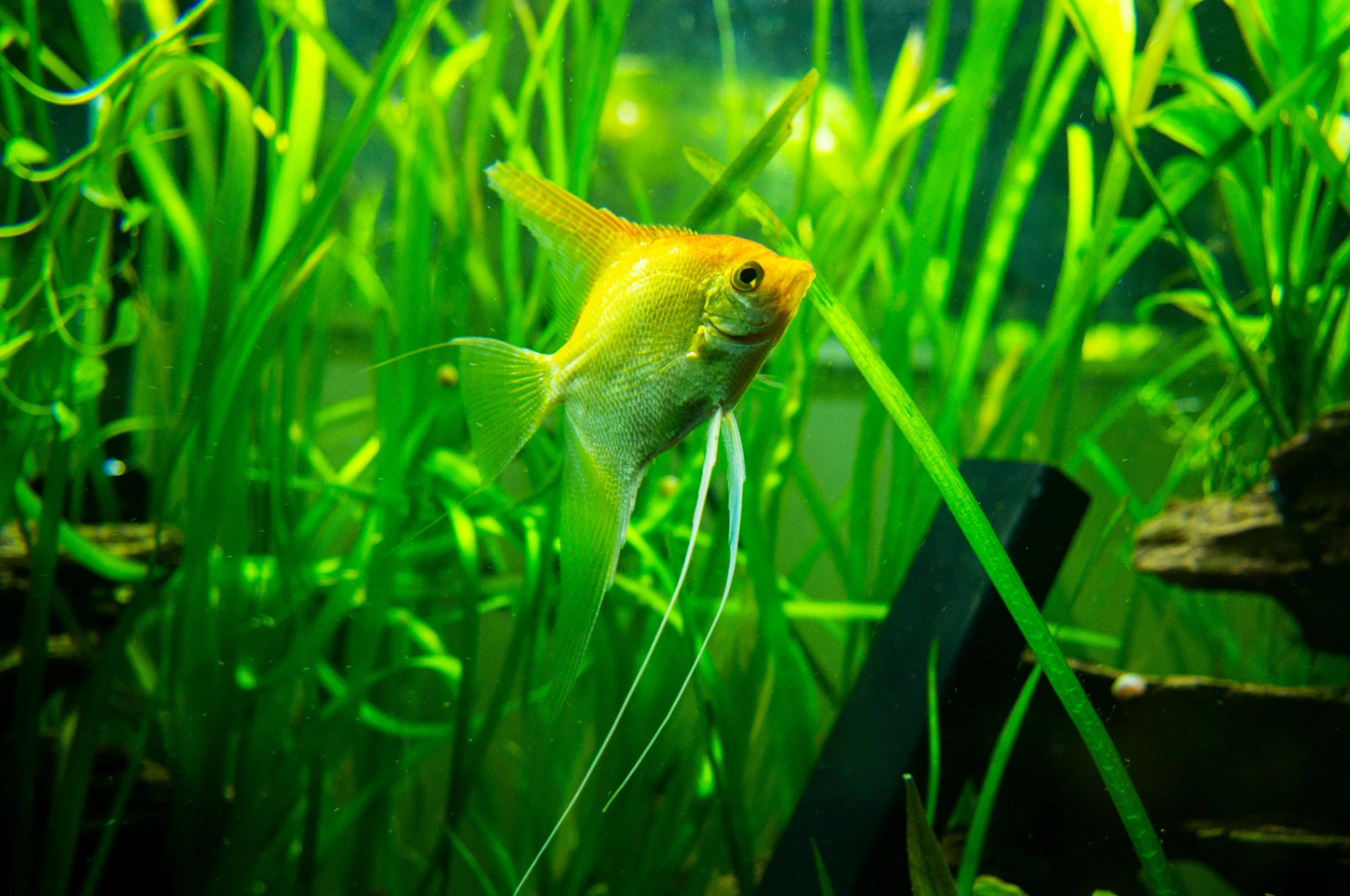
Angelfish
Pterophyllum scalare

Blood Parrot Cichlid
Amphilophus hybrid

Electric Blue Acara
Andinoacara pulcher hybrid

Firemouth Cichlid
Thorichthys meeki

OB Peacock
Aulonocara sp. 'OB'

Peacock Cichlid
Aulonocara sp.
Ready to Add Compressiceps to Your Tank?
Use our free stocking calculator to check compatibility, bioload, and get personalized recommendations.