
Anubias Care Guide
Reviewed by the AquariumStocking team · Updated August 2026
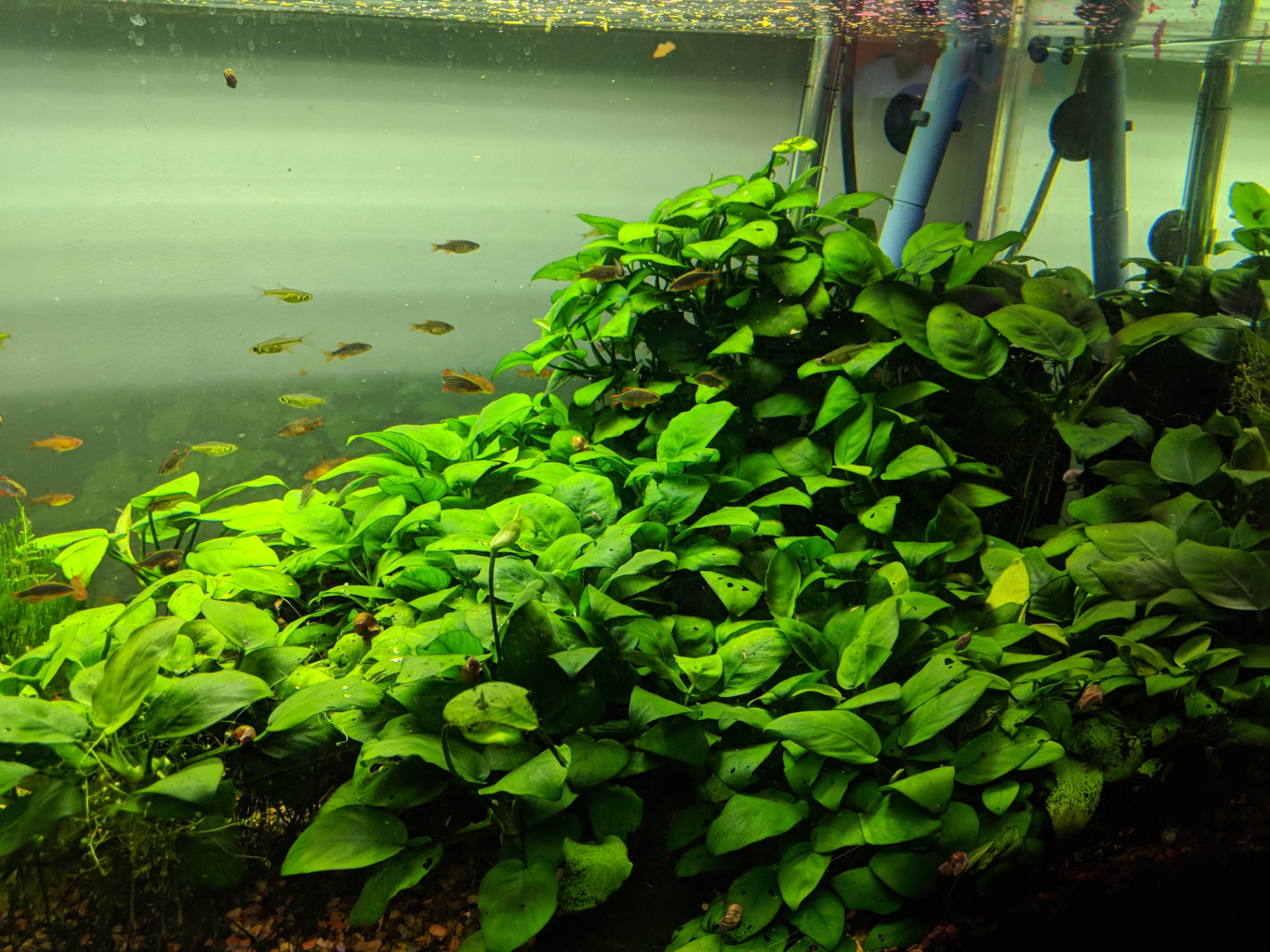
Thick, waxy, near-indestructible leaves on a rhizome that will not propagate itself and rots from the inside if you bury it. Sold in sizes from two centimetres to thirty, and it flowers underwater.
Anubias quick facts
- Light demand
- Low
- CO2 requirement
- Not needed
- Difficulty
- Beginner
- Growth rate
- Slow
- Placement
- Foreground / Midground
- Growth habit
- Rhizome/epiphyte
- Substrate need
- None — attaches to hardscape
- Max size
- 30 cm (11.8 in) tall, ~25 cm wide
- pH
- 6.0–7.5
- Hardness
- 3–18 dGH
- Propagation
- Rhizome division only — it produces no plantlets
- Temperature
- 22–28 °C (72–82 °F)
The rhizome must stay exposed. Buried, it does not merely fail to thrive — it softens and collapses, and anubias rhizome rot is usually fatal.
Overview
Anubias barteri is a West African aroid — the same family as pothos and philodendron — and it grows the way you would expect a jungle aroid to: thick, leathery, dark leaves on a creeping rhizome that grips rock and wood rather than rooting in soil. In the aquarium it grows submersed, emersed, or half in and half out, and its leaves last for years.
The rhizome rule is the same as java fern's and does not need re-explaining here — if you have not met it, the mechanism is covered in detail on the java fern page. What is worth stating plainly is that the consequence is more severe on anubias. Java fern melt is a leaf problem. Anubias rot is a rhizome problem, and it kills.
Two things set it apart from every other low-light epiphyte. It will not reproduce without you cutting it, and it comes in a size range from a three-centimetre "Petite" to a forty-centimetre hastifolia — an enormous scaping range within one genus, and the main reason it turns up in both nano tanks and cichlid tanks.
What you're buying
Anubias is nursery-grown emersed and it converts to submersed growth far better than most plants — the leaves are built to be tough in air and water alike, so the dramatic melt other emersed plants go through mostly does not happen. What you are inspecting is the rhizome and the price tag.
Rhizome first, leaves second
Look for a firm, pale-green rhizome with no soft, brown or hollow sections. Any mushiness is rot, and it spreads through the whole rhizome from a small starting point.
Size is a purchase decision
A "Petite" and a barteri var. barteri look similar in a small pot and mature ten times apart. Buy the variety, not the plant in front of you.
Price tracks growth rate
Variegated and dwarf forms cost more because they grow so slowly they take years to produce. That slowness follows them into your tank.
Rock wool comes off completely before attaching. Fibres trapped against the rhizome hold detritus and moisture against it, which is the same problem as burying it in miniature and a common cause of rot in newly bought plants.
The leaves usually survive the move, which is genuinely different from most nursery plants and worth knowing: if an anubias loses leaves in the first month, that is not a normal conversion melt and the rhizome is worth inspecting.
Light, CO2 & nutrients
Light
Low
CO2
Not needed
Fertilisation
Water column (liquid)
Light
Low light is not just tolerated, it is preferred. Under an aroid canopy in the wild the plant sees almost no direct sun, and in a tank strong light gives it nothing extra — it cannot photosynthesise fast enough to use it, so the surplus goes to algae on the leaf surface instead.
A shaded position under hardscape or below taller plants is genuinely better than an open one. Anubias is one of the few plants where you should deliberately put it in the darkest part of the tank if the fixture is strong.
The one variety worth treating differently is the variegated stock. Pinto and similar forms have less chlorophyll and are slower again, and they benefit from marginally more light — but they are also more algae-prone for exactly the same reason, so the margin is narrow.
CO2
Not needed, and the effect of adding it is smaller here than on nearly any other plant. Anubias is metabolically slow by design; carbon is not what limits it, and injection produces a plant that is still slow.
It sits comfortably in a high-tech tank as a shade planting on hardscape, and the faster-growing plants around it will keep the water clean enough to make the algae problem below more manageable.
Work out your CO2 injection rate →
Nutrients
It feeds through the leaves, so root tabs are wasted on it. What is unusual is how little it actually needs: leaves that last two or three years represent very little new tissue per month, and a low weekly dose of an all-in-one covers a large plant.
Deficiency is correspondingly rare and slow to appear. Yellowing on anubias is much more often a symptom of rhizome trouble or an ageing leaf reaching the end of a multi-year life than a fertiliser problem, so check the rhizome before you change your dosing.
Overdosing is the more realistic risk in an anubias-heavy tank: nutrients the plants cannot consume stay in the water, and in a bright tank they feed the algae sitting on those long-lived leaves.
Water & temperature
pH
6.0–7.5
Hardness
3–18 dGH
Temperature
22–28 °C (72–82 °F)
It is tolerant across roughly 6.0–7.5 pH and 3–18 dGH, and the hard-water end of that is worth noting — anubias is one of the few plants that does well in African rift lake tanks, where the hardness and alkalinity kill most planting.
Temperature is the one parameter it is fussier about than java fern. It prefers 22–28 °C and does not enjoy the cooler end that java fern shrugs off, so it is a poorer fit for unheated or goldfish-temperature setups even though goldfish themselves cannot damage it.
Water quality matters more than water chemistry. Rot follows poor conditions — high organics, dead spots and detritus collecting around the rhizome — so flow across the plant and a clean tank do more for it than any parameter adjustment.
Planting & attaching
- 1Remove the plant from the pot and gently separate the roots from the rock wool.
- 2Split the rhizome into clumps if you want more than one piece — keep 3–4 leaves per section.
- 3Choose driftwood or a porous rock. Rhizome plants will not attach to smooth glass or sand.
- 4Apply a small bead of cyanoacrylate (super glue) gel to the hardscape, or position the rhizome and bind it with cotton thread or fishing line.
- 5Press the rhizome — not the leaves — firmly against the surface for about 30 seconds.
- 6Keep the rhizome fully exposed. Roots may touch or enter the substrate; the rhizome must not be buried.
- 7After roughly 4–8 weeks the roots grip the hardscape. Cut the thread away or leave it to rot off.
Rhizome rot is not melt. If the rhizome softens, discolours or goes hollow, cut well back into firm tissue immediately and discard the rest — the collapse travels along the rhizome and through attached divisions, and by the time the leaves react it is usually too late. Burial, physical damage and poor water quality are the three triggers.
Placement & aquascaping role
Anubias is a foreground and midground plant, and that is a direct consequence of the size range rather than a fixed rule. Petite and nana sit at the front on stones and low branches; coffeefolia and glabra work midground; the full barteri and hastifolia are large enough to fill the middle of a big tank on their own.
The thing it does better than anything else here is cover hardscape at eye level. Rigid leaves hold their shape and angle instead of drifting, so a rhizome fixed into a crevice reads as growth out of the rock rather than a plant placed on it — which is why it is the standard choice for hiding a join, a bolt or a bare patch of wood.
In a rift lake or large cichlid tank it is often the only planting that works, glued into rockwork above the substrate line where the fish cannot get leverage on it. In a nano, Petite on a small stone is one of the few epiphytes that stays in scale for years without any trimming.
Growth, trimming & maintenance
A new leaf every three to six weeks is normal, and slower in dim water or on a dwarf variety. Individual leaves then last two to three years, which is the longest of any plant on this site and the origin of most of its problems as well as most of its appeal.
Trimming is close to nonexistent. Cut a leaf off at the rhizome when it is genuinely finished — yellow, holed, or so encrusted with algae that it is not worth keeping — and otherwise leave the plant alone. Never trim the rhizome itself for tidiness; every cut is a rot entry point.
The real maintenance job is leaf hygiene, not pruning. Wipe accumulated detritus off the leaf surfaces during water changes and keep flow moving across the plant, because a big flat rigid leaf in a dead spot collects debris that a moving leaf would shed.
Do not move it. A settled anubias that is quietly growing should be left where it is; the most common route to a dead plant is repeatedly detaching and reattaching it while rescaping.
Propagation
This is the clearest practical difference between anubias and the other epiphytes here: it does not propagate itself. There are no plantlets on the leaves, no runners, no fragments that take root. A single anubias left alone for five years is still a single anubias, just a larger one.
The only route to more plants is cutting the rhizome, which means propagation is a deliberate act with a real risk attached — every cut is an open wound on the exact tissue that is prone to rot. That risk is the reason the plant stays expensive: nurseries cannot mass-produce it any faster than you can.
It also flowers underwater, and while the white spathe is not a propagation route in the aquarium — pollination needs air — it is the thing keepers most often write in about. It is a normal sign of a settled plant.
- 1Wait until the rhizome is long and carrying plenty of leaves; a small plant divided too early rarely recovers well.
- 2Sterilise a blade or scissors — a clean cut on clean tissue is the entire difference between a division and a rot.
- 3Cut cleanly across the rhizome, leaving at least three or four leaves and some roots on each section.
- 4Leave the cut ends exposed to open water for the first weeks; do not press them against wood or into a crevice while they seal.
- 5Attach each division with glue gel or thread as usual and leave it undisturbed for two to three months.
- 6Watch the cut faces for softening or discolouration and cut back further immediately if you see any.
Sori vs plantlets
Anubias flowers underwater, which is unusual enough that it is regularly mistaken for a snail egg cluster, a fungal growth or a diseased leaf. The flower is a spathe and spadix — a pale white or cream hood wrapped around a narrow central spike, on a stalk from the rhizome — exactly the same structure as a peace lily, which is a close relative.
It is a sign of a healthy, settled plant rather than a problem, and it costs the plant a little energy that would otherwise go into leaves. Submersed flowers cannot be pollinated, so nothing follows from them. Leave it to fade and remove it once it browns, or cut it off at the base straight away if you would rather the plant put the energy into growth.
Troubleshooting & diagnosis
Anubias has very few problems and one serious one. Algae and slow growth are cosmetic and expected; anything happening to the rhizome is urgent, and the distinction between the two is the most useful thing on this page.
| Symptom | Likely cause | Fix |
|---|---|---|
| Rhizome soft, brown or hollow; leaves detaching in sequence | Rhizome rot — from burial, damage or poor water quality | Act immediately. Cut back into firm, pale tissue, discard everything soft, reattach the healthy remainder in open flow. |
| Hard green spots on older leaves that resist wiping | Green spot algae on a leaf that has been in place for years | Nerite snails, more shade, shorter photoperiod. Persistent leaves come off at the rhizome. |
| One or two old leaves yellowing while new growth is fine | Normal leaf senescence at the end of a two to three year life | Cut the leaf off at the rhizome. No action needed. |
| Widespread yellowing including new leaves | Rhizome damage, or a genuine nutrient shortfall in a very lean tank | Inspect the rhizome first, then add a light weekly all-in-one dose. |
| No new leaves for months | Usually normal for the variety and light level | Compare against expectation — one leaf per three to six weeks is typical, and dwarf forms are slower still. |
| White hooded flower on a stalk | Submersed flowering — a healthy, settled plant | Nothing. Remove once it browns, or cut it early to redirect energy into leaves. |
| Plant repeatedly detaching from its wood | Thread failing on a heavy rhizome, or large fish dislodging it | Use glue gel rather than thread on the larger varieties; wedge the rhizome into a crevice as well as fixing it. |
Algae relationship
Anubias has a harder algae problem than java fern, and the reason is arithmetic rather than biology. Java fern replaces a leaf every few weeks; anubias holds the same leaf for two or three years. Every surface on the plant is therefore older, more stable and more thoroughly colonised than anything on a faster epiphyte, and green spot algae on anubias leaves is close to universal in a bright tank.
The leaf structure changes what that looks like. Java fern's thin leaves let algae work into the tissue and go soft under it; the anubias cuticle is thick and waxy, so algae sits on the surface as a hard, distinct crust. That is better and worse at once — the plant is not being damaged, but the algae is visible, sharp-edged and does not wipe off with a thumb.
Because the leaf cannot be replaced by waiting, the advice that works on faster plants does not apply. There is no growing out of it. The three interventions that do work are physical: shade the plant deliberately, put nerite snails on it — the waxy surface takes a nerite's rasping without damage in a way softer leaves do not — and remove terminal leaves at the rhizome rather than scrubbing them.
The prevention worth taking seriously is placement. An anubias positioned in the shadow of hardscape from day one will still be clean in three years; the same plant in open light under a strong fixture will be crusted within one, and by then the affected leaves are the plant's entire body of growth.
Varieties & cultivars
| Variety | Appearance | Mature size | Availability |
|---|---|---|---|
| Barteri var. barteri | The standard form: large, broad, slightly ruffled oval leaves on long petioles | ~30–40 cm tall | Very common |
| Nana | A compact natural variety of barteri, half the size with smaller rounded leaves | ~10–15 cm tall | Very common |
| Nana 'Petite' | Dwarf selection of nana; leaves the size of a fingernail on a fine rhizome | ~3–5 cm tall | Common |
| Barteri var. nana 'Golden' | Nana with pale lime-yellow new growth that darkens as leaves mature | ~10–15 cm tall | Common |
| Barteri var. nana 'Pinto' | Variegated white and green marbling; slower again because of the reduced chlorophyll | ~10–15 cm tall | Uncommon, expensive |
| Barteri var. coffeefolia | Deeply corrugated leaves that emerge bronze-red and harden to dark green | ~20–25 cm tall | Common |
| Barteri var. glabra | Narrow, elongated arrowhead leaves; more upright and less bushy than the standard | ~20–30 cm tall | Uncommon |
| Barteri var. angustifolia (Afzelii-type) | Long, strap-like narrow leaves, often sold as "Anubias lanceolata" | ~25–30 cm tall | Uncommon |
| Anubias hastifolia | A separate species: large arrow- or spear-shaped leaves with pronounced basal lobes | ~40 cm+ | Uncommon |
| Anubias gracilis | A separate species with distinctly triangular leaves on tall, slim petioles | ~30–35 cm | Rare |
Care is identical across all of them; only size, leaf shape and growth speed change. Two cautions: "Anubias lanceolata" and "Anubias afzelii" are trade names attached loosely to narrow-leaf barteri forms, so the plant in the pot may not match the label; and the variegated forms such as Pinto and White are genuinely slower and more rot-prone than plain green stock, which makes them a poor first anubias despite the price.
Natural habitat & origin
Native range
West and Central Africa — Cameroon, Nigeria, Guinea and the surrounding region
Habitat type
Shaded rainforest streams and river margins, growing on rock and roots at the waterline
Wild growing conditions
Deep shade, warm water, frequently emersed with the rhizome above the waterline
Anubias barteri grows along shaded streams and rivers in the West African rainforest, gripping rock, tree roots and fallen wood right at the waterline — often with the rhizome above water and the leaves in humid air, and submerging entirely only when the river rises.
That amphibious position explains the leaf. A leaf that has to work both underwater and in air, and survive both, ends up thick, rigid and coated in a waxy cuticle to stop water loss when exposed. The toughness that makes anubias cichlid-proof in a tank is a drought adaptation, not a defence against being eaten.
The deep forest shade explains the light preference and, indirectly, the growth rate. A plant that photosynthesises under a closed canopy has no reason to grow quickly, and a leaf that takes that long to build is worth keeping for years — which is precisely the trait that makes it an algae magnet under an aquarium LED it never evolved for.
Being an aroid explains the rest. It is a relative of the peace lily and the philodendron, which is why it flowers with a spathe and spadix, why the rhizome creeps along surfaces rather than descending into soil, and why that rhizome needs open air or open water around it to stay healthy.
Fish & invert compatibility
Anubias survives rough tanks on structure alone. The leaves are thick, rigid and coated in a waxy cuticle, which is a mechanical defence rather than a chemical one — cichlids that shred soft plants cannot get purchase on it, and because nothing is planted in substrate there is nothing for a digger to uproot. The realistic threats are large fish dislodging the attachment and grazers scraping algae off the leaf surface.
Safe with Anubias
 OscarAstronotus ocellatus
 Jack DempseyRocio octofasciata
 Convict CichlidAmatitlania nigrofasciata
 Yellow LabLabidochromis caeruleus
 Red ZebraMaylandia estherae
 Firemouth CichlidThorichthys meeki
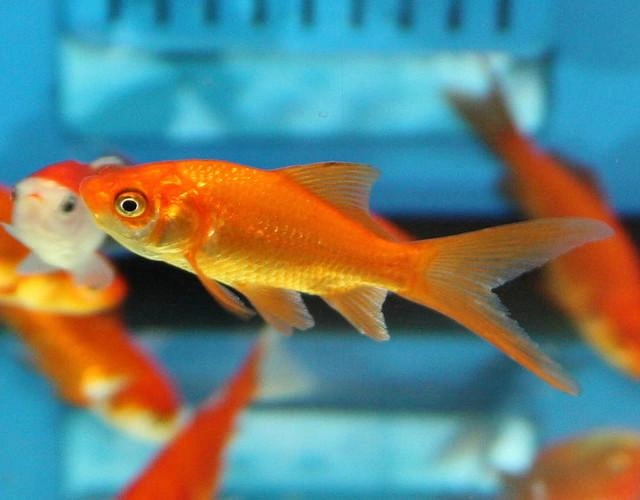 Common GoldfishCarassius auratus
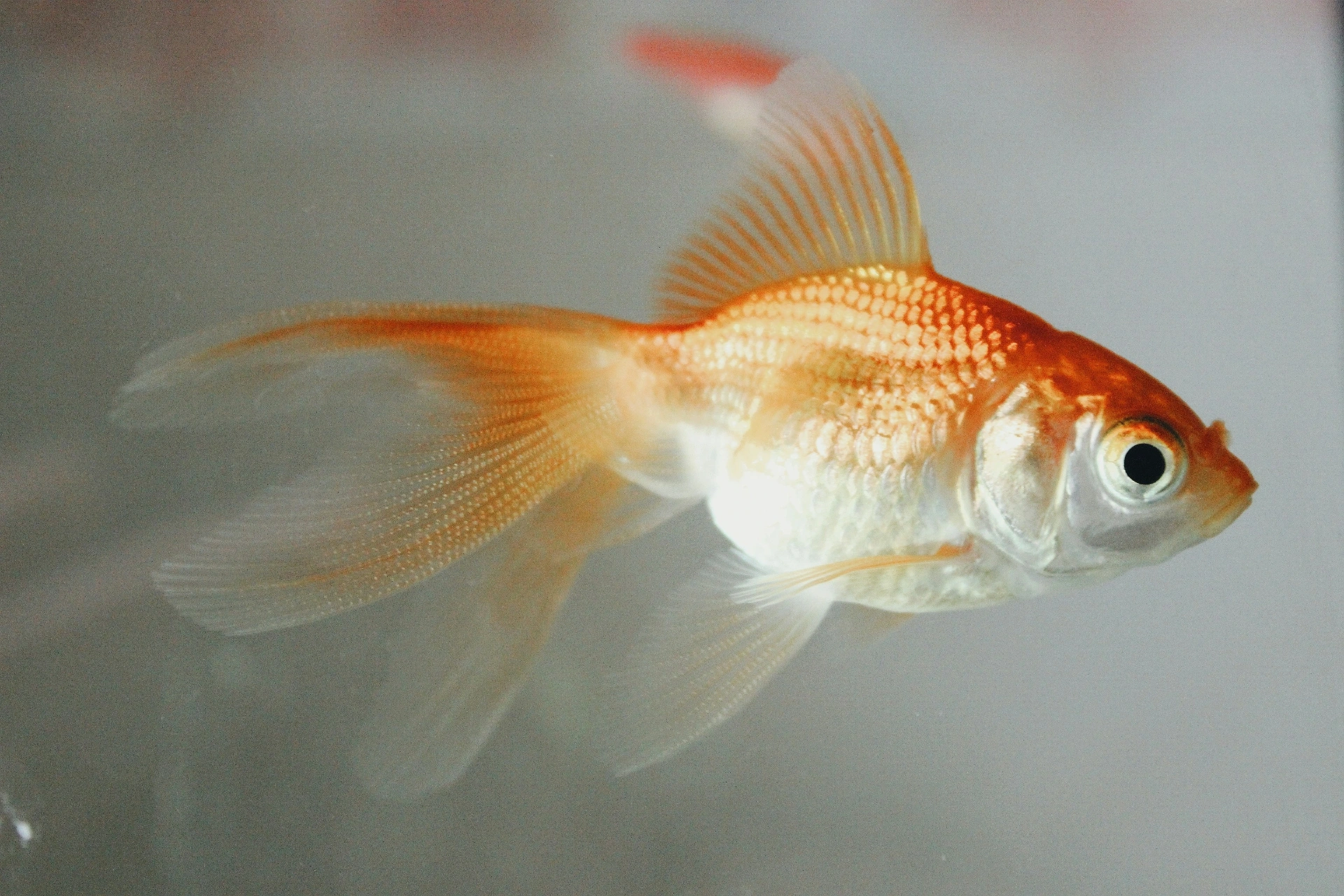 Fancy GoldfishCarassius auratus
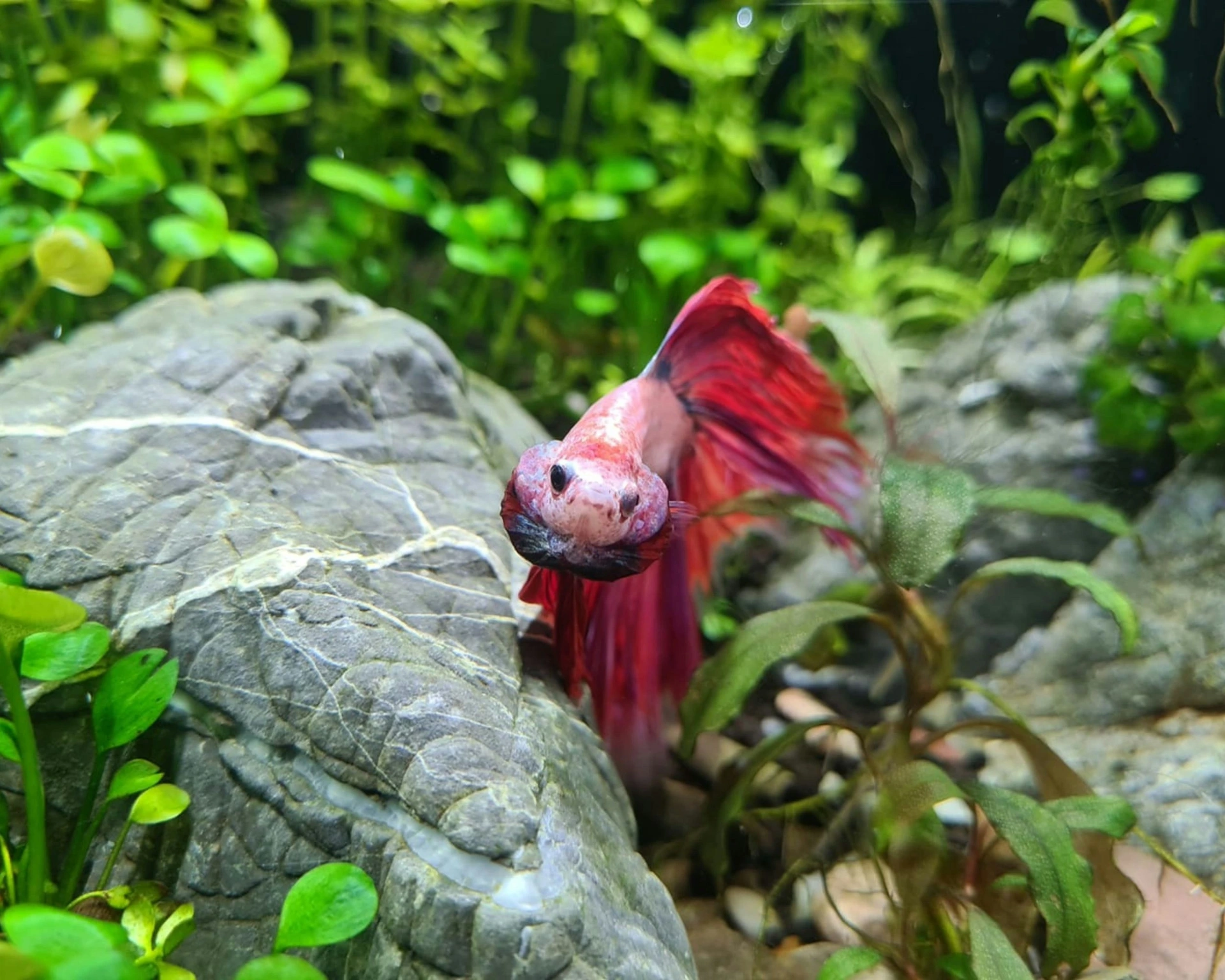 BettaBetta splendens
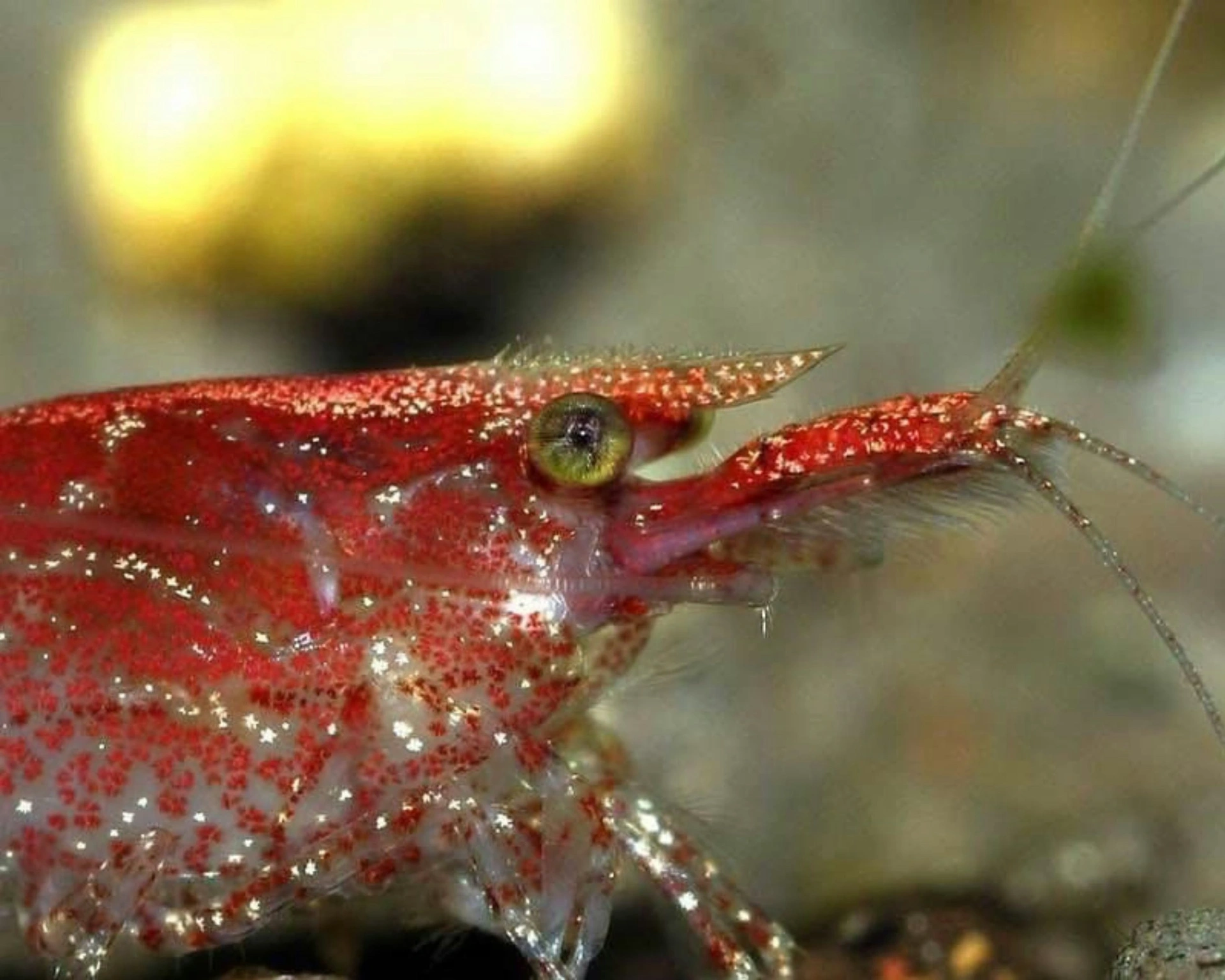 Cherry ShrimpNeocaridina davidi
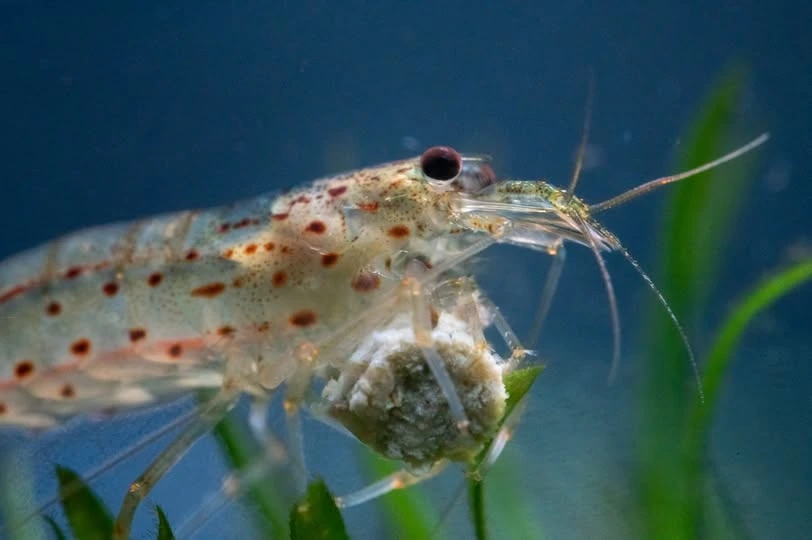 Amano ShrimpCaridina multidentata
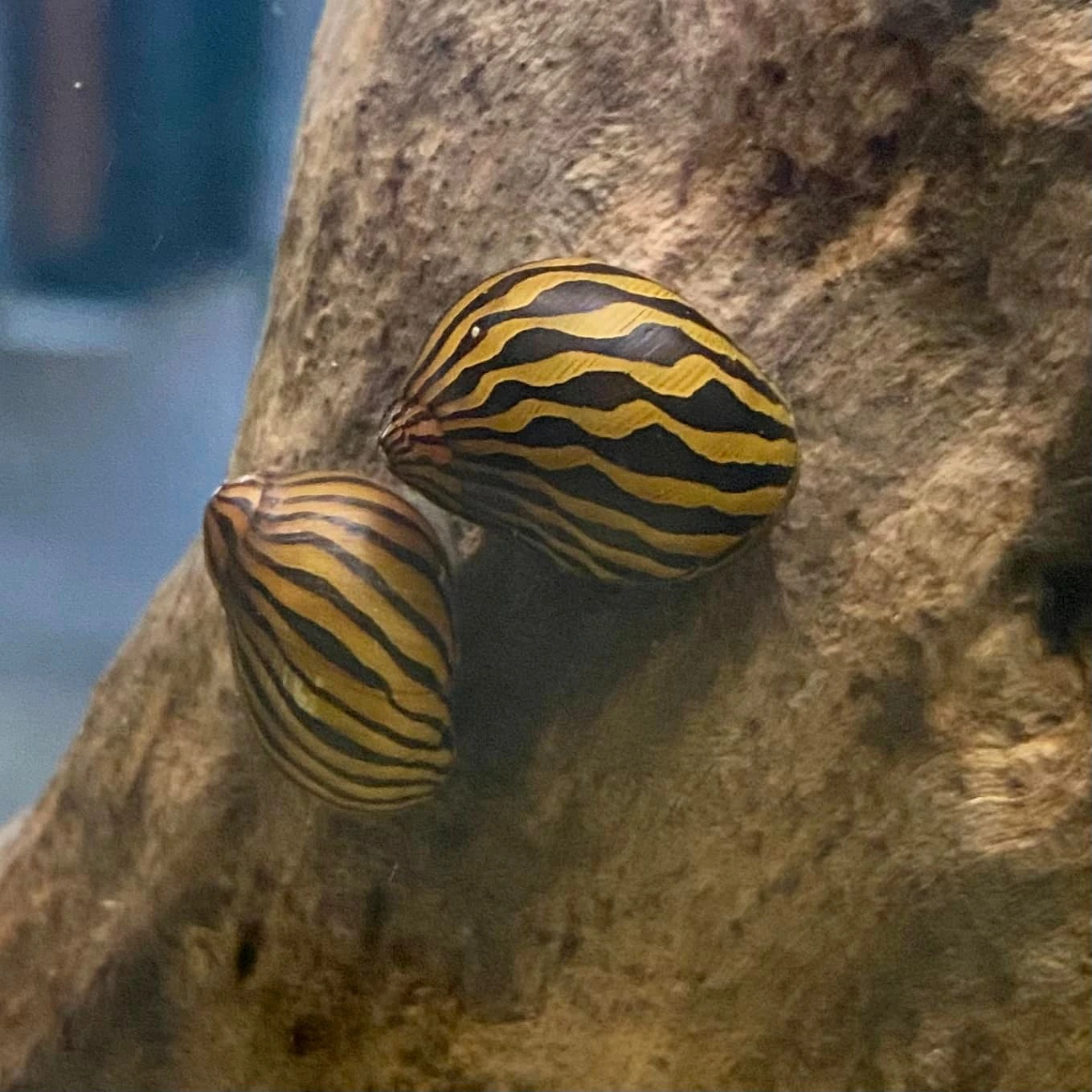 Nerite SnailNeritina sp.Useful on anubias specifically — it grazes green spot algae off the leaf surface without damaging the waxy cuticle.
Will eat or uproot it
Companion plants
The pairing logic here is not just shared light and CO2 — it is shared attachment. Everything below fixes to hardscape or tolerates deep shade, so a single piece of wood can carry the whole group and the substrate stays open.
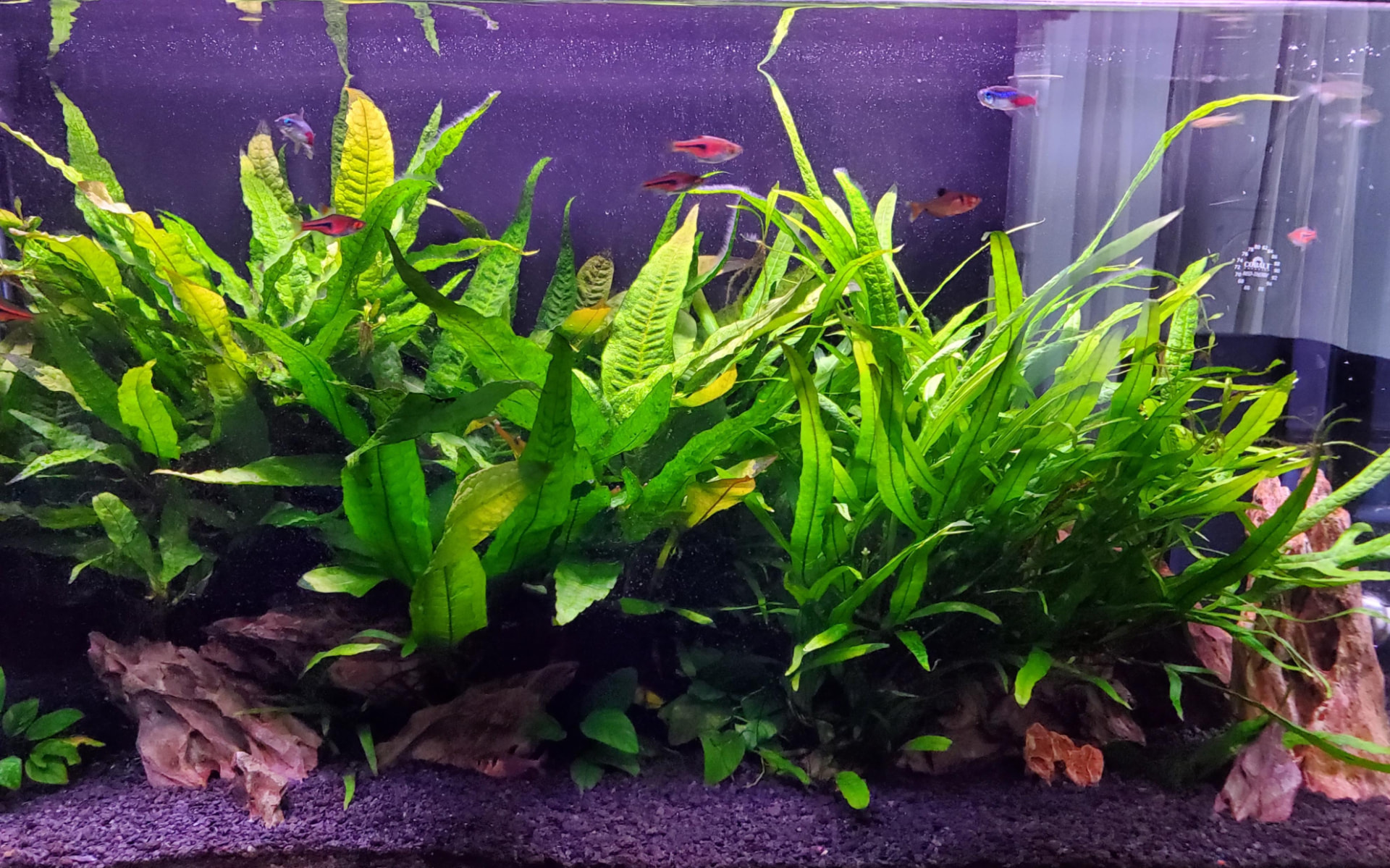
Java Fern
Microsorum pteropus
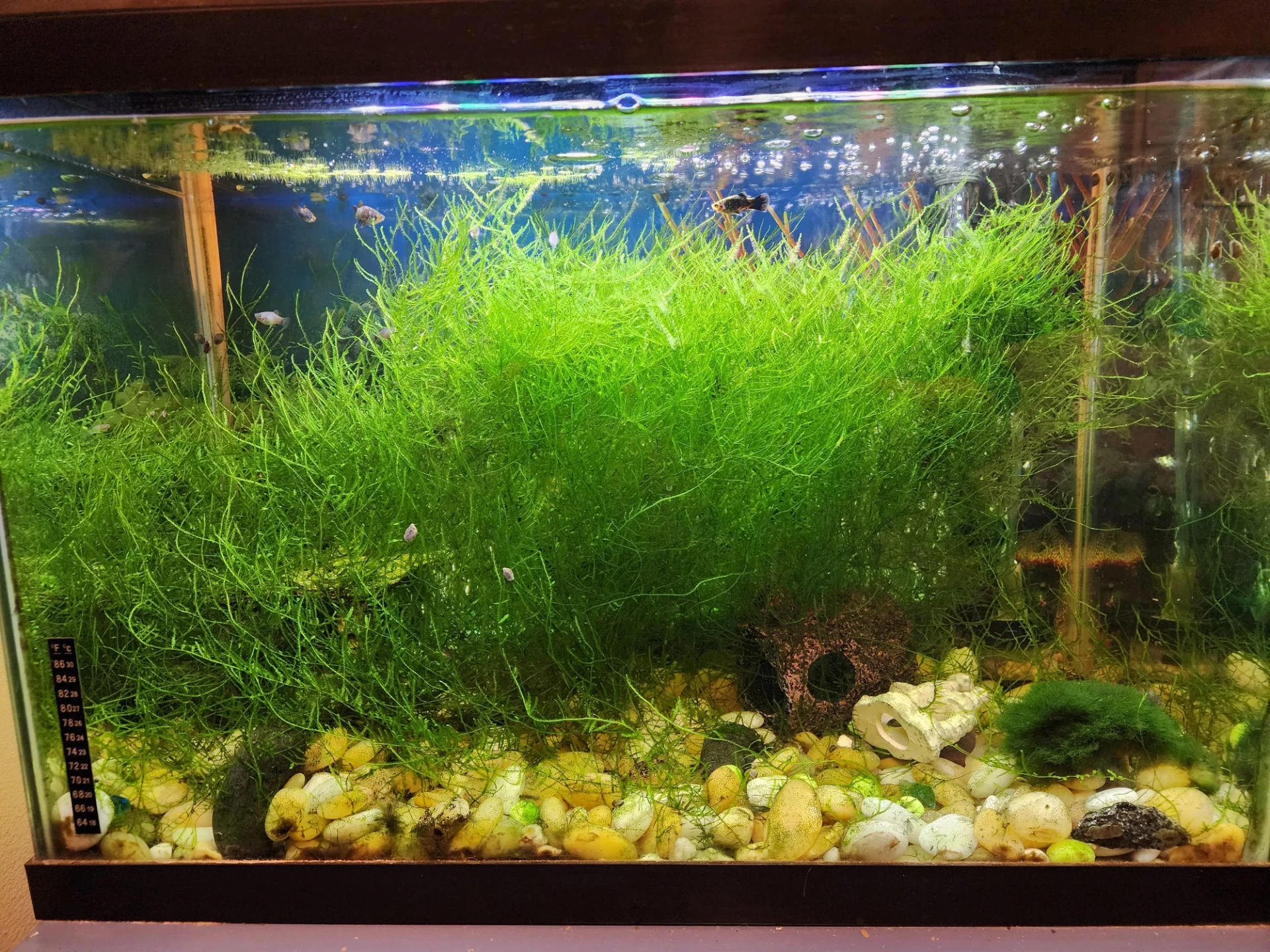
Java Moss
Taxiphyllum barbieri
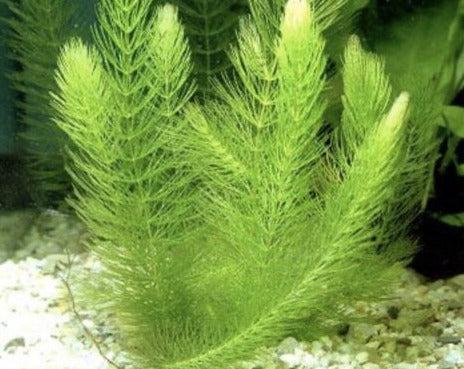
Hornwort
Ceratophyllum demersum
Pro tips & common mistakes
Pro tips
- Use glue gel rather than thread on the larger varieties — a thick rigid rhizome pivots against thread and the binding cuts into it.
- Wedge the rhizome into a crevice as well as gluing it; the leaves then look like they are growing out of the rock.
- Petite and nana are the easiest plants to attach to small, detailed hardscape where nothing else will fit.
- Put it in the darkest spot in a bright tank. It is one of the few plants that genuinely does better shaded.
- Keep a nerite or two if algae is a concern — the waxy cuticle takes their grazing without damage.
- Start with plain green nana rather than a variegated form; Pinto and White are slower and considerably more rot-prone.
- Leave a settled plant alone. Repeated detaching and reattaching during rescapes is a leading cause of rhizome rot.
Common mistakes
- Burying the rhizome, which on anubias means rot and death rather than a slow decline.
- Waiting to see whether soft rhizome tissue recovers — it does not, and the collapse spreads while you watch.
- Expecting plantlets. Anubias never propagates itself; the only route to more plants is cutting the rhizome.
- Buying "Petite" for a large tank or full barteri for a nano, on the assumption that anubias is one size.
- Leaving rock wool fibres trapped against the rhizome after unpotting.
- Treating a white underwater flower as a disease and dosing the tank for it.
- Putting it under the brightest part of the fixture, where a three-year-old leaf gets crusted in green spot algae.
Frequently asked questions
Sources
- Plants of the World Online — Accepted name Anubias barteri Schott and its West African distribution.
- IUCN Red List — Least Concern assessment for Anubias barteri.
Related plants
Marimo Moss Ball
Aegagropila linnaei
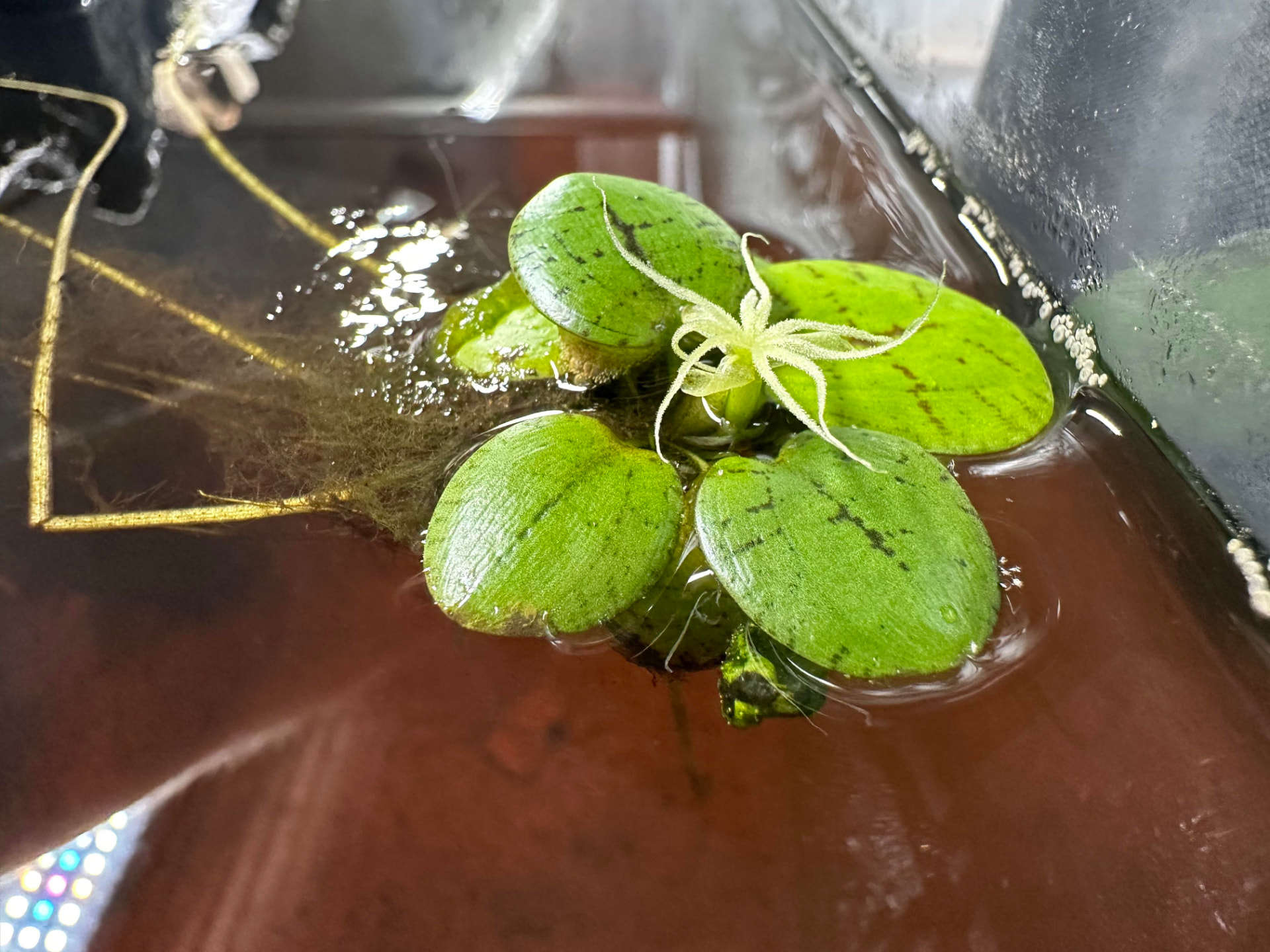
Amazon Frogbit
Limnobium laevigatum
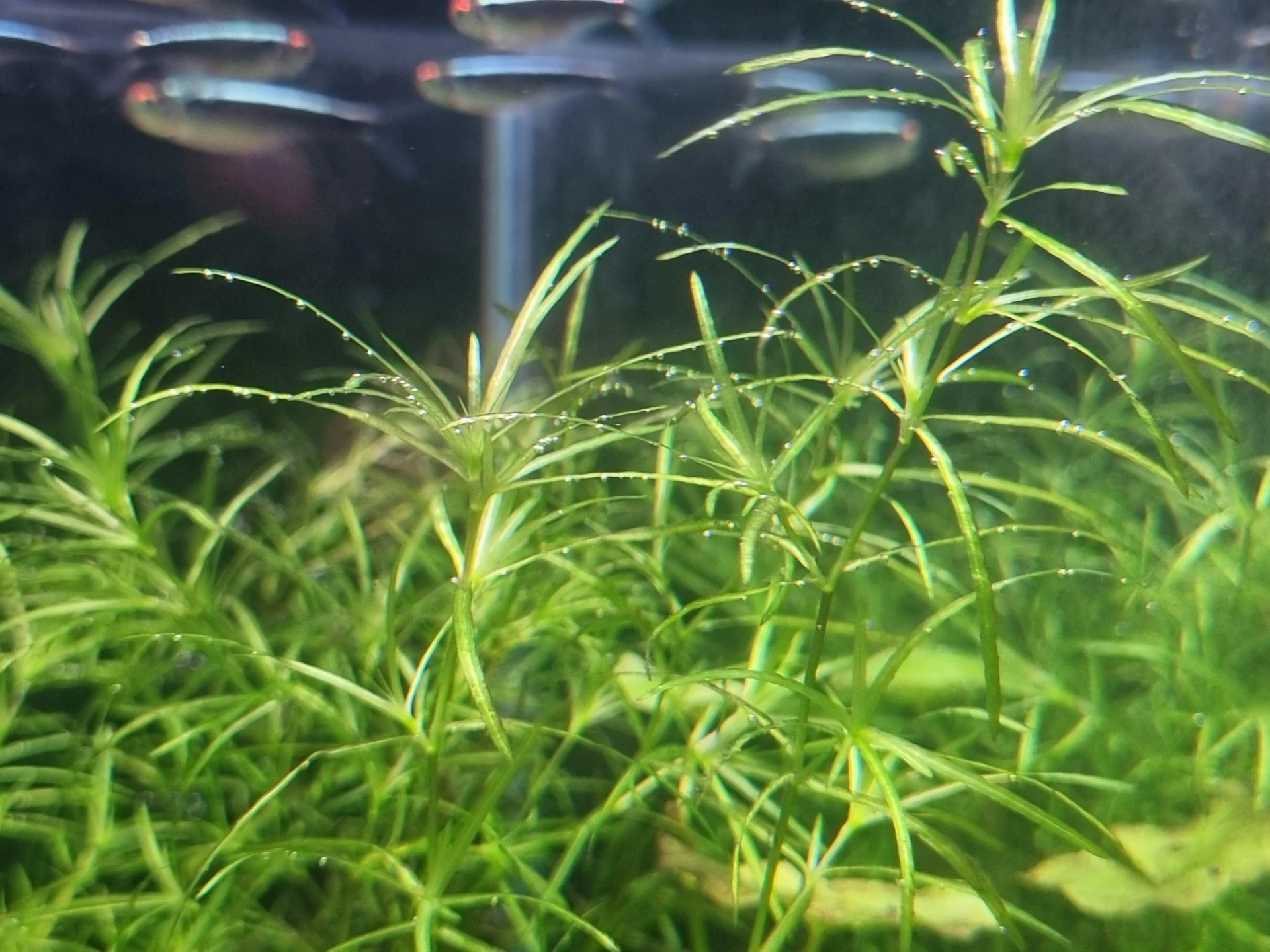
Guppy Grass
Najas guadalupensis
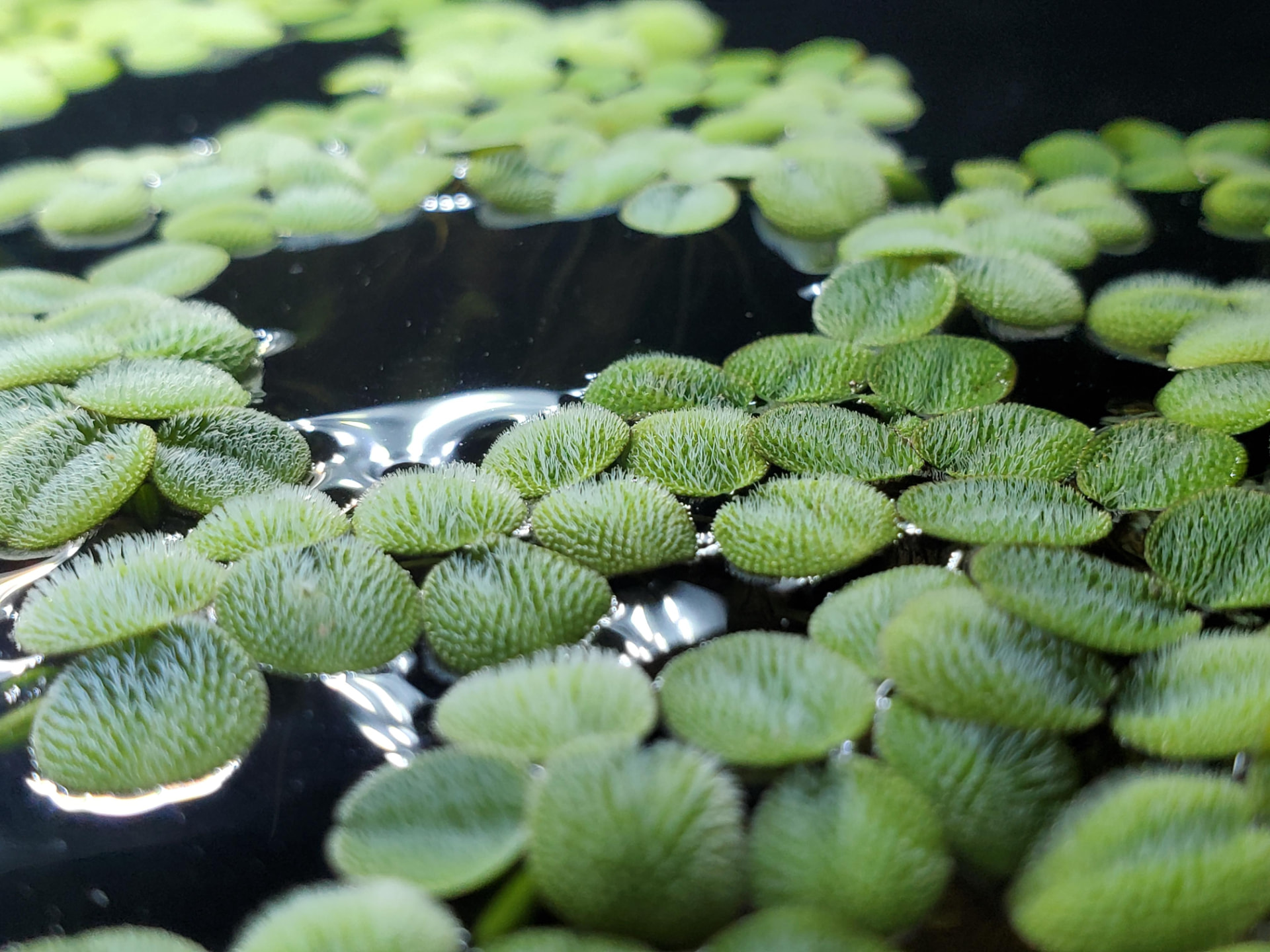
Salvinia
Salvinia minima
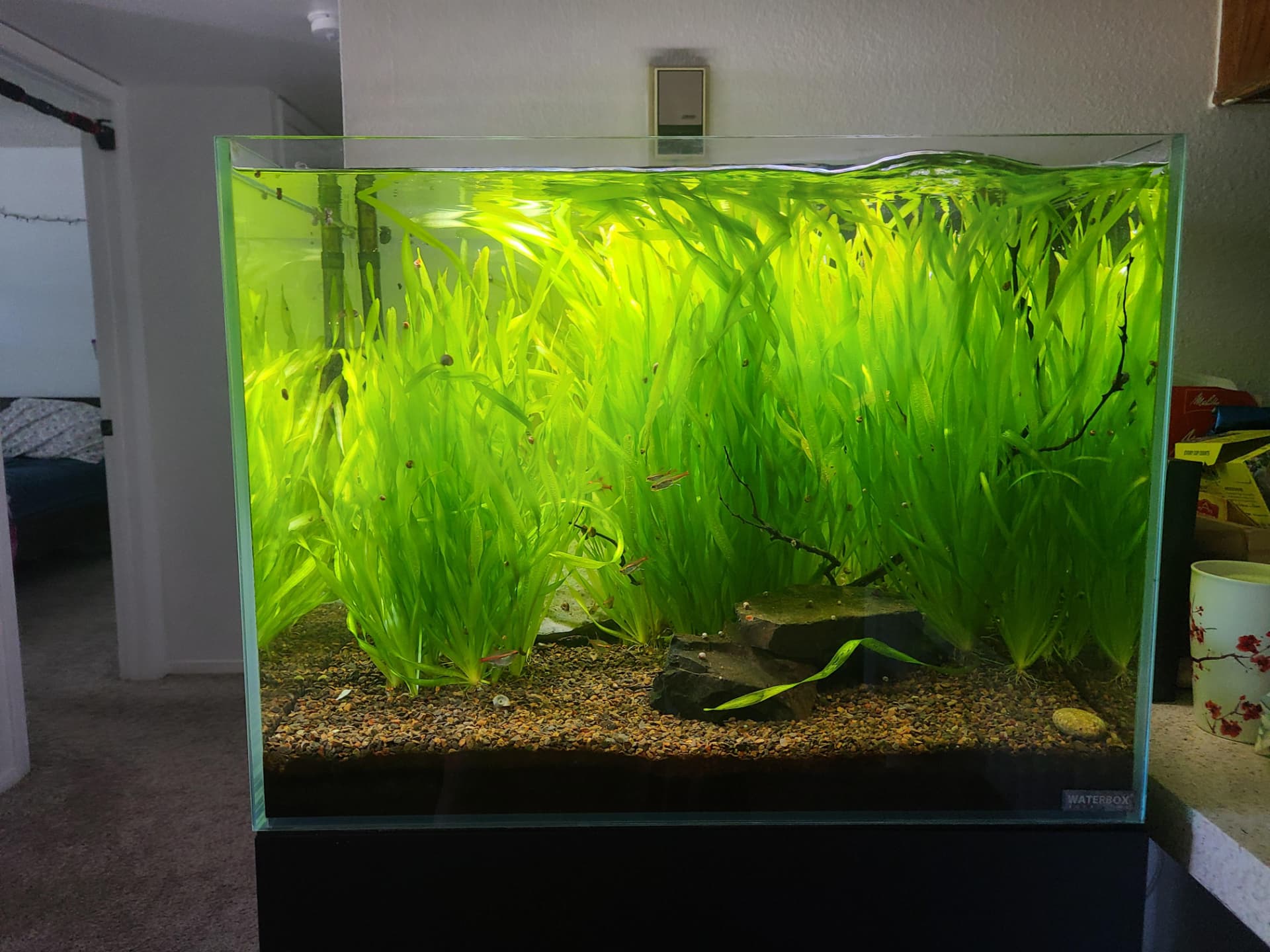
Vallisneria
Vallisneria spiralis
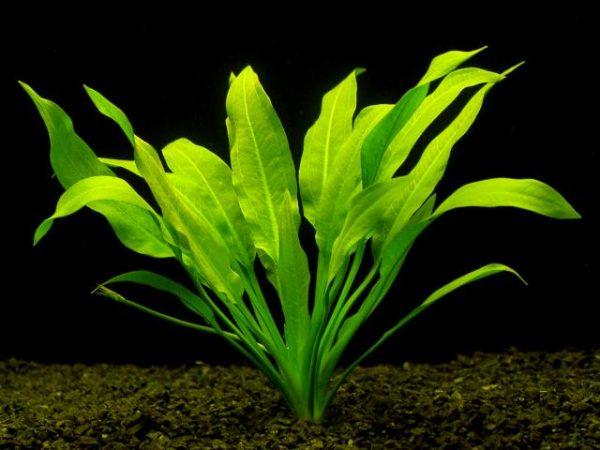
Amazon Sword
Echinodorus grisebachii
Anubias frees up the substrate
A tank scaped entirely on hardscape has no planting to work around, which usually means bigger or messier fish become an option. Check what the footprint and filtration actually support.
Reviewed by the AquariumStocking team · Updated August 2026