

Care Requirements
Adult Size
4.7" (12cm)
Min Tank
75 gal
Temperature
75-82°F
pH Range
7.8-9
Lifespan
8-12 years
Min Group
12+ fish
Diet
Herbivore
Swim Level
Middle
Bioload
3/10
Hardness
12-20 dGH
About Tropheus Duboisi
Tropheus Duboisi is one of the most visually striking cichlids in the hobby — but its beauty comes with significant challenges that make it strictly an advanced keeper's fish. Juveniles display a spectacular pattern of white polka dots on a jet-black body, earning them the nickname 'White Spotted Cichlid.' As they mature, this pattern transforms into a dark body with a distinctive wide yellow or white band across the midsection.
Originating from Lake Tanganyika rather than Lake Malawi, Duboisi require even harder, more alkaline water than their Malawi relatives. They're also strict herbivores with digestive systems so sensitive that a single feeding of high-protein food can trigger fatal bloat. This dietary fragility eliminates any room for error.
Perhaps most challenging is their aggression. Tropheus species are notoriously combative with their own kind, and Duboisi must be kept in large groups of 15 or more to survive. Smaller groups result in dominant fish systematically eliminating subordinates. This requirement means large tanks and significant commitment before the first fish is purchased.
For keepers willing to meet these demands, Duboisi offer rewards few fish can match. Their unique coloration, active behavior, and the dramatic transformation from spotted juveniles to banded adults create an unforgettable display. But they're not fish to purchase on impulse — success requires research, preparation, and dedication.
Natural Habitat & Origin
Conservation status: Endangered (EN)
Tropheus Duboisi are endemic to the rocky coastlines of northern Lake Tanganyika, primarily around Bemba and Karilani Island in the Democratic Republic of Congo. Lake Tanganyika is the second-deepest lake in the world with extreme water chemistry — even harder and more alkaline than Lake Malawi.
In the wild, Duboisi inhabit the surge zone where wave action is constant. They graze on aufwuchs defending small territories while maintaining visual contact with their colony. This social structure requires large groups for stable hierarchy.
The lake's ancient, stable chemistry means Duboisi have zero tolerance for parameter fluctuations. Their native conditions feature pH often exceeding 8.5, extreme hardness, and minimal organic pollution.
Native Region
Lake Tanganyika, northern regions (Bemba, Karilani Island, DRC)
Habitat Type
Rocky shoreline surge zones with constant wave action
Wild Water Conditions
Very hard, alkaline water (pH 8.0-9.0+), extremely stable parameters, high oxygen
Appearance & Varieties
Duboisi are famous for their dramatic color transformation. Juveniles display a stunning jet-black body covered in brilliant white polka dots. As fish mature over 6-12 months, spots fade and are replaced by a dark blue-black body with a distinctive wide vertical band across the midsection.
The band color varies by geographic variant — 'Maswa' Duboisi have yellow bands, while 'Kigoma' and other variants may have white or narrow bands. Both sexes display similar coloration; venting is the only reliable sexing method.
Popular Varieties
| Variety | Description | Rarity |
|---|---|---|
| Maswa (Yellow Band) | Dark body with a wide bright yellow band across the midsection. The most common and popular variant. | Common |
| Kigoma (Narrow Band) | Dark body with a narrower white or pale yellow band. More subtle appearance. | Uncommon |
| Bemba (White Band) | Dark body with white rather than yellow banding. Starker contrast. | Uncommon |
Tank Setup & Requirements
Quick Requirements Summary
Tank Size
Minimum Tank Size
75 gallons
Recommended Tank Size
100 gallons
Duboisi tanks must address three critical requirements: large groups, extreme water chemistry, and conditions that minimize stress and bloat risk. This species tolerates no shortcuts in setup.
Water Parameters
Lake Tanganyika chemistry is even more extreme than Lake Malawi. Temperature 24-28°C (75-82°F), pH 7.8-9.0, hardness 12-20+ dGH. pH should ideally exceed 8.0. Use aragonite substrate, limestone, crushed coral, and/or Tanganyikan buffers. Stability is absolutely critical. Zero ammonia and nitrite; nitrates as low as possible.
Substrate
Aragonite sand actively buffers pH and hardness. Crushed coral can supplement. Avoid inert substrates that don't contribute to water chemistry maintenance.
Plants & Decorations
Extensive rockwork with multiple territories is critical. Create numerous territories with caves and visual barriers. Texas holey rock, limestone, and slate contribute to water chemistry. Plants are not recommended — Duboisi will destroy them and extreme chemistry kills most species.
Filtration & Water Flow
Aim for 10x+ tank volume turnover per hour. Multiple filters provide redundancy — a filter failure can be disastrous. Powerheads improve circulation and oxygenation. Pristine water quality is essential; any organic waste contributes to bloat risk.
Lighting
Higher lighting promotes algae growth on rocks for supplemental grazing. Standard aquarium lighting works fine.
Diet & Feeding Guide
Diet Type
herbivore
Feeding Frequency
Multiple small feedings throughout the day (3-4 times)
Portion Size
Small amounts consumed in 30-60 seconds per feeding. Tropheus should always appear slightly hungry rather than fully satiated.
Diet is life-or-death for Tropheus Duboisi. They are strict herbivores with digestive systems that cannot process protein without risking fatal bloat. Their natural diet consists entirely of aufwuchs. Bloat is often fatal within 24-48 hours of symptom onset. A single feeding of bloodworms can kill fish that have thrived for years. There is no margin for error.
Best Foods for Tropheus Duboisi
- High-quality spirulina flakes/pellets — Should form 90%+ of diet. Use the highest quality spirulina foods available. This isn't the species to economize on food.
- Specialized Tropheus foods — Several manufacturers produce foods specifically formulated for Tropheus — worth the premium.
- Fresh vegetable matter — Blanched zucchini, cucumber, romaine lettuce, spinach, and shelled peas. Provides fiber and variety.
- Nori/seaweed sheets — Dried seaweed provides excellent nutrition similar to natural aufwuchs. Clip to glass for all-day grazing.
Foods to Avoid
- Bloodworms — Extremely dangerous — can trigger fatal bloat from a single feeding. Never feed under any circumstances.
- Brine shrimp — Too high in protein. Avoid entirely.
- Any protein-based foods — Krill, mysis shrimp, fish meal-based pellets — Tropheus cannot safely process these.
- Low-quality or expired foods — Spoiled food contributes to digestive issues. Use fresh, high-quality foods only.
Multiple small meals mimic natural grazing better than one or two large feedings. Overfeeding contributes to bloat. Tropheus should always appear slightly hungry.
Behavior & Temperament
Tropheus aggression is legendary in cichlid keeping. Despite relatively small size, they're intensely aggressive toward conspecifics. This aggression is paradoxically managed by keeping large groups: with 15+ fish, aggression spreads across so many targets that no single fish is singled out.
Smaller groups are death sentences. A group of 4-6 Tropheus will methodically reduce to 1-2 fish as dominant individuals eliminate rivals. There is no safe 'small group' size for Tropheus.
Within properly sized colonies, Tropheus display fascinating social dynamics. Loose hierarchies form with dominant males controlling the best territories. Constant activity, grazing, sparring, and displaying create engaging aquarium displays.
Toward other species, Tropheus are generally tolerant — their aggression is primarily intraspecific.
Tank Mates: Compatibility Guide
Compatible Tank Mates
Classic Tanganyikan companion. Same water requirements. Bottom-dwelling nature keeps them out of territorial zones.
Julidochromis species
Tanganyikan rock-dwellers occupying different niches. Same water requirements.
Neolamprologus species (carefully chosen)
Some Tanganyikan cichlids like shell-dwellers can coexist. Research specific species carefully.
Other Tropheus species (in very large tanks)
Different species can be mixed in 150+ gallon tanks if each has adequate numbers (15+). Risky but possible for experts.
Tank Mates to Avoid
Lake Malawi cichlids
Different lake, different chemistry, different social dynamics. Not recommended for demanding species like Tropheus.
Other Tropheus (in small numbers)
Adding a few to an established colony usually results in newcomers being killed.
Aggressive feeders
Tropheus need constant grazing access. Tankmates that outcompete them cause stress.
Any fish requiring protein-based diet
Tropheus tanks must be strictly herbivore-friendly. Carnivorous tankmates risk accidental Tropheus protein exposure.
Common Pairing Questions
Can Tropheus live with Malawi cichlids?
Not recommended. Different lakes with different water chemistry and social dynamics. Tropheus are too demanding for mixed-lake setups.
Can different Tropheus species be mixed?
Possible in very large tanks (150+ gallons) if each species has 15+ individuals and is introduced simultaneously.
Tropheus Duboisi are maternal mouthbrooders that breed readily in stable colonies. Females hold 5-15 eggs for 4-5 weeks — an unusually long incubation period. During this time they don't eat and become noticeably thinner. Fry are large when released and can accept crushed spirulina flake immediately. Fry survival in display tanks is low — serious breeding requires separating holding females. The transformation from spotted juvenile to banded adult occurs gradually over 6-12 months.
Health Issues & Disease Prevention
Tropheus health management revolves around one overwhelming concern: bloat. This species is so prone to fatal digestive issues that bloat prevention must be the central focus of all husbandry decisions.
Common Diseases
| Disease | Symptoms | Treatment |
|---|---|---|
| Bloat (Malawi Bloat equivalent) | Swollen abdomen, loss of appetite, white stringy feces, lethargy. Often fatal within 24-72 hours. | Isolate IMMEDIATELY. Stop all feeding. Epsom salt bath. Metronidazole in water. Success rate is poor once visible; prevention is the only reliable approach. |
| Ich (White Spot Disease) | Small white spots on body and fins, flashing against rocks, clamped fins. | Raise temperature to 30°C for 10-14 days. Aquarium salt. Caution: ich treatment stress can trigger bloat. |
| Aggression Injuries | Torn fins, missing scales, wounds from fighting. | Minor injuries heal in clean water. Severe injuries require isolation. Address root cause — usually inadequate colony size. |
| Stress-Related Issues | Faded coloration, hiding, loss of appetite, susceptibility to other diseases. | Identify and address stressors: water quality, aggression, inadequate hiding spots. Stress often precedes bloat. |
Signs of a Healthy Tropheus Duboisi
- Active, constant grazing behavior
- Bold coloration appropriate to age
- Integration into colony social structure
- Normal body shape
- Clear eyes and intact fins
- Brown, normal feces
Prevention Tips
- Strictly herbivorous diet — absolutely no protein
- Multiple small feedings daily
- Large colony size (15+)
- Pristine water quality with very low nitrates
- Stable parameters
- Extensive rockwork
- Remove severely stressed fish before bloat develops
- Quarantine new fish thoroughly
Frequently Asked Questions
Minimum 15, ideally 20 or more. Non-negotiable for survival. Smaller groups result in dominant fish killing subordinates. Plan for this commitment before purchasing.
Almost certainly one of three causes: (1) Diet issues causing bloat; (2) Colony too small; (3) Water quality or parameter instability. Identify and address the specific cause before adding more fish.
Juveniles display white polka dots on a jet-black body. Adults have a dark body with a wide yellow or white band across the midsection. Both stages are dramatically different.
Absolutely not. Among the most demanding freshwater aquarium fish due to extreme bloat sensitivity, mandatory large colony sizes, and exacting water chemistry.
Possible but challenging in very large tanks (150+ gallons) with adequate numbers (15+ each). Must be introduced simultaneously. Advanced-level undertaking.
Strictly plant-based: spirulina, specialized Tropheus foods, blanched vegetables, nori. Cannot safely digest any protein. This restriction is absolute.
Emergency requiring immediate action. Usually caused by inappropriate diet, poor water quality, or chronic stress. Isolate immediately, stop feeding, treat with Metronidazole. Focus on prevention for remaining fish.
Minimum 75 gallons for a colony of 15. 100+ gallons strongly recommended. Serious keepers use 125-180 gallon tanks. Tank length (6 feet) matters more than height.
Tips for Keeping Tropheus Duboisi
Pro Tips
- ✓Buy juveniles in large groups — 15-20 that grow up together for stable hierarchy
- ✓Feed multiple small meals throughout the day to mimic natural grazing
- ✓Keep nitrates as low as possible — under 10 ppm ideally
- ✓Have Metronidazole on hand before you need it — bloat progresses too fast to wait
- ✓Resist the urge to 'just try a few' bloodworms — the dietary restriction is absolute
Common Mistakes to Avoid
- ✗Keeping in small groups — dominant fish systematically kill subordinates
- ✗Feeding any protein-based food — single feeding can trigger fatal bloat
- ✗Impulse purchasing based on juvenile coloration — unprepared for demanding requirements
- ✗Adding new Tropheus to established colonies — newcomers are attacked and killed
- ✗Underestimating water chemistry needs — parameter fluctuations trigger bloat
- ✗Keeping with inappropriate tankmates — protein foods in tank pose bloat risk
Sources
- FishBase — Accepted scientific name, maximum size and native range for Tropheus Duboisi.
- IUCN Red List — Endangered conservation assessment for Tropheus duboisi.
Related Species You Might Like
View All Fish →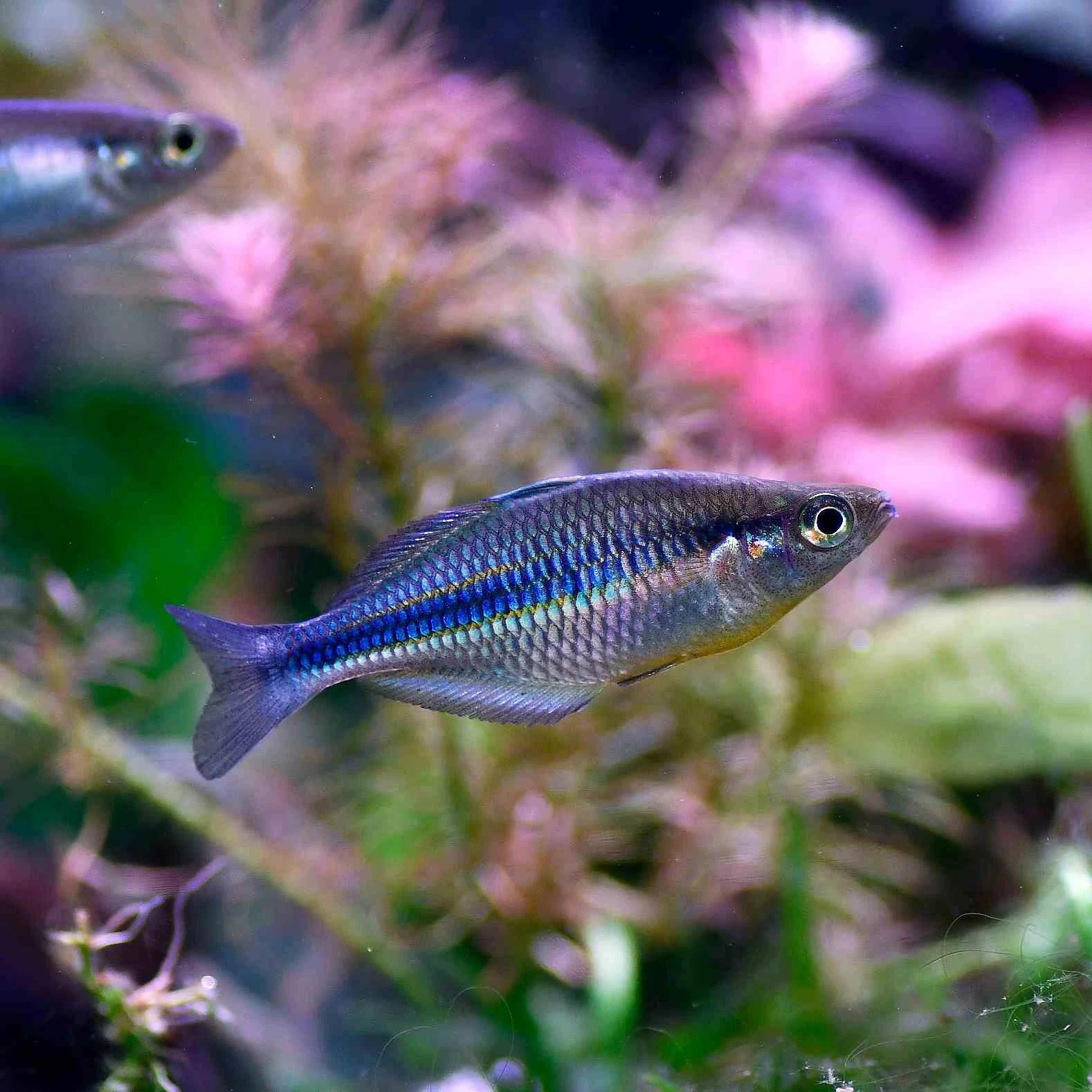
Turquoise Rainbowfish
Melanotaenia lacustris

Bumblebee Cichlid
Pseudotropheus crabro

Green Terror
Andinoacara rivulatus

Jack Dempsey
Rocio octofasciata

Oscar
Astronotus ocellatus

Flowerhorn Cichlid
Hybrid (Amphilophus × Vieja crosses)

Acei Cichlid
Pseudotropheus acei

Electric Blue Hap
Sciaenochromis fryeri
Ready to Add Tropheus Duboisi to Your Tank?
Use our free stocking calculator to check compatibility, bioload, and get personalized recommendations.