
Care Requirements
Adult Size
3.9" (10cm)
Min Tank
30 gal
Temperature
75-82°F
pH Range
7.5-8.5
Lifespan
15+ years
Min Group
3+ fish
Diet
Omnivore
Swim Level
Bottom
Bioload
3/10
Hardness
10-25 dGH
About Synodontis Petricola
Synodontis Petricola is a fascinating catfish endemic to the rocky shores of Lake Tanganyika in Africa. These attractive spotted catfish have earned fame for their remarkable 'cuckoo' breeding behavior—sneaking their eggs among those of mouthbrooding cichlids, tricking the cichlids into raising catfish fry instead of their own offspring.
Beyond their fascinating reproductive strategy, Petricola are excellent aquarium fish. They're more active and visible than many catfish species, often swimming mid-tank and emerging during daylight hours once established. Their squeaking vocalizations when stressed, upside-down feeding behavior, and social nature make them engaging tank residents.
Their requirement for hard, alkaline water makes them perfect companions for African Rift Lake cichlid tanks, particularly Tanganyikan species. This same requirement, however, makes them incompatible with soft-water community setups—they're specialists for specific tank types.
Natural Habitat & Origin
Synodontis Petricola is endemic to Lake Tanganyika, one of Africa's great Rift Valley lakes. They're found nowhere else in the world naturally. Within the lake, they inhabit the rocky shoreline zones at depths of 3-20 meters, living among boulders and rock formations.
Lake Tanganyika is characterized by exceptionally hard, alkaline water with stable parameters. This ancient lake's unique chemistry has shaped the evolution of Petricola and explains their strict water requirements in captivity. They cannot adapt to soft, acidic conditions like many other catfish species.
Native Region
Lake Tanganyika, Africa (endemic)
Habitat Type
Rocky shorelines, boulder zones at 3-20 meter depths
Wild Water Conditions
Hard, alkaline water (pH 8.5-9.2), high mineral content, well-oxygenated
Appearance & Varieties
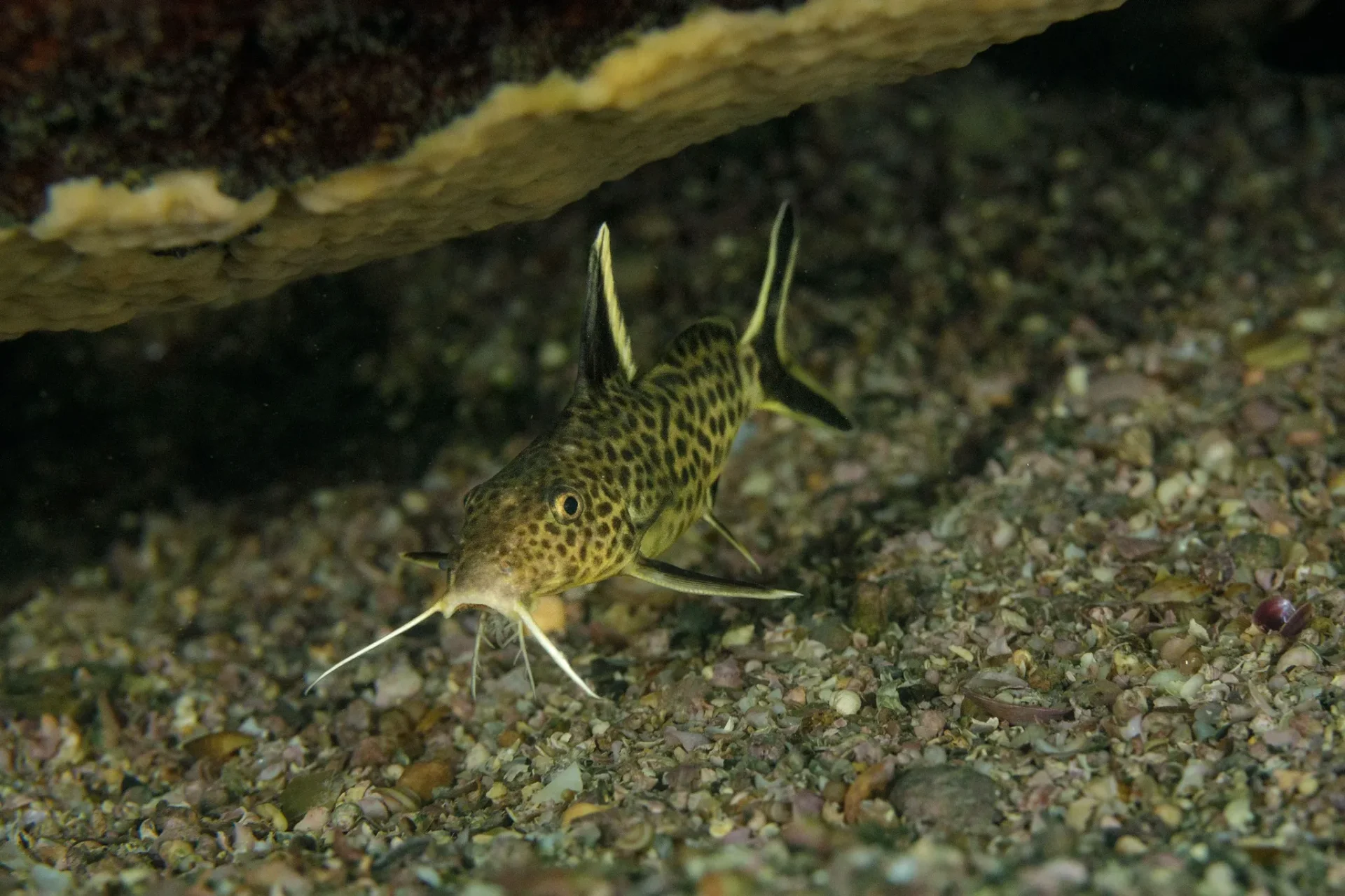
Synodontis Petricola are attractively patterned with a base color of cream to light brown covered in dark spots. Their dorsal fin has a distinctive white edge (important for identification vs. similar species). They possess three pairs of barbels and a forked tail.
Adults reach approximately 4 inches (10cm) in aquariums. Males and females are difficult to distinguish, though females may be slightly rounder when gravid. Their adipose fin is well-developed, and their pectoral fins contain sharp spines that can cause painful injuries if handled improperly.
Tank Setup & Requirements
Quick Requirements Summary
Tank Size
Minimum Tank Size
30 gallons
Recommended Tank Size
40 gallons
Synodontis Petricola require a minimum of 30 gallons for a small group, with 40+ gallons recommended for a comfortable community. The tank should feature rockwork mimicking their Lake Tanganyika habitat.
Water Parameters
Hard, alkaline water is essential—pH 7.8-9.0 and hardness 10-25 dGH. This is non-negotiable; they cannot thrive in soft, acidic conditions. Temperature should be maintained between 73-81°F (23-27°C).
Substrate
Sand or fine gravel allows natural foraging behavior. They'll sift through substrate searching for food, so avoid sharp materials that could damage barbels.
Plants & Decorations
Rockwork is essential—stack rocks to create caves, crevices, and hiding spots. Live plants are challenging due to the alkaline water; Java fern, Anubias, and Vallisneria may survive. Artificial plants are commonly used.
Filtration & Water Flow
Strong filtration with good oxygenation is important. This mimics their well-oxygenated lake habitat. Ensure adequate water movement.
Lighting
Moderate lighting is fine. They're not strictly nocturnal and will emerge during the day once comfortable, especially around feeding time.
Diet & Feeding Guide
Diet Type
omnivore
Feeding Frequency
Once daily, evening preferred
Portion Size
What they consume in 3-5 minutes
Synodontis Petricola are omnivores that feed on invertebrates, insect larvae, algae, and organic matter in the wild. They're also known to consume fish eggs—part of their cuckoo breeding strategy. In captivity, they accept a wide variety of sinking foods.
Best Foods for Synodontis Petricola
- Sinking pellets — Catfish tablets and cichlid pellets work well
- Spirulina wafers — Provides vegetable matter in their diet
- Frozen bloodworms — Excellent protein source
- Brine shrimp — Frozen or live, both readily accepted
- Blanched vegetables — Zucchini, cucumber for variety
- Live blackworms — Natural prey item, promotes foraging
Foods to Avoid
- Floating foods only — They don't readily surface feed—food must sink
- Acidic water conditions — Wrong environment, not a food issue but often confused
They'll eat at any time but are more active at dusk and dawn. Don't rely on leftover food—provide dedicated sinking foods. They become bold feeders once established and may even feed from your hand.
Behavior & Temperament
Synodontis Petricola are social catfish that should be kept in groups of 3 or more. Unlike many catfish, they're not strictly nocturnal and will often be visible during the day, especially once comfortable in their environment.
They're known as 'squeaker' catfish for the sounds they produce when stressed, created by grinding their pectoral fin spines. They also display the Synodontis habit of swimming upside-down to feed from surfaces and rock undersides. Their famous 'cuckoo' breeding behavior—parasitizing mouthbrooding cichlids—is one of the most fascinating reproductive strategies in the fish world.
Tank Mates: Compatibility Guide
Compatible Tank Mates
Tanganyikan Cichlids
Perfect match—same water requirements and natural coexistence
Shell Dwellers
Different niches, peaceful coexistence
Frontosa
Large Tanganyikan cichlid, good in big tanks
Other Synodontis
Can mix species with similar requirements
Malawi Cichlids
Similar water requirements, though monitor for aggression
Tank Mates to Avoid
Soft water fish
Completely incompatible water requirements
Amazonian species
Wrong water chemistry
Shrimp
Will be eaten
Very aggressive cichlids
May bully the catfish
Common Pairing Questions
Can Synodontis Petricola live with Malawi cichlids?
Often yes—both require hard, alkaline water. However, some aggressive Malawi cichlids may bully them. They're more naturally suited to Tanganyikan cichlid communities. Ensure adequate hiding spots.
What is the 'cuckoo' breeding behavior?
Like cuckoo birds, these catfish are brood parasites. They sneak their eggs among those of mouthbrooding cichlids. The cichlid then incubates the catfish eggs in their mouth. The catfish fry hatch first and may eat the cichlid eggs/fry. Fascinating survival strategy.
Synodontis Petricola have a remarkable 'cuckoo' breeding strategy. When mouthbrooding cichlids spawn, Petricola sneak in during the chaos, eat some of the cichlid eggs, and deposit their own eggs. The unsuspecting cichlid then mouthbroods the catfish eggs along with their own offspring.
The catfish eggs hatch slightly earlier than the cichlid eggs. The catfish fry may then consume the remaining cichlid eggs or fry before being released by the host. This brood parasitism is one of the most fascinating reproductive strategies in the fish world.
Breeding requires mouthbrooding cichlid hosts in the tank. They can also scatter eggs normally without hosts, but the cuckoo method is their specialty. Sexing is difficult—females may be slightly rounder when full of eggs.
Health Issues & Disease Prevention
Synodontis Petricola are hardy fish when kept in appropriate hard, alkaline water. They're long-lived, reaching 15-20 years with proper care. The main health challenge is maintaining proper water chemistry.
Common Diseases
| Disease | Symptoms | Treatment |
|---|---|---|
| Ich (White Spot Disease) | White spots, flashing, lethargy | Raise temperature gradually, use half-dose medication (scaleless fish) |
| Bloat | Swollen abdomen, loss of appetite, lethargy | Improve water quality, Epsom salt baths, varied diet. Common in African cichlid tanks |
| Bacterial infections | Red patches, fin erosion, ulcers | Antibacterial treatment, pristine water quality |
Signs of a Healthy Synodontis Petricola
- Active swimming, especially at dusk/dawn
- Clear spotted pattern
- Good appetite
- Confident behavior
- Intact fins and barbels
Prevention Tips
- Maintain hard, alkaline water
- Keep in groups for confidence
- Provide adequate hiding spots
- Regular water changes
- Quarantine new additions
Frequently Asked Questions
They're often confused. S. petricola has a white-edged dorsal fin and grows to 4 inches. S. lucipinnis (Dwarf Petricola) has a black-edged dorsal and stays smaller at 3 inches. Both have similar care and the 'cuckoo' breeding behavior. Stores frequently mislabel them.
Yes—they're endemic to Lake Tanganyika and require pH 7.8-9.0 and hard water (10-25 dGH). They won't thrive in soft, acidic conditions. Perfect for African Rift Lake cichlid tanks but incompatible with Amazon community setups.
Like cuckoo birds, these catfish are brood parasites. They sneak their eggs among those of mouthbrooding cichlids. The cichlid then incubates the catfish eggs in their mouth. The catfish fry hatch first and may eat the cichlid eggs/fry.
Not recommended. They're social catfish that are much more active and confident in groups of 3 or more. Single specimens often hide constantly and show stress behaviors.
They're crepuscular (most active at dawn/dusk) rather than strictly nocturnal. Once established, they're much more visible than many catfish and will emerge during the day, especially at feeding time.
Often yes—both require hard, alkaline water. However, some aggressive Malawi cichlids may bully them. They're more naturally suited to Tanganyikan cichlid communities. Ensure adequate hiding spots.
Tips for Keeping Synodontis Petricola
Pro Tips
- ✓Perfect addition to Tanganyikan cichlid tanks—same water requirements
- ✓More visible than most catfish—you'll actually see them regularly
- ✓Groups of 4-6 create confident, active fish
- ✓Watch for the cuckoo breeding if keeping with mouthbrooders—fascinating behavior
- ✓Often confused with S. lucipinnis at stores—check dorsal fin edge color
- ✓Long-lived (15-20 years)—a lasting addition to your tank
- ✓Will swim upside-down to feed from rock undersides—entertaining to watch
- ✓Makes squeaking sounds when netted—handle with care due to spines
Common Mistakes to Avoid
- ✗Keeping in soft, acidic water—they need hard, alkaline conditions
- ✗Keeping alone—they need groups for confidence
- ✗No rocky hiding spots—essential for natural behavior
- ✗Housing with incompatible soft-water species
- ✗Confusing with S. lucipinnis—similar but different species
- ✗Expecting strictly nocturnal behavior—they're more visible than that
- ✗Using nets carelessly—pectoral spines can tangle and injure
- ✗Not committing to 15-20 year lifespan
Sources
- FishBase — Accepted scientific name, maximum size and native range for Synodontis Petricola.
Featured in Biotope Presets
Related Species You Might Like
View All Fish →
Thai Micro Crab
Limnopilos naiyanetri
Upside Down Catfish
Synodontis nigriventris
Blue Phantom Pleco
Hemiancistrus sp.
Bristlenose Pleco
Ancistrus sp.
Glass Catfish
Kryptopterus vitreolus
Rubber Lip Pleco
Chaetostoma formosae
Striped Raphael Catfish
Platydoras armatulus
Twig Catfish
Farlowella acus
Ready to Add Synodontis Petricola to Your Tank?
Use our free stocking calculator to check compatibility, bioload, and get personalized recommendations.