
Care Requirements
Adult Size
7.9" (20cm)
Min Tank
55 gal
Temperature
75-82°F
pH Range
6-7.5
Lifespan
15-20 years
Min Group
Can be kept alone
Diet
Omnivore
Swim Level
Bottom
Bioload
5/10
Hardness
4-18 dGH
About Striped Raphael Catfish
The Striped Raphael Catfish is one of the hardiest and longest-lived catfish available in the aquarium hobby. These striking fish, with their bold black and white striping and armored appearance, can live 15-20 years with proper care—often outlasting their owner's interest in the hobby.
What makes Raphael catfish particularly interesting is their ability to produce sounds. By grinding their pectoral spines and using their swim bladder, they create distinct croaking or grunting sounds when stressed or removed from water. This 'talking' ability, combined with their prehistoric appearance and peaceful nature, has made them enduring favorites among catfish enthusiasts.
Despite their impressive size (up to 8 inches) and armor-like appearance, Striped Raphaels are remarkably peaceful. They'll ignore virtually all tankmates that are too large to eat. However, their strictly nocturnal habits mean you may rarely see them—they're masters of hiding and can 'disappear' for weeks at a time, only emerging after lights out to forage.
Natural Habitat & Origin
Striped Raphael Catfish originate from the vast river systems of South America, including the Amazon, Orinoco, Essequibo, and Paraná basins. Their range spans Brazil, Peru, Bolivia, Colombia, Venezuela, and neighboring countries, making them one of the most widely distributed catfish species.
In the wild, they inhabit slow-moving rivers, tributaries, flooded forests, and backwater areas with soft, sandy substrates. They spend daylight hours hidden among submerged roots, leaf litter, and fallen wood, emerging at night to forage for food. This nocturnal lifestyle and preference for hiding carries directly into aquarium behavior.
Native Region
South America (Amazon, Orinoco, Essequibo, Paraná River basins)
Habitat Type
Slow-moving rivers, tributaries, flooded forests, backwaters
Wild Water Conditions
Warm, soft to moderately hard, slightly acidic to neutral water
Appearance & Varieties
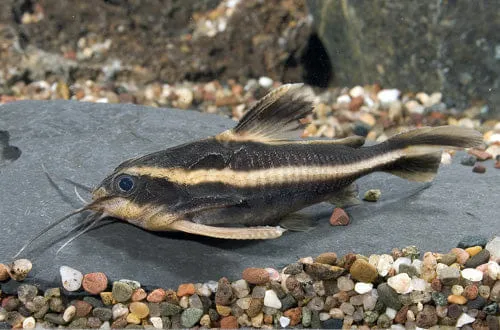
Striped Raphael Catfish are strikingly patterned with bold alternating black and white/cream stripes running horizontally along their body. Their head is large and flattened with a broad mouth suited for scavenging. The body is covered with bony scutes providing armor-like protection.
Their most notable physical feature is their sharp, serrated pectoral spines that can lock in place when the fish feels threatened. These spines make handling dangerous and netting nearly impossible without injury to the fish or handler. Adults reach approximately 8 inches (20cm) in aquariums.
Tank Setup & Requirements
Quick Requirements Summary
Tank Size
Minimum Tank Size
55 gallons
Recommended Tank Size
75 gallons
Striped Raphael Catfish require a minimum of 50 gallons due to their adult size, with 75+ gallons recommended. They're bottom dwellers that need ample floor space and numerous hiding spots to feel secure during the day.
Water Parameters
Temperature should be maintained between 72-82°F (22-28°C). They tolerate a pH range of 6.0-7.5 and moderate hardness. While adaptable, stable water conditions are always preferred.
Substrate
Sand is strongly preferred as it allows natural foraging behavior and protects their barbels. They'll sift through sand searching for food, which is entertaining to watch during their active periods.
Plants & Decorations
Live plants are safe—they won't damage vegetation. Provide abundant hiding spots with caves, driftwood, PVC pipes, and dense cover. They'll wedge themselves into tight spaces during the day, so ensure hiding spots are appropriately sized.
Filtration & Water Flow
Moderate to strong filtration is needed as they produce significant bioload. Good oxygenation is appreciated but they're not demanding about flow.
Lighting
Subdued lighting is preferred. As strictly nocturnal fish, they're stressed by bright lights without adequate cover. Provide shaded areas for daytime hiding.
Diet & Feeding Guide
Diet Type
omnivore
Feeding Frequency
Once daily, after lights out
Portion Size
What they consume during nighttime foraging
Striped Raphael Catfish are opportunistic omnivores that scavenge for various foods in the wild including mollusks, crustaceans, insects, worms, and organic detritus. In captivity, they accept most sinking foods but must be fed after lights out when they're active.
Best Foods for Striped Raphael Catfish
- Sinking pellets — Catfish tablets and shrimp pellets should form the staple
- Frozen bloodworms — Excellent protein source, highly accepted
- Live blackworms — Natural prey item, promotes foraging behavior
- Algae wafers — Provides vegetable matter in their diet
- Chopped earthworms — Nutritious treat, cut to appropriate size
- Snails — They'll eat pest snails, useful for population control
Foods to Avoid
- Floating foods only — They don't surface feed—food must sink
- Overfeeding — They're efficient scavengers but excess food pollutes water
Feed after lights out when they emerge to forage. Don't rely on them eating leftover food from other fish—provide dedicated sinking foods. They have large appetites but can survive extended periods without food if necessary.
Behavior & Temperament
Striped Raphael Catfish are peaceful and reclusive. They tolerate their own species but aren't truly social—they simply ignore each other and other tankmates. Their defining characteristic is their strictly nocturnal lifestyle; they hide during the day and emerge only after lights out.
Their 'talking' ability is fascinating but indicates stress. When removed from water or threatened, they produce croaking or grunting sounds by grinding their pectoral spines and using their swim bladder as a resonating chamber. This is a defense mechanism, not a sign of contentment.
Tank Mates: Compatibility Guide
Compatible Tank Mates
Armoured and nocturnal, so the gourami never gets a reaction from it
Classic pairing—both large, peaceful South Americans
Too large to eat, similar water requirements
Different niches, peaceful coexistence
Severum
Peaceful large cichlid, good community member
Large Tetras
Species too large to fit in their mouth
Rainbowfish
Active mid-dwellers, won't compete for hiding spots
Tank Mates to Avoid
Small fish
Anything that fits in their mouth will be eaten at night
Shrimp
Will be eaten
Small snails
Will be eaten—useful for pest control but not ornamental snails
Aggressive fish
May stress the peaceful catfish
Common Pairing Questions
Can Striped Raphael Catfish live with Oscars?
Yes—this is a classic and successful pairing. Both are large, peaceful South American fish with similar water requirements. The Raphael is too large and armored to be bothered by the Oscar, and their nocturnal habits mean they largely ignore each other.
Will Striped Raphael Catfish eat my other fish?
They'll eat any fish small enough to fit in their mouth, which is larger than it appears. Neon tetras, guppies, and similar small fish are at risk, especially at night. Keep only with fish too large to be eaten.
Breeding Striped Raphael Catfish in home aquariums is extremely rare and largely undocumented. Males reportedly build bubble nests, but successful spawning in captivity is virtually unheard of.
These fish are nearly impossible to sex visually. Females may be slightly rounder when full of eggs, but this is difficult to determine. Most specimens in the hobby are wild-caught, and commercial breeding is not established.
Don't expect to breed them. Focus on providing good long-term care for these remarkably long-lived fish.
Health Issues & Disease Prevention
Striped Raphael Catfish are exceptionally hardy, which contributes to their popularity. They tolerate a wide range of conditions and are forgiving of beginner mistakes. However, their sharp spines present unique handling challenges.
Common Diseases
| Disease | Symptoms | Treatment |
|---|---|---|
| Ich (White Spot Disease) | White spots on body, flashing against objects, lethargy | Raise temperature gradually to 86°F (30°C), use half-dose ich medication (scaleless fish) |
| Physical injury | Scrapes, wounds, missing scales from hitting glass or decorations | Pristine water quality, possible antibacterial treatment for wounds. Prevent by avoiding sudden movements near tank |
| Handling injuries | Wounds from improper handling, tangled in nets | Prevention only—never use nets, always use containers to move them |
Signs of a Healthy Striped Raphael Catfish
- Emerges at night to forage
- Good appetite
- Intact barbels and spines
- Clear eyes
- Healthy striping pattern
Prevention Tips
- Never use nets—use containers
- Provide smooth decorations without sharp edges
- Maintain stable water quality
- Remove sharp objects that could injure panicking fish
Frequently Asked Questions
They're 'talking catfish' that produce croaking or grunting sounds by grinding their pectoral spines and using their swim bladder. This happens when stressed, handled, or removed from water. It's a defense mechanism.
Probably yes! They're extremely nocturnal and may hide for days or weeks at a time, only emerging briefly at night. Check for them after lights out with a dim flashlight. Food disappearing overnight is a good sign they're active.
15-20 years with proper care—this is a serious long-term commitment. They're one of the longest-lived common aquarium catfish. Consider this before purchasing.
Never handle them directly. Their pectoral spines are sharp, serrated, and can lock in place, causing painful wounds prone to infection. Always use a container to move them, never a net.
They'll eat any fish small enough to fit in their mouth, which is larger than it appears. Small tetras, guppies, and similar fish are at risk, especially at night. Keep only with fish too large to be eaten.
Probably not—they deliberately wedge themselves into tight spaces to feel secure. If they can get in, they can usually get out. Only intervene if the fish shows signs of genuine distress over multiple days.
Tips for Keeping Striped Raphael Catfish
Pro Tips
- ✓The 15-20 year lifespan means they may outlive your interest in the hobby—plan accordingly
- ✓Feed after lights out with a red light to watch them forage
- ✓PVC pipe sections make perfect affordable hiding spots
- ✓They'll eat pest snails—useful for population control
- ✓Never, ever use a net—use a large container or plastic bag
- ✓One of the hardiest catfish available—tolerates beginner mistakes
- ✓Don't worry if you don't see them for weeks—they're masters of hiding
- ✓Their 'talking' ability is entertaining but indicates stress when it happens
Common Mistakes to Avoid
- ✗Expecting to see them during the day—they're strictly nocturnal
- ✗Using nets—their spines tangle and can cause injury
- ✗Tank too small—they grow to 8 inches and need space
- ✗No hiding spots—they need caves and cover
- ✗Keeping with small fish—they'll be eaten at night
- ✗Not committing to 15-20 year lifespan
- ✗Handling directly—those spines are dangerous
- ✗Panicking when they 'disappear'—they hide for extended periods
Sources
- FishBase — Accepted scientific name, maximum size and native range for Striped Raphael Catfish.
Related Species You Might Like
View All Fish →
Sunshine Peacock
Aulonocara baenschi
Blue Phantom Pleco
Hemiancistrus sp.
Bristlenose Pleco
Ancistrus sp.
Glass Catfish
Kryptopterus vitreolus
Rubber Lip Pleco
Chaetostoma formosae
Synodontis Petricola
Synodontis petricola
Twig Catfish
Farlowella acus
Upside Down Catfish
Synodontis nigriventris
Ready to Add Striped Raphael Catfish to Your Tank?
Use our free stocking calculator to check compatibility, bioload, and get personalized recommendations.