
Care Requirements
Adult Size
2.0" (5cm)
Min Tank
10 gal
Temperature
72-82°F
pH Range
7.5-8.5
Lifespan
2-3 years
Min Group
3+ fish
Diet
Omnivore
Swim Level
Bottom
Bioload
3/10
Hardness
10-25 dGH
About Fiddler Crab
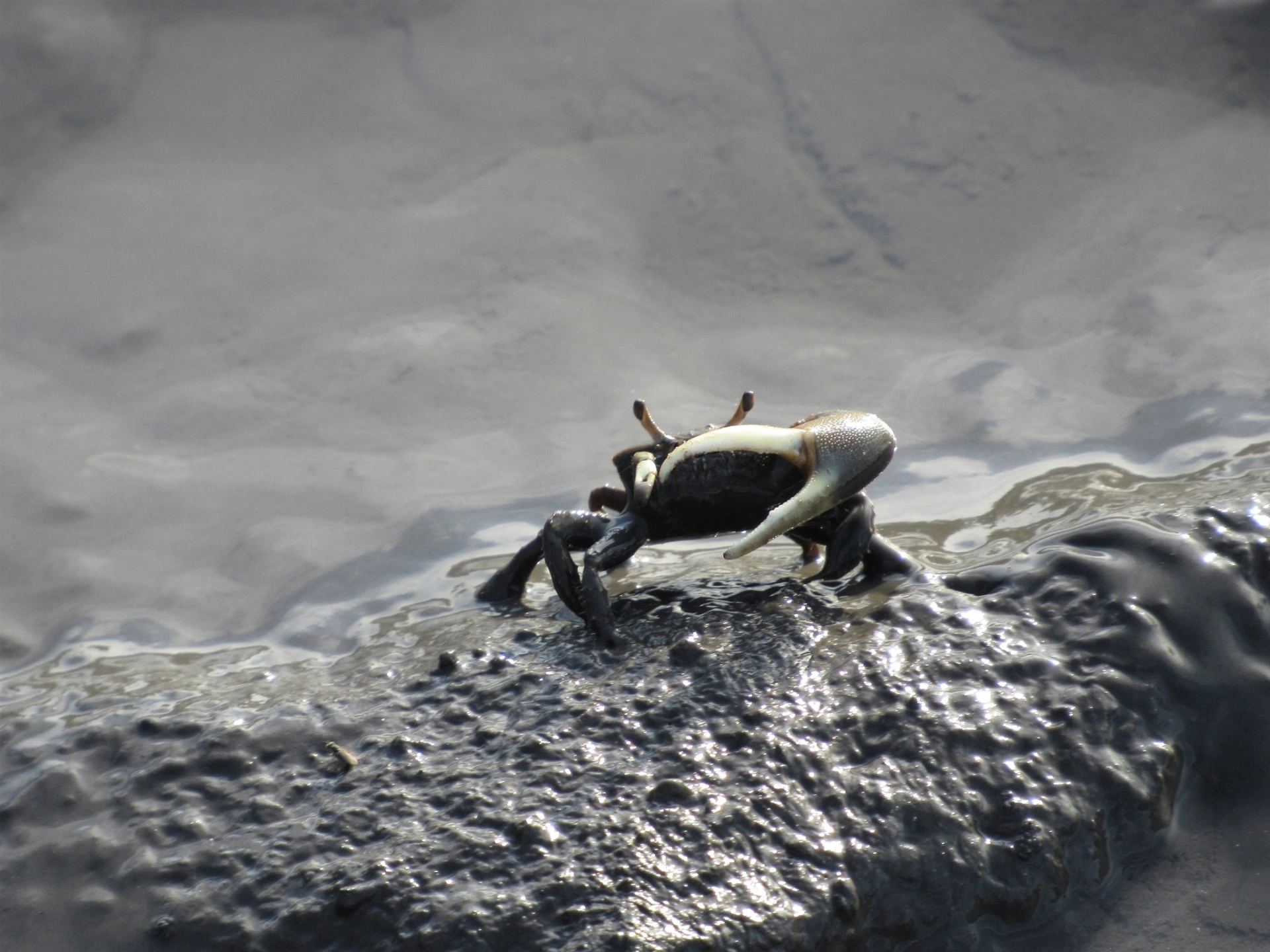
Fiddler Crabs (Uca spp.) are among the most recognizable crustaceans in the world, instantly identified by the male's single dramatically oversized claw. This massive claw — which can account for nearly half the crab's body weight — is used exclusively for territorial display and courtship signaling, not for feeding. The smaller claw handles all food manipulation, while the big claw waves in elaborate patterns to attract females and warn rival males. This waving behavior, which resembles someone playing a fiddle, gives the genus its common name.
Fiddler Crabs represent a large genus of over 100 species found in coastal areas worldwide, from the Americas to Africa, Asia, and Oceania. The species most commonly sold in the aquarium trade are from the Atlantic and Gulf coasts of the Americas, though exact species identification is rarely provided by pet stores. Regardless of species, all Fiddler Crabs share the same fundamental requirements: brackish water, sand substrate for burrowing, land access, and social housing.
Despite being sold as 'freshwater community tank' additions in many pet stores, Fiddler Crabs are semi-terrestrial brackish water animals. They live in the intertidal zone of mudflats and mangrove swamps, where they spend hours out of the water on exposed sand and mud. In captivity, they need a paludarium with 60-70% land (sand beach) and 30-40% shallow brackish water. Without these conditions, they slowly decline over weeks to months.
Fiddler Crabs are highly social and should always be kept in groups of at least 3, with more being better. In groups, they display fascinating social behaviors: males wave their oversized claws in complex patterns, construct and defend burrows, and engage in ritualized combat that rarely causes injury. Watching a colony of Fiddler Crabs on a sandy beach enclosure is one of the most entertaining experiences the invertebrate hobby offers.
Natural Habitat & Origin
Fiddler Crabs inhabit the intertidal zones of coastal areas worldwide — mudflats, mangrove swamps, sandy beaches, and salt marshes where land meets brackish or saltwater. They are found across tropical and subtropical coasts of the Americas, West Africa, the Indo-Pacific, and Australia. Their habitat is defined by tidal cycles: during low tide, they emerge onto exposed sand and mud to feed, display, and maintain burrows. During high tide, they retreat into their burrows, sealing the entrance with a mud or sand plug to trap an air pocket for breathing.
Native Region
Pantropical — coastal Americas, Africa, Asia, Oceania
Habitat Type
Intertidal mudflats, mangrove swamps, salt marshes, sandy estuaries
Wild Water Conditions
Brackish to marine salinity (SG 1.005-1.025), alkaline pH, hard water with tidal fluctuation
Appearance & Varieties
Fiddler Crabs are compact crabs measuring about 5 cm (2 inches) across the carapace. The most distinctive feature is sexual dimorphism in claw size: males possess one enormously enlarged claw (the 'major cheliped') and one normal-sized feeding claw. The major claw can be on either the left or right side and varies in color from white to orange to red depending on species. Females have two equally small claws. Body coloration varies by species from tan and brown to blue, purple, or brightly patterned. Eyes are mounted on long, thin stalks that provide excellent 360-degree vision for detecting predators and rivals.
Popular Varieties
| Variety | Description | Rarity |
|---|---|---|
| Atlantic Sand Fiddler (Uca pugilator) | Tan to brown body with a pale or white major claw. The most commonly sold species in North American pet stores. | Common |
| Atlantic Marsh Fiddler (Uca pugnax) | Olive to dark brown body with a blue-tinged major claw. Often mixed with sand fiddlers in pet store tanks. | Common |
| Red-jointed Fiddler (Uca minax) | Larger species with distinctive red joints on the walking legs and a more robust build. | Uncommon |
| Painted Fiddler (various tropical spp.) | Several tropical species with vivid blue, orange, or multicolored patterns. Rarely identified to species in trade. | Uncommon |
Tank Setup & Requirements
Quick Requirements Summary
Tank Size
Minimum Tank Size
10 gallons
Recommended Tank Size
20 gallons
Fiddler Crabs need a paludarium that replicates their intertidal habitat — a sandy beach sloping into shallow brackish water. The land area should comprise 60-70% of the enclosure with a deep sand bed (at least 10-15 cm) for burrowing. The water section should be shallow (8-12 cm deep) with brackish salinity (SG 1.005-1.015). This setup is fundamentally different from a standard aquarium and must be planned accordingly.
Water Parameters
Temperature 22-28°C (72-82°F), pH 7.5-8.5, hardness 10-25 dGH. Water MUST be brackish — use marine salt mix (like Instant Ocean) to achieve SG 1.005-1.015 measured with a hydrometer or refractometer. Never use aquarium salt or table salt. Perform 20% weekly water changes with pre-mixed brackish water.
Substrate
Sand is mandatory — specifically fine, smooth sand deep enough for burrowing (minimum 10-15 cm or 4-6 inches). Pool filter sand or play sand works perfectly. Slope it from deep water at one end to a dry beach on the other. Fiddler Crabs construct elaborate burrows in the sand, and this burrowing behavior is essential for their psychological wellbeing.
Plants & Decorations
Mangrove propagules or salt-tolerant plants in the water section add authenticity. Rocks and driftwood on the beach provide climbing opportunities and visual barriers between territorial males. Avoid plants on the sandy beach area — crabs will dig them up. A piece of cuttlebone on the beach provides essential calcium.
Filtration & Water Flow
A small internal or HOB filter handles the shallow water volume. Sponge filters work well for gentle water movement. The filter only needs to service the water section, which is typically quite small. Ensure intakes can't trap crabs.
Lighting
Standard lighting on a 10-12 hour cycle. Fiddler Crabs are diurnal (day-active) — unlike most crabs — so good lighting lets you observe their fascinating social behaviors. LED lighting that doesn't overheat the enclosure is ideal.
Diet & Feeding Guide
Diet Type
omnivore
Feeding Frequency
Daily for groups
Portion Size
Small amounts scattered on the sand
Fiddler Crabs are detritivores and scavengers in the wild, using their small feeding claw to sift through sand and mud for organic particles, algae, bacteria, and tiny organisms. Males can only eat with their one small claw (the major claw is useless for feeding), which means they eat more slowly than females. In captivity, they accept a wide range of foods scattered on the sand beach where they can forage naturally.
Best Foods for Fiddler Crab
- Sinking pellets and flakes — Shrimp pellets, crab cuisine, or crushed tropical flakes scattered on the sand beach
- Blanched vegetables — Zucchini, spinach, and peas chopped small and placed on the beach area
- Freeze-dried bloodworms — High-protein treat — scatter on damp sand for natural foraging behavior
- Dried seaweed/nori — Provides essential marine-origin nutrients and minerals
- Calcium supplements — Cuttlebone placed on the beach — essential for shell health and molting
- Decomposing leaf litter — Indian almond or oak leaves on the beach provide grazing material and biofilm
Foods to Avoid
- Seasoned or processed food — Preservatives, excess salt, and additives are toxic to crabs
- Copper-containing products — Lethal to crustaceans even in trace amounts — check all product labels
- Large food chunks — Males can only feed with their small claw — food must be small enough to manipulate
- Citrus fruits — Too acidic for their system and disrupts water chemistry
Scatter food on the damp sand beach rather than in water — this encourages natural foraging and keeps the water cleaner. Males eat slower than females due to having only one feeding claw. Ensure enough food reaches all crabs, especially subordinate males in groups. Calcium via cuttlebone should be permanently available.
Behavior & Temperament
Fiddler Crabs are diurnal and among the most behaviorally fascinating crustaceans in the hobby. Males wave their oversized claw in species-specific patterns to attract females and warn rivals — this display is their signature behavior and is endlessly entertaining to watch. They construct and defend burrows in the sand, sometimes building 'hoods' or walls around the entrance. Ritualized combat between males involves interlocking major claws and pushing, rarely causing injury. Females evaluate males based on claw size, wave pattern, and burrow quality. In groups, a clear social hierarchy forms with dominant males occupying prime beach territory. Healthy crabs are active during the day, wave their claws regularly, maintain burrows, and eat eagerly. Stress signs include constant hiding, refusal to emerge during the day, loss of color, and not constructing burrows.
Tank Mates: Compatibility Guide
Compatible Tank Mates
Other Fiddler Crabs
Social species — keep in groups of 3+ with at least one male for display behavior
Large brackish snails
Nerite snails may coexist in the water section — too large for crabs to eat
Fiddler crabs of different species
Different Uca species can often coexist as they occupy slightly different niches
Tank Mates to Avoid
Fish (any species)
Water section is too shallow and brackish for most fish; crabs may catch bottom-resting fish
Shrimp
Will be caught and eaten — crabs are effective predators of invertebrates
Red Claw Crabs
More aggressive species that will dominate and injure fiddler crabs
Hermit crabs
Different humidity and salinity requirements — typically need higher salinity and humidity
Common Pairing Questions
Can Fiddler Crabs live in a freshwater tank?
No. Despite being sold this way, Fiddler Crabs are brackish water animals. Freshwater keeping leads to molting failure, gill problems, and a dramatically shortened lifespan. They need marine salt mix at SG 1.005-1.015.
Can I keep just one Fiddler Crab?
You shouldn't. Fiddler Crabs are highly social and display their most interesting behaviors in groups. A single crab will be stressed, inactive, and won't perform the iconic claw-waving display. Keep at least 3, ideally more.
Can they live with hermit crabs?
Not ideal. Hermit crabs typically need higher humidity, different salinity, and are terrestrial rather than semi-aquatic. Their care requirements don't overlap well enough for successful cohabitation.
Fiddler Crabs mate on land, and females carry fertilized eggs under their abdominal flap for about two weeks before releasing them into the water. The larvae are planktonic and require full marine salinity to develop through multiple larval stages (zoea) before metamorphosing into tiny crabs. This larval development takes several weeks and requires specific planktonic foods (phytoplankton, rotifers). Successful captive rearing from larva to juvenile is extremely challenging and rarely achieved by hobbyists. In nature, larvae are released during high tide into the open ocean where they develop before returning to shore as juvenile crabs.
Health Issues & Disease Prevention
Fiddler Crabs are hardy animals when kept in correct conditions — brackish paludarium with sand, land access, and social housing. Most health problems trace directly to incorrect husbandry: freshwater instead of brackish, no land access, or solitary confinement. Molting is the most vulnerable period, and failures are typically caused by calcium deficiency or incorrect salinity.
Common Diseases
| Disease | Symptoms | Treatment |
|---|---|---|
| Failed molt | Stuck in old exoskeleton, trapped limbs, death during or shortly after molt attempt | Ensure brackish conditions (SG 1.005+), provide permanent calcium source (cuttlebone), ensure sand deep enough for burrowing during molt. Prevention is the only effective approach. |
| Gill damage | Lethargy, staying on land constantly, refusing to enter water, labored movement | Transition to proper brackish water gradually. Freshwater keeping is the primary cause. Damage may be irreversible if prolonged. |
| Limb loss | Missing legs or claw from aggressive encounters with conspecifics | Provide more space, hiding spots, and visual barriers. Lost limbs regenerate over 2-3 molts. Separate aggressive individuals. |
| Lethargy from solitary keeping | Constant hiding, no claw waving, refusal to eat, loss of coloration | Add more fiddler crabs — they are social animals that need conspecifics for normal behavior. A group of 5+ usually resolves the issue. |
Signs of a Healthy Fiddler Crab
- Active during daylight
- Regular claw waving (males)
- Burrow construction and maintenance
- Eager feeding
- Vibrant coloration
- Social interaction with other crabs
Prevention Tips
- Keep in brackish water (SG 1.005-1.015) at all times
- Provide deep sand (10+ cm) for burrowing
- Ensure land access — 60-70% of enclosure
- Keep in groups of 3 or more
- Provide permanent calcium source
- Seal all escape routes
Frequently Asked Questions
Only males have the oversized claw (called the major cheliped), and it's used exclusively for display and territorial signaling — not for feeding or defense. Males wave this claw in complex species-specific patterns to attract females and warn rival males. If a male loses his major claw, it will regenerate over successive molts, sometimes switching to the opposite side. Females have two small, equal-sized claws.
Yes — sand is essential, not optional. Fiddler Crabs construct burrows in sand that serve as shelters, molting chambers, and territory markers. Without deep sand (minimum 10-15 cm), they cannot perform this critical natural behavior and become stressed. Use fine, smooth sand — pool filter sand or play sand works perfectly. Gravel is unacceptable.
No. Fiddler Crabs are brackish water animals that live in estuaries and mangrove swamps where freshwater mixes with seawater. In captivity, they need water mixed with marine salt (like Instant Ocean) to a specific gravity of 1.005-1.015. Keeping them in freshwater leads to molting failures, gill damage, and premature death. This is the most common care mistake, perpetuated by incorrect pet store advice.
Yes — this is one of the best reasons to keep Fiddler Crabs! Unlike most crabs which are nocturnal, Fiddler Crabs are diurnal (day-active) and wave their claws primarily during daylight hours. Males wave more frequently when females are present and when they feel secure in their territory. A well-established group in a proper setup will display regularly, often in synchronized waves that are mesmerizing to watch.
Minimum 3, ideally 5 or more. They are genuinely social animals that need conspecifics for normal behavior. A ratio of 1 male to 2-3 females works well for reducing aggression while still allowing display behavior. Solitary Fiddler Crabs become inactive, stop waving, and often refuse to eat — they truly need a social group to thrive.
Tips for Keeping Fiddler Crab
Pro Tips
- ✓Create a sloped sand beach that transitions smoothly into shallow water — this replicates their natural intertidal habitat perfectly.
- ✓Use a refractometer rather than a hydrometer for accurate brackish water salinity readings.
- ✓Place food on damp sand rather than in water — it's cleaner and more natural for their foraging style.
- ✓Keep the enclosure near a window with natural light cycles (but not direct sun) — diurnal rhythms enhance their display behavior.
Common Mistakes to Avoid
- ✗Keeping them in freshwater — they need brackish water at SG 1.005-1.015 for long-term health.
- ✗Using gravel instead of sand — they cannot burrow in gravel and it causes stress and foot damage.
- ✗Keeping a single crab — they are social animals that need groups of 3+ for normal behavior.
- ✗Not providing land access — they spend most of their time out of water in the wild.
- ✗Using aquarium salt instead of marine salt mix — aquarium salt lacks essential minerals.
Related Species You Might Like
View All Fish →
Figure 8 Puffer
Dichotomyctere ocellatus
Red Claw Crab
Perisesarma bidens
Vampire Crab
Geosesarma dennerle

African Clawed Frog
Xenopus laevis

Apistogramma Cacatuoides
Apistogramma cacatuoides

Black Skirt Tetra
Gymnocorymbus ternetzi

Buenos Aires Tetra
Hyphessobrycon anisitsi

Bumblebee Goby
Brachygobius xanthozonus
Ready to Add Fiddler Crab to Your Tank?
Use our free stocking calculator to check compatibility, bioload, and get personalized recommendations.