
Care Requirements
Adult Size
1.2" (3cm)
Min Tank
10 gal
Temperature
72-82°F
pH Range
7-8.5
Lifespan
2-3 years
Min Group
Can be kept alone
Diet
Omnivore
Swim Level
Bottom
Bioload
2/10
Hardness
4-16 dGH
About Vampire Crab
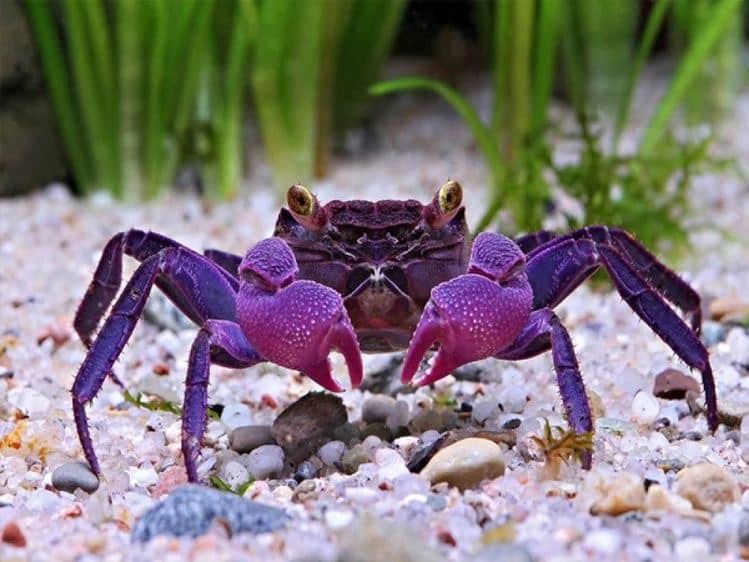
The Vampire Crab (Geosesarma dennerle) is one of the most visually striking invertebrates available in the aquarium hobby. Named for its eerie yellow eyes set against a deep purple body with vivid purple or orange claws, these tiny crabs look like creatures from a fantasy world. Described scientifically only in 2015, they were actually present in the hobby years before formal classification, sold under various trade names that only added to their mystique.
Native to the highland streams and riverbanks of Java, Indonesia, Vampire Crabs are semi-terrestrial animals that spend the majority of their time on land. This is a critical distinction from fully aquatic species — Vampire Crabs will drown if kept in deep water without land access. They require a paludarium setup with approximately 70-80% land area and 20-30% shallow water, replicating the humid forest floors and stream edges of their natural habitat.
Despite their intimidating name, Vampire Crabs are relatively small, reaching only about 3 cm (1.2 inches) in leg span. Their care is manageable for intermediate hobbyists willing to maintain proper humidity levels (75-85%) and provide appropriate land-to-water ratios. They are nocturnal and secretive, spending much of the day hidden among leaf litter, moss, and wood before emerging at dusk to forage.
One of the most rewarding aspects of Vampire Crab keeping is their breeding behavior. Unlike most crabs that release larvae into water, Vampire Crabs are direct developers — females carry fully formed miniature crabs rather than planktonic larvae. This means they can breed successfully in captivity without brackish water stages, making them one of the few crab species that readily reproduce in home setups.
Natural Habitat & Origin
Vampire Crabs inhabit the forested highlands of Java, Indonesia, where they live along the banks of small streams and seepage areas in tropical rainforest. They are found in areas with dense leaf litter, moss-covered rocks, and rotting wood — environments that maintain consistently high humidity. The water in their habitat is typically shallow, slow-moving, and slightly alkaline from mineral-rich substrates. They spend most of their time in the splash zone or on damp land rather than submerged, venturing into shallow pools primarily to hydrate and molt.
Native Region
Java, Indonesia
Habitat Type
Highland forest stream banks, seepage areas, humid leaf litter zones
Wild Water Conditions
Shallow, slow-moving, slightly alkaline freshwater with high surrounding humidity
Appearance & Varieties
Vampire Crabs are among the most colorful crustaceans in the freshwater hobby. Their carapace is typically dark purple to deep burgundy, while their claws range from vivid purple to bright orange depending on the species and morph. The most iconic feature is their piercing yellow or orange eyes, which create a striking contrast against the dark body. Males tend to have slightly larger claws and a narrower abdominal flap compared to females. Their legs are banded in darker and lighter purple tones, and the overall body is covered in fine setae (hair-like structures) that give them a velvety texture.
Popular Varieties
| Variety | Description | Rarity |
|---|---|---|
| Purple Vampire Crab | The classic form with deep purple body, vivid purple claws, and bright yellow eyes. The most commonly available variety. | Common |
| Orange Vampire Crab | Features bright orange claws contrasting with a dark purple body. Often sold as Geosesarma hagen or a color morph. | Common |
| Red Devil Vampire Crab | Deep red to crimson coloration across the body and claws. Less commonly available than purple or orange forms. | Uncommon |
| Tangerine Vampire Crab | Bright tangerine-orange body with contrasting dark legs. A newer variety gaining popularity in the hobby. | Uncommon |
Tank Setup & Requirements
Quick Requirements Summary
Tank Size
Minimum Tank Size
10 gallons
Recommended Tank Size
15 gallons
Vampire Crabs require a paludarium — a setup combining land and water areas. This is non-negotiable: they are not aquatic animals and will stress and eventually die in fully submerged setups. The ideal enclosure features 70-80% land area with 20-30% shallow water no deeper than the crab's body height (about 5-8 cm). Cork bark, driftwood, and rocks create land platforms, while live moss, tropical plants, and leaf litter provide hiding spots and maintain humidity.
Water Parameters
Temperature 22-28°C (72-82°F), pH 7.0-8.5, hardness 4-16 dGH. Water should be dechlorinated and shallow — no deeper than 5-8 cm. A small submersible heater may be needed for the water portion. Partial water changes of 20% weekly keep the shallow water section clean.
Substrate
Use a combination of coconut fiber (coco coir) or organic potting soil for the land area, topped with leaf litter and moss. The water section can use fine gravel or sand. Avoid sharp substrates that could damage the crabs during molting. ABG mix (tropical bioactive substrate) works excellently for the land portion.
Plants & Decorations
Live tropical plants like Pothos, Fittonia, Selaginella, and various mosses (Java moss, pillow moss) thrive in the humid environment and provide essential cover. Cork bark flats and tubes create hiding caves. Driftwood bridges between land and water. Leaf litter (Indian almond leaves, oak leaves) serves as both hiding spots and supplemental food as it decomposes.
Filtration & Water Flow
A small sponge filter or HOB filter rated for the water volume is sufficient for the shallow water portion. Air-driven sponge filters work well and won't create dangerous currents. Some keepers use no filter at all in heavily planted paludariums, relying on plants and regular water changes instead.
Lighting
Low to moderate LED lighting on a 10-12 hour cycle supports plant growth without overheating the enclosure. Avoid intense lighting that could raise temperatures or reduce humidity. Vampire Crabs are nocturnal and prefer dim conditions — they'll be more active and visible with subdued lighting.
Diet & Feeding Guide
Diet Type
omnivore
Feeding Frequency
Every other day
Portion Size
Small amounts — what they can consume in a few hours
Vampire Crabs are true omnivores with a slight preference for protein. In the wild, they feed on small insects, decomposing leaf litter, algae, and fallen fruit. In captivity, variety is key to keeping them healthy and colorful. They are opportunistic feeders that will scavenge both on land and in shallow water. Overfeeding should be avoided as uneaten food quickly fouls the small water volume in a paludarium.
Best Foods for Vampire Crab
- Freeze-dried bloodworms — High-protein favorite — drop small amounts on land areas for natural foraging behavior
- Blanched vegetables — Zucchini, spinach, and peas provide essential plant matter and minerals
- Calcium-rich foods — Crushed cuttlebone, calcium powder, or crushed eggshell — essential for healthy molting and shell formation
- Sinking pellets/wafers — Shrimp pellets, algae wafers, or crab-specific foods placed on land or in shallow water
- Small insects — Fruit flies, springtails, and small crickets provide enrichment and protein
- Indian almond leaves — Decomposing leaves serve as a constant grazing food source and maintain humidity
Foods to Avoid
- Citrus fruits — Too acidic — can irritate gills and damage the delicate water chemistry
- Processed human food — Salt, preservatives, and seasonings are toxic to invertebrates
- Large food items — Uneaten portions decompose rapidly in the warm, humid environment causing bacterial blooms
- Copper-containing foods — Copper is lethal to crustaceans even in trace amounts — check all food ingredient labels
Offer food every other day, alternating between protein and plant-based options. Place food on land areas where crabs can forage naturally. Remove uneaten food after 12 hours to prevent mold. Calcium supplementation is critical before and after molting periods.
Behavior & Temperament
Vampire Crabs are predominantly nocturnal, spending daylight hours hidden among leaf litter, under cork bark, or inside moss-covered caves. They emerge at dusk to forage, explore, and interact with other crabs. Males are territorial and will display to rivals by raising their claws and standing tall, though actual fights are rare when space is adequate. They are surprisingly agile climbers and will scale vertical surfaces, driftwood, and even glass walls — escape-proofing is absolutely essential. During molting, they become extremely vulnerable and will hide for several days until their new exoskeleton hardens. Healthy crabs are active foragers at night, maintain vibrant coloration, and eat regularly. Signs of stress include prolonged hiding (beyond normal nocturnal behavior), loss of color, refusal to eat, and lethargy. Frequent failed molts indicate calcium deficiency or poor water quality.
Tank Mates: Compatibility Guide
Compatible Tank Mates
Springtails
Excellent cleanup crew for the land area — also serve as supplemental food
Isopods
Tropical dwarf isopods help maintain the bioactive land area and are generally ignored
Small snails
Ramshorn or bladder snails in the water section — some may be eaten, consider them supplemental
Dense moss colonies
Java moss in water areas provides cover and maintains water quality
Tank Mates to Avoid
Fish (any species)
The shallow water section is too small for fish, and crabs will catch slow-moving species
Shrimp
Will be hunted and eaten — crabs are opportunistic predators of smaller invertebrates
Other crab species
Interspecies aggression and competition — keep only one Geosesarma species per enclosure
Frogs
Size overlap creates competition and predation risk in both directions
Common Pairing Questions
Can Vampire Crabs live with fish?
No. The paludarium water section is too shallow for fish keeping, and crabs will attempt to catch any fish present. The two are fundamentally incompatible in a Vampire Crab setup.
Can I keep multiple Vampire Crab species together?
It's not recommended. Different Geosesarma species may interbreed or fight. Stick to one species per enclosure for best results and genetic purity.
Are they safe with dart frogs?
Generally no. While some keepers have attempted this combination, there's significant risk of predation in both directions, competition for food, and stress from proximity.
Vampire Crabs are one of the few crab species that breed readily in captivity. Females carry eggs under their abdominal flap for about 4-6 weeks. Unlike most crabs, they are direct developers — the eggs hatch as fully formed miniature crabs rather than planktonic larvae. A single clutch produces 20-80 tiny crabs. The babies are independent from birth but extremely small and vulnerable. Dense moss, leaf litter, and hiding spots are critical for baby survival. In a well-established paludarium with plenty of cover and food (springtails, decomposing leaves), some juveniles will survive to adulthood without intervention. Separate rearing tanks improve survival rates significantly.
Health Issues & Disease Prevention
Vampire Crabs are generally hardy when their humidity and environmental needs are met. The most common health issue is failed molting, which is almost always linked to insufficient calcium or improper humidity. Successful molting requires the crab to absorb water to expand its new shell — if humidity drops below 70%, molting fails. Always leave the shed exoskeleton in the enclosure as crabs eat it to recycle calcium. Bacterial infections can occur in stagnant water conditions. Copper exposure from medications, fertilizers, or contaminated water is lethal.
Common Diseases
| Disease | Symptoms | Treatment |
|---|---|---|
| Failed/incomplete molt | Crab stuck in old exoskeleton, lethargy, inability to move limbs, partial shell retention | Increase humidity to 85%+, provide calcium supplements, ensure shallow water is accessible. Prevention is key — maintain consistent humidity and calcium. |
| Shell rot | Dark spots, pitting, or erosion on the carapace; mushy texture on shell | Improve water quality, increase ventilation slightly to reduce stagnation, isolate affected crab. Ensure substrate isn't perpetually waterlogged. |
| Bacterial infection | Cloudy or discolored joints, lethargy, loss of appetite, unusual odor from water | Complete water change in the water section, improve filtration, remove any decomposing food. Isolation of affected individuals. |
| Copper poisoning | Sudden lethargy, twitching, loss of coordination, rapid death | No cure once symptomatic. Prevention: never use copper-based medications, check water sources, avoid fertilizers with copper micronutrients. |
Signs of a Healthy Vampire Crab
- Active foraging at night
- Vibrant purple/orange coloration
- Regular eating
- Successful periodic molting
- Exploring land and water areas
- Responsive to food
Prevention Tips
- Maintain humidity 75-85% consistently
- Provide calcium via cuttlebone at all times
- Keep water shallow and clean
- Seal all potential escape routes
- Avoid copper in any form
- Provide leaf litter for grazing
Frequently Asked Questions
Absolutely not. Vampire Crabs are semi-terrestrial and require 70-80% land area in their enclosure. They will drown in deep water without land access. A paludarium setup is mandatory — think of it as a terrarium with a shallow water feature rather than an aquarium with land. This is the single most important care requirement and the most common mistake new keepers make.
Humidity should stay between 75-85%. Use a glass lid (not mesh) to retain moisture. Live moss, regular misting with dechlorinated water, and a well-sealed enclosure maintain humidity naturally. A small hygrometer placed inside the enclosure helps monitor levels. Ventilation is still needed — a small gap or mesh strip prevents stagnation while retaining most humidity.
Yes — they are expert escape artists and will climb silicone seams, filter intakes, cords, and any textured surface. Every opening must be sealed. Use a tight-fitting glass lid with no gaps larger than a few millimeters. Block any cord or tubing entry points with foam or silicone. Escaped crabs dehydrate quickly and rarely survive more than a day outside the enclosure.
It depends on your room temperature. If your home stays between 22-28°C (72-82°F), no additional heating is needed. In cooler rooms, a small submersible heater in the water portion or a heat mat on the side of the enclosure keeps temperatures stable. Avoid heat lamps — they dry out the enclosure and crash humidity.
Young crabs molt every 4-6 weeks as they grow. Adults molt less frequently, roughly every 2-3 months. During molting, the crab will hide for several days and should not be disturbed. Leave the shed exoskeleton in the enclosure — the crab will eat it to reclaim calcium. Failed molts are the leading cause of death and are prevented by consistent calcium access and proper humidity.
Tips for Keeping Vampire Crab
Pro Tips
- ✓Create a bioactive land area with springtails and isopods — they clean up waste and uneaten food automatically.
- ✓Use Indian almond leaves both in water and on land — they provide tannins, food, and hiding spots.
- ✓Keep a piece of cuttlebone permanently accessible — calcium is the single most important supplement.
- ✓Dim blue or red LED moonlights let you observe their fascinating nocturnal behavior without disturbing them.
Common Mistakes to Avoid
- ✗Keeping them in fully aquatic setups — they will stress and drown without land access.
- ✗Forgetting calcium supplementation — leads to fatal molting failures.
- ✗Using mesh lids that allow humidity to escape — glass lids are essential.
- ✗Leaving gaps in the lid — crabs will find and exploit any escape route.
- ✗Using copper-based plant fertilizers or fish medications in the enclosure.
Related Species You Might Like
View All Fish →
Vampire Shrimp
Atya gabonensis
Fiddler Crab
Uca spp.
Red Claw Crab
Perisesarma bidens

African Clawed Frog
Xenopus laevis

Apistogramma Cacatuoides
Apistogramma cacatuoides

Black Skirt Tetra
Gymnocorymbus ternetzi

Buenos Aires Tetra
Hyphessobrycon anisitsi

Bumblebee Goby
Brachygobius xanthozonus
Ready to Add Vampire Crab to Your Tank?
Use our free stocking calculator to check compatibility, bioload, and get personalized recommendations.