
Care Requirements
Adult Size
5.9" (15cm)
Min Tank
30 gal
Temperature
75-82°F
pH Range
6.5-7.5
Lifespan
5+ years
Min Group
Can be kept alone
Diet
Omnivore
Swim Level
Bottom
Bioload
3/10
Hardness
4-15 dGH
About Vampire Shrimp
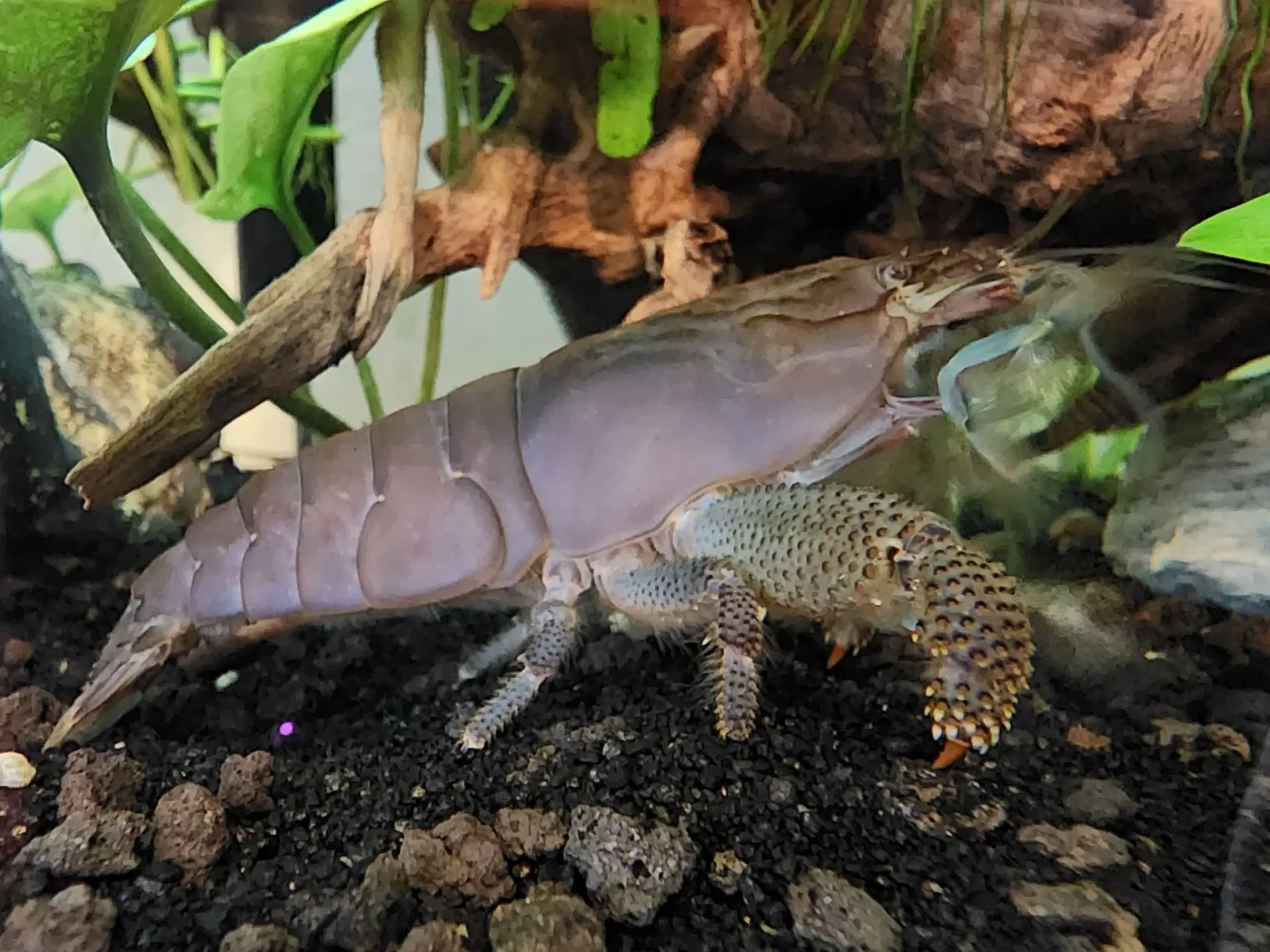
The Vampire Shrimp is one of the most fascinating and misunderstood creatures in the freshwater aquarium hobby. Despite their intimidating name and impressive size — reaching up to 15 cm (6 inches) — they're completely peaceful filter feeders with no ability to harm any tankmate. The 'vampire' name comes from their armored, somewhat imposing appearance, not their behavior.
What makes Vampire Shrimp truly captivating is their unique feeding method. They position themselves on rocks or driftwood in areas of strong current and extend specialized fan-shaped appendages to catch microscopic food particles carried by the water flow. Watching them feed is mesmerizing — their fans open and close rhythmically as they sift through the current for food.
Vampire Shrimp are also remarkable color-changers, shifting between white, cream, blue, gray, brown, red, and deep navy depending on their mood, diet, and molting cycle. All specimens in the trade are wild-caught, as their complex larval lifecycle (requiring brackish water) makes captive breeding virtually impossible.
Natural Habitat & Origin
Vampire Shrimp have a fascinating amphiatlantic distribution — they're found along the West African coast from Senegal to the Democratic Republic of Congo, and also in parts of Central and South America. This unusual range reflects ancient geological connections between the continents.
In the wild, they inhabit fast-flowing rivers and streams with rocky substrates, positioning themselves on rocks and wood in areas of strong current where they can filter-feed on microorganisms and fine particulate matter. Their entire biology is adapted to life in flowing water — their fan appendages, their powerful grip on rocks, and their armored bodies are all evolved for stream life.
Native Region
West Africa (Senegal to DR Congo) and parts of Central/South America
Habitat Type
Fast-flowing rivers and streams with rocky substrates
Wild Water Conditions
Warm (73-82°F), moderate hardness, slightly acidic to neutral pH, strong current
Appearance & Varieties
Vampire Shrimp are impressive creatures, reaching up to 15 cm (6 inches) — making them one of the largest freshwater shrimp available in the hobby. Their bodies are heavily armored with a thick, segmented exoskeleton that gives them their somewhat intimidating appearance.
Their most distinctive feature is the pair of specialized fan-shaped appendages (modified first walking legs) used for filter feeding. When extended into the current, these fans create a mesmerizing display as they rhythmically catch food particles.
Perhaps most remarkably, Vampire Shrimp change color dramatically based on mood, health, diet, and molting cycle. They can range from white and cream to brilliant blue, gray, brown, red, and even deep navy — sometimes changing over days or weeks. No single color indicates poor health; what matters is vibrancy and consistency. Sexing is very difficult — males may have slightly larger fan appendages, and females may appear slightly wider in the abdomen when carrying eggs.
Tank Setup & Requirements
Quick Requirements Summary
Tank Size
Minimum Tank Size
30 gallons
Recommended Tank Size
40 gallons
Current flow is the single most important setup element. Without proper current carrying food particles to their fans, Vampire Shrimp will slowly starve. Position rocks or wood directly in the flow path so they have stable platforms to perch and feed from. Provide multiple hiding spots for molting periods.
Water Parameters
Temperature 73-82°F (23-28°C), pH 6.5-7.5, hardness 6-15 dGH. Stability is critical — shrimp are far more sensitive to parameter swings than most fish. Avoid any sudden changes, especially around molting periods. NEVER use copper-based products.
Substrate
Sand or fine gravel preferred. Sand is better as they may occasionally pick at the substrate when filter feeding is insufficient.
Plants & Decorations
Rocks and driftwood positioned in areas of current flow are essential — these are their feeding perches. Create multiple positions at different flow intensities so they can choose their preferred spot. Provide hiding caves for molting. Recommended plants: Java Moss, Java Fern, Anubias, Bucephalandra, Marimo Moss Balls.
Filtration & Water Flow
Moderate to strong current is essential — this is how they feed. A powerhead or spray bar aimed across their feeding perch is ideal. CRITICAL: Cover all filter intakes with sponge pre-filters to prevent injury or entrapment. The balance of strong flow without dangerous intakes is key.
Lighting
Low to moderate preferred. They're more active and comfortable in dimmer lighting. Bright light tends to make them hide. They're primarily nocturnal — most active feeding occurs at night or in dim lighting.
Diet & Feeding Guide
Diet Type
omnivore
Feeding Frequency
1-2 times daily
Portion Size
Small amounts of powder dispersed in current
Feeding Vampire Shrimp is the biggest challenge of keeping them. They ONLY eat by filtering particles from the water column with their fan-like appendages. You cannot simply drop food into the tank and expect them to eat it. If you see them picking at the substrate instead of fanning, they're not getting enough food from the water column and are essentially starving.
Best Foods for Vampire Shrimp
- Powdered spirulina — Dispersed in water flow — excellent staple
- Crushed fish flakes (very fine) — Must be powdered, not whole flakes
- Specialized filter-feeder foods — Products designed for fan/filter feeders
- Baby shrimp powder food — Fine enough to stay suspended in current
- Phytoplankton supplements — Natural food source — excellent nutrition
- Liquid fry food — Designed to stay in suspension
- Live baby brine shrimp — Excellent treat — carried by current to fans
- Green water (phytoplankton culture) — The most natural food source available
Foods to Avoid
- Large pellets or wafers — Cannot filter these — they sink before fans can catch them
- Any food that sinks and settles — Filter feeders need particles suspended in the water column
Crush food into fine powder and release it upstream of their position so the current carries it to their fans. Use a turkey baster or pipette for targeted feeding. Feed at night or in dim light for best results — they're more active feeders in low light. Green water (phytoplankton culture) is an excellent natural food source if you can culture it separately.
Behavior & Temperament
Vampire Shrimp are peaceful and completely non-aggressive — despite their intimidating name and size, they're gentler than Cherry Shrimp. They spend most of their time stationary in current, perched on rocks or wood with their fans extended, rhythmically filtering food from the flow.
They're primarily nocturnal, becoming most active at night or in dim lighting. During the day in brightly lit tanks, they tend to hide. They can be kept singly or in small groups — when kept together, they may congregate at the best current spots.
Their most notable behavior is the dramatic disappearing act during molting. Vampire Shrimp will hide extensively during and after molting, sometimes vanishing for days to weeks. This is completely normal — finding an empty molt (shed shell) is a good sign, not a bad one. Don't panic and start tearing apart the tank looking for them.
Tank Mates: Compatibility Guide
Compatible Tank Mates
Completely peaceful coexistence — zero threat
Fellow peaceful shrimp, different feeding style
Small, peaceful — perfect companions
Peaceful bottom-dwellers
Gentle algae eaters, compatible temperament
Peaceful bottom-dweller
Peaceful, zero conflict
Tank Mates to Avoid
Oscar
Large predator — will eat shrimp
Convict Cichlid
Aggressive — will attack during molting
Crayfish
Will attack and kill Vampire Shrimp
Pufferfish
Eat shrimp and invertebrates
Large aggressive fish
Will attack during vulnerable post-molt periods
Common Pairing Questions
Can Vampire Shrimp live with Cherry Shrimp?
Yes, perfectly. They're completely peaceful and pose zero threat to any shrimp species. The only consideration is ensuring enough food for both, as they eat differently.
Do Vampire Shrimp need to be kept in groups?
No — they can be kept singly with no issues. They can also be kept in small groups of 2-3 where they may congregate at preferred feeding spots.
Are Vampire Shrimp safe with small fish?
Completely safe. They have no claws or pincers capable of catching or harming any fish. They're pure filter feeders.
Breeding Vampire Shrimp in home aquaria is essentially not feasible. Like Amano Shrimp, their larvae require brackish to marine water to develop, then must transition back to freshwater. This complex lifecycle makes home breeding impractical with current knowledge.
Females carry fertilized eggs under the abdomen — hundreds to thousands of tiny eggs that are carried for several weeks. Larvae would naturally be released into the current and carried downstream to brackish estuaries. All Vampire Shrimp in the trade are wild-caught, which contributes to their somewhat inconsistent availability and occasional high prices.
Health Issues & Disease Prevention
Vampire Shrimp health revolves around two critical factors: proper feeding and avoiding copper. Starvation is the most common cause of decline — if they're picking at substrate instead of fan-feeding, they're not getting enough food. Copper from medications or fertilizers is lethal to all invertebrates and must be completely avoided.
Common Diseases
| Disease | Symptoms | Treatment |
|---|---|---|
| Molting failure (White Ring of Death) | White ring around the body between head and thorax, lethargy, inability to complete molt | Maintain proper mineral content (GH 6-15), provide calcium sources, keep water parameters stable. Prevention is key — once a molt fails, recovery is difficult. |
| Bacterial infection | Milky or opaque patches on shell, pink/red discoloration at joints, lethargy | Pristine water quality. Do NOT use copper-based medications — use shrimp-safe treatments only. |
| Copper poisoning | Lethargy, loss of color, sudden death | Remove copper source immediately, large water change with dechlorinated water. Prevention: NEVER use copper-based medications or fertilizers containing copper. |
| Starvation | Substrate picking instead of fan feeding, shrinking body mass, loss of coloration, lethargy | Increase powdered food in water column, adjust flow to pass over feeding perch, target-feed with turkey baster. |
Signs of a Healthy Vampire Shrimp
- Active fan feeding in current
- Vibrant coloration (any color is fine)
- Strong, intact shell
- Responsive to food in water column
- Regular molting cycle
Prevention Tips
- Ensure adequate food particles in water column — substrate picking means starvation
- NEVER use copper-based products — check ALL medication and fertilizer labels
- Maintain stable water parameters — shrimp are sensitive to swings
- Cover all filter intakes with sponge pre-filters
- Provide hiding spots for molting — they're vulnerable with soft shells
- Drip acclimate new shrimp slowly — they're sensitive to parameter changes
Frequently Asked Questions
Not at all. Despite their intimidating name and large size (up to 15 cm), they're completely peaceful filter feeders with no ability to harm anything. The name comes from their armored appearance, not their behavior. They're gentler than Cherry Shrimp.
This is the #1 sign your shrimp isn't getting enough food. Substrate picking means insufficient food particles are reaching their fans. Increase powdered food in the current, adjust flow over their perching spot, or add a powerhead for better current.
Probably not. They hide extensively during molting, which can take days to weeks. Check for an empty molt (shed shell) which confirms they're in hiding. Only worry if you haven't seen them for several weeks AND can't find a molt.
Completely normal. They range from white and cream to blue, gray, brown, red, and deep navy — sometimes changing over days or weeks. Color shifts relate to diet, molting, mood, and environment. Vibrancy matters more than which specific color they display.
Crush food into fine powder and release it upstream of their position so the current carries it to their fans. Liquid fry food and phytoplankton supplements also work well. Use a turkey baster for targeted feeding. The key is getting fine particles into the water flow.
Yes, perfectly. They pose zero threat to any shrimp species. The only consideration is ensuring enough food for both, as they eat differently.
No — they can be kept singly with no issues. Groups of 2-3 work fine too. Budget and tank size are the main factors since they're relatively expensive and all wild-caught.
Escape attempts usually indicate poor water conditions, copper contamination, extreme stress, or inadequate oxygen. Check water parameters immediately, especially for copper. Ensure adequate oxygenation. A secure lid with no gaps is essential.
Tips for Keeping Vampire Shrimp
Pro Tips
- ✓Position a flat rock or driftwood directly in filter/powerhead output — this creates the perfect feeding platform
- ✓Substrate picking = starving. Increase powdered food in the water column immediately
- ✓Use a turkey baster to target-feed powdered food directly upstream of their position
- ✓Don't panic when they disappear — healthy shrimp can hide 1-2 weeks during molting
- ✓Cover ALL filter intakes with sponge pre-filters — fans can get caught in unprotected intakes
- ✓Avoid any copper-based products — read ALL labels. Even trace copper can be lethal
- ✓Feed at night or in dim light — they're more active and feed more enthusiastically in low light
- ✓Green water (phytoplankton culture) is an excellent natural food source if you can culture it
Common Mistakes to Avoid
- ✗Expecting them to survive on tank waste and algae alone — they need targeted feeding with fine particles
- ✗Not providing adequate water current — without flow, the entire feeding mechanism doesn't work
- ✗Using copper-based medications — copper is lethal to all invertebrates
- ✗Assuming they're dead when molting — they can hide for days to weeks, and finding a shed shell is good news
- ✗Keeping with aggressive fish that attack during vulnerable post-molt periods
- ✗Not covering filter intakes with sponge pre-filters — fan appendages can get trapped
- ✗Being alarmed by color changes — this is normal, not a sign of illness
- ✗Buying as novelty pets without understanding specialized feeding requirements
Related Species You Might Like
View All Fish →
Venustus Cichlid
Nimbochromis venustus

Australian Rainbowfish
Melanotaenia splendida
Blue Phantom Pleco
Hemiancistrus sp.
Boesemani Rainbowfish
Melanotaenia boesemani
Bristlenose Pleco
Ancistrus sp.
Celebes Rainbowfish
Marosatherina ladigesi

Congo Tetra
Phenacogrammus interruptus
Denison Barb
Sahyadria denisonii
Ready to Add Vampire Shrimp to Your Tank?
Use our free stocking calculator to check compatibility, bioload, and get personalized recommendations.