
Care Requirements
Adult Size
1.6" (4cm)
Min Tank
20 gal
Temperature
72-79°F
pH Range
5.5-7.5
Lifespan
5-7 years
Min Group
6+ fish
Diet
Omnivore
Swim Level
Middle
Bioload
2/10
Hardness
5-20 dGH
About Serpae Tetra
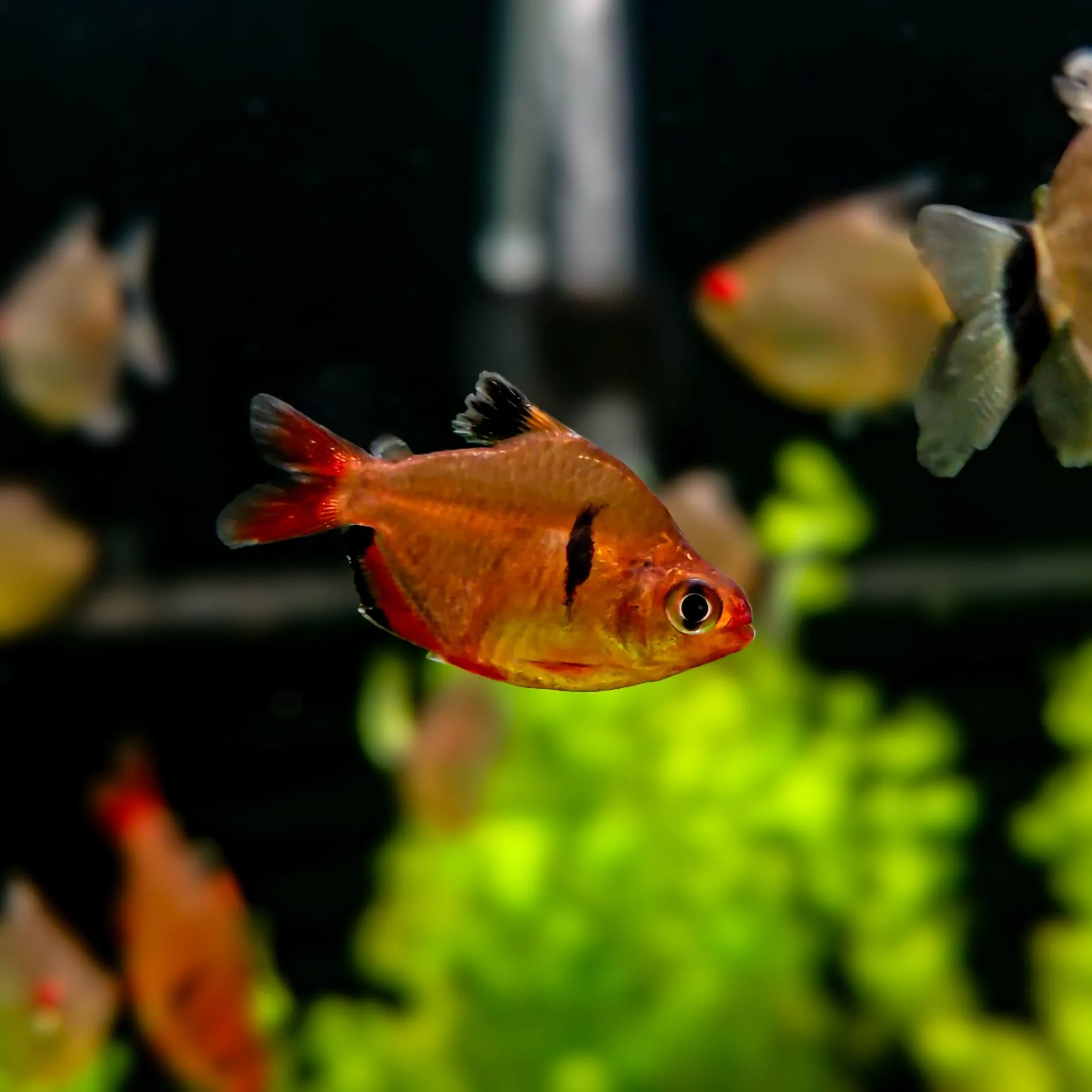
The Serpae Tetra is one of the most strikingly colored tetras available—a deep, blood-red body with a distinctive black comma-shaped marking on the shoulder. When healthy and properly kept, they're undeniably beautiful fish that add brilliant color to any tank.
However, Serpae Tetras come with a significant caveat: they're notorious fin nippers. This isn't occasional or minor—it's persistent and can be relentless. They'll target any slow-moving or long-finned tankmate, shredding fins down to stumps in severe cases. This behavior is their nature, not a result of poor keeping.
The key to keeping Serpae Tetras successfully is understanding and working with their temperament. Large groups (8-10+) focus their nipping behavior on each other rather than tankmates. Choosing robust, fast-moving companions that can avoid or tolerate them is essential. With the right setup and tankmates, they're hardy, beautiful, and easy to keep. With the wrong ones, they're a menace.
Natural Habitat & Origin
Serpae Tetras are native to the Amazon basin in South America, including the Paraguay and Guapore rivers. They inhabit slow-moving and still waters—ponds, backwaters, and densely vegetated areas with abundant leaf litter.
Their natural habitat features soft, acidic water stained with tannins, subdued lighting, and abundant plant cover. These conditions are easily replicated in aquariums, and while captive-bred specimens adapt to various conditions, they display best coloration in setups that mirror their natural environment.
Native Region
South America—Amazon basin, Paraguay, Guapore rivers
Habitat Type
Slow-moving and still waters, ponds, backwaters, densely vegetated areas
Wild Water Conditions
Soft, acidic, tannin-stained water with leaf litter and dense vegetation
Appearance & Varieties
Serpae Tetras are small (about 1.6 inches / 4 cm) but intensely colored. Their body is a deep blood-red to flame-red, with a distinctive black comma or wedge-shaped marking behind the gill cover. The dorsal fin is predominantly black, especially in males, adding striking contrast.
Males are slimmer with more intense coloration and fully black dorsal fins. Females are rounder (especially when carrying eggs) with slightly less vivid color. Both sexes can display remarkable intensity when healthy—truly one of the reddest fish in the freshwater hobby.
Popular Varieties
| Variety | Description | Rarity |
|---|---|---|
| Wild Type | Deep red with black comma marking and black dorsal | Very Common |
| Long-finned | Extended finnage—less common variant | Uncommon |
Tank Setup & Requirements
Quick Requirements Summary
Tank Size
Minimum Tank Size
20 gallons
Recommended Tank Size
20 gallons
Serpae Tetras need at least 20 gallons (75 liters) for a proper school, with 30 gallons (115 liters) being preferable. The emphasis should be on horizontal swimming space and providing enough room for the school to spread out.
Water Parameters
Adaptable: temperature 72-82°F (22-28°C), pH 5.5-7.5, GH 5-20. They're hardy and tolerate a range of conditions, though best color develops in slightly acidic water.
Substrate
Dark substrate significantly enhances their red coloration. Light substrates wash out their appearance.
Plants & Decorations
Plants are beneficial, creating visual barriers that help distribute territorial behavior. Create a layout with planted perimeters and open swimming space. Floating plants provide appreciated shade.
Filtration & Water Flow
Standard filtration with gentle to moderate flow. They prefer calmer waters typical of their natural backwater habitats.
Lighting
Moderate lighting—not too bright. Subdued conditions enhance their red coloration.
Diet & Feeding Guide
Diet Type
omnivore
Feeding Frequency
1-2x daily
Portion Size
What they consume in 2-3 minutes
Serpae Tetras are unfussy omnivores that accept most aquarium foods readily. Keeping them well-fed may slightly reduce aggression—hungry fish are more nippy—but good diet primarily affects their health and color intensity.
Best Foods for Serpae Tetra
- High-quality flakes — Staple diet—color-enhancing formulas recommended
- Micro pellets — Good variety for their small mouths
- Frozen bloodworms — Favorite food, enhances color
- Frozen brine shrimp — Excellent protein supplement
- Daphnia — Good live/frozen option
- Live foods — Occasional treats for conditioning
Foods to Avoid
- Low-quality foods — Affects color and health
- Overfeeding — Water quality issues, though won't stop nipping
Color-enhancing foods maintain their deep red coloration. Varied diet keeps them healthy. Keep them well-fed—hungry Serpae Tetras are more aggressive, though feeding alone won't eliminate their nipping behavior.
Behavior & Temperament
Serpae Tetras are active, boisterous fish that establish hierarchies through chasing and fin nipping. This behavior is constant within the school—they nip each other regularly, establishing and maintaining pecking orders.
The problem arises when they redirect this behavior toward tankmates. Slow-moving fish, long-finned fish, and anything that can't escape or defend itself becomes a target. This isn't aggression in the typical sense—it's more like compulsive behavior they can't resist.
Larger groups (8-10+) are essential because they distribute this behavior across many fish rather than concentrating it on a few. In a proper school with appropriate tankmates, Serpae Tetras are manageable. In small groups with vulnerable tankmates, they're destructive.
Tank Mates: Compatibility Guide
Compatible Tank Mates
Can hold their own
Fast and robust
Too fast to be targets
Larger rasboras
Quick and can avoid trouble
Usually ignored on the bottom
Armored and ignored
Different level, robust
Tank Mates to Avoid
Bettas
Will be relentlessly fin-nipped to exhaustion
Angelfish
Long fins, slow movement—irresistible targets
Fancy Guppies
Flowing tails will be destroyed
Slow-moving fish
Easy targets they can't resist
Peaceful, delicate species
Will be harassed and stressed
Very small fish
May be bullied or eaten
Congo Tetras
Their flowing fins will be shredded
Common Pairing Questions
Why are serpae tetras so aggressive?
It's their nature—they establish hierarchies through nipping. Larger groups (8+) spread aggression so no single fish is targeted. Small groups concentrate aggression on few individuals.
Can I keep serpae tetras with bettas?
Absolutely not. Serpae tetras will relentlessly nip betta fins. This applies to all long-finned, slow-moving fish—they're irresistible targets.
How do I reduce serpae tetra aggression?
Keep large groups (10+), provide plenty of space, maintain sight breaks with plants, keep them well-fed, and choose appropriate tankmates that can handle or avoid them.
Serpae Tetras are easy to breed in home aquariums. They're egg scatterers that spawn readily with minimal encouragement.
Set up a breeding tank with fine-leaved plants or spawning mops, soft acidic water, and dim lighting. Condition breeders with live foods for 1-2 weeks. Males chase females, and 200-300 eggs are scattered among plants.
Remove parents immediately after spawning—they will eat eggs without hesitation. Eggs hatch in 24-48 hours and fry become free-swimming shortly after. Feed infusoria initially, then baby brine shrimp. Eggs and fry are light-sensitive, so keep the breeding tank dim.
Health Issues & Disease Prevention
Serpae Tetras are hardy fish that tolerate a range of conditions. They're among the easier tetras to keep healthy, provided basic care requirements are met.
Common Diseases
| Disease | Symptoms | Treatment |
|---|---|---|
| Ich | White spots, scratching on objects | Raise temperature, standard ich medication |
| Fin rot | Deteriorating fins from nipping damage | Larger groups reduce damage, improve water quality |
| Neon Tetra Disease | Fading color, curved spine, erratic swimming | No cure—isolate affected fish, buy healthy stock |
| Velvet | Gold dust appearance | Copper-based treatment, dim lighting |
Signs of a Healthy Serpae Tetra
- Deep red coloration
- Active swimming and schooling
- Good appetite
- Intact fins (some minor damage normal)
- Interacting with school
Prevention Tips
- Quarantine new fish for 2 weeks
- Keep in large groups (8+) to distribute nipping
- Maintain good water quality
- Provide adequate space for the school
- Choose robust tankmates that can tolerate them
Frequently Asked Questions
It's their nature—they establish hierarchies through nipping. Larger groups (8+) spread aggression so no single fish is targeted. Small groups concentrate aggression on few individuals.
Absolutely not. Serpae tetras will relentlessly nip betta fins. This applies to all long-finned, slow-moving fish—they're irresistible targets.
Keep large groups (10+), provide plenty of space, maintain sight breaks with plants, keep them well-fed, and choose appropriate tankmates that can handle or avoid them.
Only with the right tankmates. They're great with other fast, robust fish like barbs and danios. They're terrible with peaceful, slow, or long-finned species.
Tips for Keeping Serpae Tetra
Pro Tips
- ✓8+ fish minimum—larger groups dramatically reduce aggression toward tankmates
- ✓One of the most beautiful red tetras when properly kept
- ✓Match with equally robust tankmates—barbs, danios, larger tetras
- ✓Never keep with bettas, angelfish, or fancy guppies
- ✓Well-fed serpae tetras are slightly less aggressive
- ✓They're hardy and easy to keep—just choose tankmates carefully
- ✓Species-only tanks showcase their beauty without compatibility issues
Common Mistakes to Avoid
- ✗Small groups—dramatically increases aggression toward tankmates
- ✗Keeping with long-finned fish—will be relentlessly nipped
- ✗Expecting peaceful community behavior
- ✗Mixing with slow or timid species
- ✗Underestimating their nippiness
- ✗Keeping with bettas or angelfish
- ✗Not providing enough swimming space
Sources
- FishBase — Accepted scientific name, maximum size and native range for Serpae Tetra.
Related Species You Might Like
View All Fish →
Severum
Heros efasciatus

Buenos Aires Tetra
Hyphessobrycon anisitsi
Black Neon Tetra
Hyphessobrycon herbertaxelrodi
Black Phantom Tetra
Hyphessobrycon megalopterus
Bleeding Heart Tetra
Hyphessobrycon erythrostigma

Colombian Tetra
Hyphessobrycon columbianus
Ember Tetra
Hyphessobrycon amandae
Flame Tetra
Hyphessobrycon flammeus
Ready to Add Serpae Tetra to Your Tank?
Use our free stocking calculator to check compatibility, bioload, and get personalized recommendations.