
Care Requirements
Adult Size
5.9" (15cm)
Min Tank
30 gal
Temperature
75-79°F
pH Range
6.5-7.5
Lifespan
10+ years
Min Group
Can be kept alone
Diet
Omnivore
Swim Level
Bottom
Bioload
4/10
Hardness
5-15 dGH
About Siamese Algae Eater
The Siamese Algae Eater is the gold standard for algae control in planted aquariums—one of the only fish that reliably eats black beard algae (BBA), the bane of many aquarists. These active, torpedo-shaped fish from Southeast Asia spend their days constantly grazing on surfaces, cleaning algae from plants, rocks, and glass.
What makes SAEs particularly valuable is their willingness to eat algae that other fish ignore. While many 'algae eaters' prefer prepared foods over actual algae, SAEs genuinely work for their keep—provided you don't overfeed them. They're also peaceful community fish that get along with most tankmates, making them easy to incorporate into established tanks.
However, prospective keepers should understand that SAEs grow much larger than often expected—up to 6 inches. They're frequently sold as juveniles in the 2-inch range, leading many buyers to underestimate their tank requirements. Plan for a 30+ gallon tank and their 10+ year lifespan.
Natural Habitat & Origin
In the wild, Siamese Algae Eaters inhabit fast-flowing streams and rivers throughout Southeast Asia, including Thailand, Malaysia, Sumatra, and Borneo. These waters feature rocky substrates, submerged logs, and abundant algae growth on every available surface.
Their natural habitat explains their behavior in aquariums—they appreciate water movement, spend time on surfaces grazing, and are excellent swimmers capable of navigating currents. Understanding their riverine origins helps explain why they thrive with good filtration and moderate flow.
Native Region
Southeast Asia (Thailand, Malaysia, Sumatra, Borneo)
Habitat Type
Fast-flowing streams and rivers with rocky substrates
Wild Water Conditions
Warm (75-79°F), moderate hardness, neutral to slightly acidic pH, well-oxygenated
Appearance & Varieties
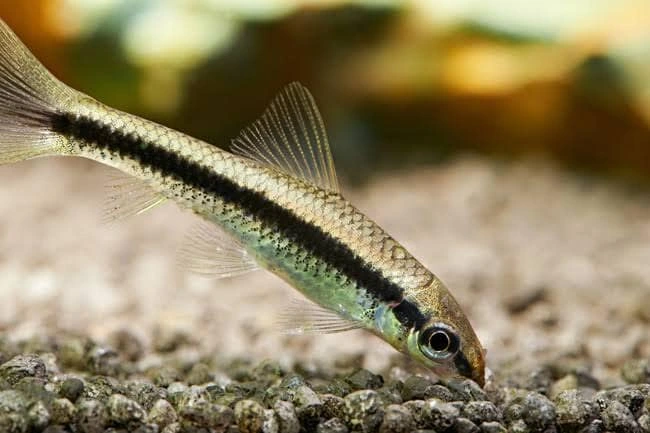
Siamese Algae Eaters have elongated, torpedo-shaped bodies reaching up to 6 inches (15 cm) in length. Their most distinctive feature is a bold black horizontal stripe running from the nose through the eye and extending INTO the tail fin—this is the key identification marker that distinguishes true SAEs from lookalikes.
The body above the stripe is olive to golden-brown, fading to a lighter belly. Their fins are transparent without coloration. They have a small, downturned mouth adapted for scraping algae from surfaces, and they often rest on their pectoral fins on leaves and decorations.
Buyers should be aware that SAEs are frequently confused with Flying Fox (yellow fins, stripe stops at tail base) and Chinese Algae Eater (aggressive, stops eating algae as adult). The stripe extending through the tail is the definitive identifier.
Tank Setup & Requirements
Quick Requirements Summary
Tank Size
Minimum Tank Size
30 gallons
Recommended Tank Size
40 gallons
Siamese Algae Eaters need space to swim and surfaces to graze. They're active fish that appreciate tanks with good horizontal swimming room and established algae growth.
Water Parameters
Temperature between 75-79°F (24-26°C), pH 6.5-8.0, and moderate hardness (5-20 dGH). They're adaptable to a range of conditions. Good oxygenation is important as they come from well-flowing waters.
Substrate
Any substrate works—they spend most of their time on surfaces rather than the substrate itself. Gravel or sand both work fine.
Plants & Decorations
Live plants are beneficial as they provide grazing surfaces. Hardy plants like Anubias, Java fern, and Amazon swords work well. Driftwood and rocks provide additional grazing surfaces and resting spots.
Filtration & Water Flow
Good filtration with moderate to strong flow is appreciated—they come from rivers and enjoy current. Aim for 6-8x tank volume turnover per hour.
Lighting
Moderate to high lighting encourages algae growth, giving them natural food. If your goal is algae control, some algae presence is actually desirable.
Diet & Feeding Guide
Diet Type
omnivore
Feeding Frequency
1-2x daily (if supplementing)
Portion Size
Keep slightly hungry for best algae eating
Siamese Algae Eaters are primarily herbivores that feed on algae and biofilm in the wild, supplemented with small invertebrates. In aquariums, they're valued specifically for their appetite for difficult algae types.
Best Foods for Siamese Algae Eater
- Natural tank algae — Their primary purpose—let them graze on tank algae
- Algae wafers — Supplement when natural algae is insufficient
- Blanched zucchini — Excellent vegetable supplement
- Blanched spinach — Good green vegetable option
- Spirulina flakes — Provides vegetable nutrition
- Cucumber — Easy to prepare, readily accepted
Foods to Avoid
- High-protein diets — Reduces motivation to eat algae
- Overfeeding meaty foods — They'll prefer easy food over algae work
Here's the key: if well-fed on prepared foods, SAEs may stop eating algae entirely. For best algae control, keep them slightly hungry. They're one of the few fish that eat black beard algae (BBA), but only when motivated by hunger.
What a Siamese Algae Eater will actually graze depends entirely on which algae you have — soft film comes off easily, while black beard and blue-green growth are ignored by almost everything. Identify the algae in your tank before deciding whether livestock is the right fix.
Behavior & Temperament
Siamese Algae Eaters are active, constantly moving fish. They spend their days grazing on surfaces—plants, rocks, glass, decorations—pausing occasionally to rest on leaves or substrate using their pectoral fins as props.
They can be kept singly or in groups. Groups may squabble and chase each other, but this rarely causes injury. As they age and grow larger, some individuals may become territorial, particularly toward similar-looking species or other algae eaters.
SAEs are one of the only fish that actively eat black beard algae (BBA), making them invaluable for planted tank maintenance. They also eat hair algae, soft green algae, and biofilm.
Tank Mates: Compatibility Guide
Compatible Tank Mates
Peaceful community fish, different niche
Peaceful schooling fish
Peaceful bottom dweller
Active, peaceful barb species
Peaceful mid-dweller
Peaceful larger community fish
Can coexist in larger tanks
Active swimmer, similar water preferences
Tank Mates to Avoid
Other algae eaters
Competition and potential aggression
Slow long-finned fish
May occasionally nip flowing fins
Very small fish (when SAE is adult)
Size difference concerns
Chinese Algae Eater
Aggressive, territorial conflicts
Common Pairing Questions
Can Siamese Algae Eaters live with shrimp?
Mostly yes. Adult shrimp like Amanos are generally safe. SAEs may eat baby shrimp but usually ignore adults. They're not active hunters, just opportunistic. Dense plants help shrimplets survive.
Can I keep multiple Siamese Algae Eaters together?
Yes, in appropriately sized tanks (50+ gallons for groups). They may chase and squabble but rarely cause injury. Provide enough space for territories and multiple grazing areas.
What's the difference between SAE and Chinese Algae Eater?
Critical distinction: Chinese Algae Eaters become aggressive and stop eating algae as adults, often attacking tankmates. True SAEs remain peaceful algae eaters. SAEs have a stripe through the tail; CAEs have sucker mouths and spotted patterns.
Breeding Siamese Algae Eaters in home aquariums has not been successfully documented. All aquarium specimens are either wild-caught or commercially bred using hormone treatments.
In the wild, SAEs are believed to be migratory spawners that travel upstream to breed, which may explain why captive breeding hasn't been achieved. Males and females are very difficult to distinguish, with females being only slightly plumper when mature.
For hobbyists, this means accepting that SAEs cannot be bred at home. If you want more, you'll need to purchase them.
Health Issues & Disease Prevention
Siamese Algae Eaters are generally hardy fish when kept in appropriate conditions. Most health issues stem from poor water quality or inadequate diet.
Common Diseases
| Disease | Symptoms | Treatment |
|---|---|---|
| Ich | White spots, scratching on objects | Raise temperature, medication |
| Bacterial infections | Red streaks, fin rot, lethargy | Improve water quality, antibacterial treatment |
| Fungal infections | White cotton-like growth | Antifungal medication, address injuries |
| Malnutrition | Sunken belly, faded color | Varied diet with vegetables and algae wafers |
Signs of a Healthy Siamese Algae Eater
- Active grazing behavior
- Full body shape
- Clear eyes
- Intact fins
- Responsive and alert
- Strong appetite
Prevention Tips
- Maintain good water quality with regular water changes
- Provide varied diet including vegetables
- Ensure adequate tank size for adult fish
- Quarantine new fish for 2-4 weeks
- Provide good water flow and oxygenation
- Don't overstock—they need space as adults
Frequently Asked Questions
Yes—they're one of the few fish that will eat BBA. However, they prefer softer algae if available. Keep them slightly hungry and limit other foods for best BBA control.
Chinese Algae Eaters become aggressive and stop eating algae as adults. True SAEs remain peaceful and continue grazing. SAEs have a stripe through the tail; CAEs have a spotted pattern and sucker mouth.
Up to 6 inches (15cm). They're often sold small but outgrow nano tanks quickly. Plan for their adult size with at least a 30-gallon tank.
Generally no—they graze algae off plants without damaging them. However, very hungry SAEs might nibble on soft plants. Keep them fed with vegetables if algae is scarce.
The black horizontal stripe must extend INTO the tail fin. Flying Fox have yellow fins and the stripe stops at the tail base. Chinese Algae Eaters have a sucker mouth and spotted pattern. The stripe-through-tail is the definitive marker.
Tips for Keeping Siamese Algae Eater
Pro Tips
- ✓Verify you're getting true SAE—the stripe must extend INTO the tail fin
- ✓Keep slightly hungry for best algae-eating performance
- ✓They're the go-to solution for black beard algae problems
- ✓Buy young—they adapt better and you'll have years of algae control
- ✓One SAE per 20-30 gallons is sufficient for algae control
- ✓They appreciate current—position filter output for flow
- ✓Don't rely solely on them for algae control—address root causes too
Common Mistakes to Avoid
- ✗Buying Chinese Algae Eater or Flying Fox by mistake—verify species
- ✗Keeping in tanks too small for adult size
- ✗Overfeeding—reduces motivation to eat algae
- ✗Expecting them to eliminate all algae—they help but aren't magic
- ✗Not accounting for 10+ year lifespan
- ✗Keeping multiple in small tanks—territorial issues
- ✗Adding to tanks without algae—they need supplemental feeding
Sources
- FishBase — Accepted scientific name, maximum size and native range for Siamese Algae Eater.
Related Species You Might Like
View All Fish →
Silver Arowana
Osteoglossum bicirrhosum

Australian Rainbowfish
Melanotaenia splendida
Blue Phantom Pleco
Hemiancistrus sp.
Boesemani Rainbowfish
Melanotaenia boesemani
Bristlenose Pleco
Ancistrus sp.
Celebes Rainbowfish
Marosatherina ladigesi

Congo Tetra
Phenacogrammus interruptus
Denison Barb
Sahyadria denisonii
Ready to Add Siamese Algae Eater to Your Tank?
Use our free stocking calculator to check compatibility, bioload, and get personalized recommendations.