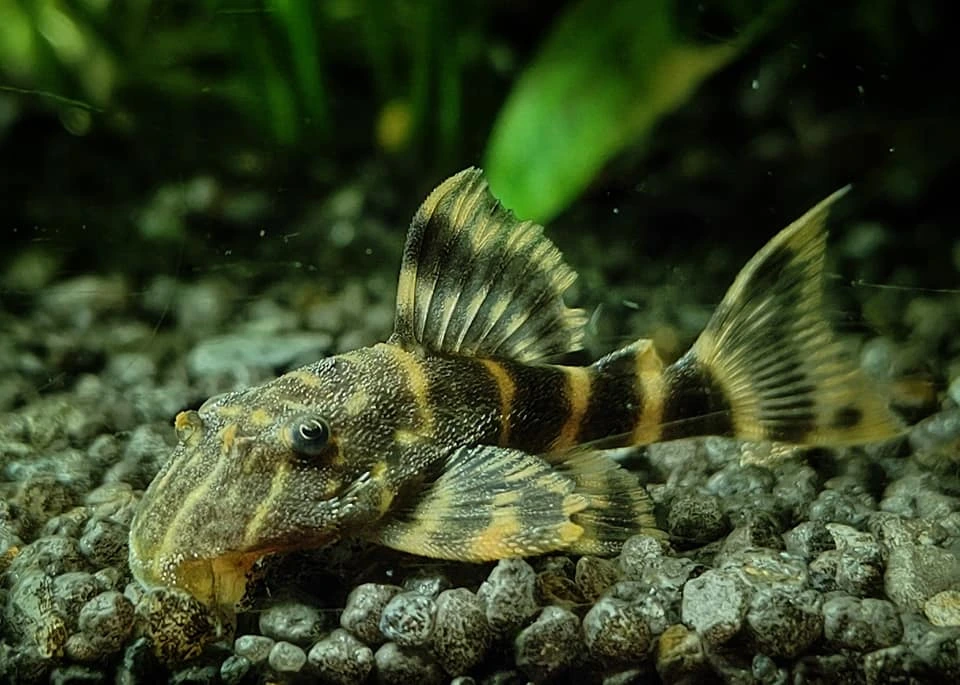
Compatibility Guide
    8 min read

    Red Tail Shark Tank Mates: 7 Compatible Species (and 7 to Avoid)

    Extinct in the wild and thriving in the trade, the Red Tail Shark is a black 15 cm minnow with a scarlet tail and an unusually low tolerance for company on the substrate. Treat it as a single-specimen fish that the rest of the tank is stocked around. It claims a cave, works outward from it, and enforces the boundary against bottom-dwellers, similar silhouettes and anything slow enough to be pinned in a corner. The stocking list below is deliberately stricter than the one for its rainbow-finned cousin, because the fish is.

    Reviewed by the AquariumStocking team · Updated

    The tank size that makes this work

    This is a floor-plan requirement rather than a water-volume one. What matters is how many separate refuges the layout holds and how far the shark can see from its cave — 210 litres, about 55 gallons, is simply the smallest footprint where that is achievable. Our database puts the red tail shark minimum at 55 gallons.

    55 gallons

    One red tail shark and mid-water stock only. At this size a second bottom fish of any kind is asking for trouble, because there is one usable cave zone and the shark has already taken it. Build two rock or wood masses at either end and leave the middle open — the shark takes one end, the mid-water fish use the rest, and nothing is forced past the cave mouth.

    Best fish for a 55 gallon tank

    75 gallons

    The first size where a second floor resident is a fair proposition, and it should be armoured and nocturnal rather than another daytime grazer. Three separate hardscape zones with genuine visual barriers between them make the difference. The extra swimming length also lets a chased fish break line of sight instead of running out of tank.

    Best fish for a 75 gallon tank

    125 gallons

    Enough space that the shark holds a corner rather than the whole floor, and the rest of the tank runs as a normal community around it. Two mid-water shoals, a surface group and a nocturnal catfish all fit without contesting anything. Even here the rule about a second shark holds — the constraint is behavioural, not spatial.

    Best fish for a 125 gallon tank

    How to choose tank mates for a red tail shark

    Take the silhouette rule literally

    Anything long, slim and bottom-oriented gets attacked: another red tail shark, a rainbow shark, a siamese algae eater, a flying fox. The trigger is shape and swimming position, not species or colour. If a fish would look like a red tail shark in outline through frosted glass, it does not go in this tank.

    Give the substrate away and stock everything else

    The simplest reliable plan is to concede the floor entirely and build the community upward. Mid-water barbs, rasboras and danios plus a surface group produce a full, busy tank in which the shark is a striking bottom feature rather than a problem. Every fish you place on the substrate is a negotiation.

    Robust beats peaceful, every time

    A red tail shark makes fast, committed rushes that end at the tank mate rather than short of it. Fish that keep swimming come to no harm. Slow, timid or long-finned species take those rushes as sustained attacks, stop feeding and decline over weeks. Prioritise fish that can absorb the behaviour rather than fish that deserve not to receive it.

    Cool the tank slightly and the list changes

    This species sits at 22–26 °C, cooler than most tropical communities, which quietly removes discus, cardinal-type warm-water specialists and other high-temperature fish from consideration. Read it as a benefit: the temperate end of the tropical range is where the sturdy barbs, danios and rainbowfish that suit this fish already live.

    Design the hardscape to break the shark's view

    One open floor equals one territory, and the shark claims it entirely. Rock piles, wood and dense planting split it into pockets with blind corners, so a chase ends after 30 cm instead of running the length of the glass. Rearranging the layout also resets an established territory, which is the standard fix when an adult starts patrolling too widely.

    Introduce it last, and only one

    Adding the shark to a settled tank puts it in the position of newcomer and it claims less ground. Adding tank mates to an established shark works better if you rearrange the hardscape the same day. And one specimen, always — a second red tail shark in a home aquarium ends with a dead fish, not a hierarchy.

    Compatible species, ranked by fit

    Seven species that stay off the substrate, take a charge without flinching, and share the cooler tropical range this fish wants.

    Odessa barb swimming in an aquarium

    Odessa Barb

    Pethia padamya

    A hardy mid-water barb that thrives at 22–26 °C, precisely the range that makes a red tail shark comfortable, and the male's red lateral stripe holds up against the shark visually rather than competing with it. It shoals actively in the middle of the tank and shows no interest in the substrate. Keep eight or more, with several males, so their display energy stays within the group. Sturdy enough that a rush from below barely interrupts feeding.

    Min tank 20 gallons+
    64-79°F
    pH 67.5
    5 cm (2")
    Peaceful
    Beginner
    Longfin rosy barb swimming in an aquarium

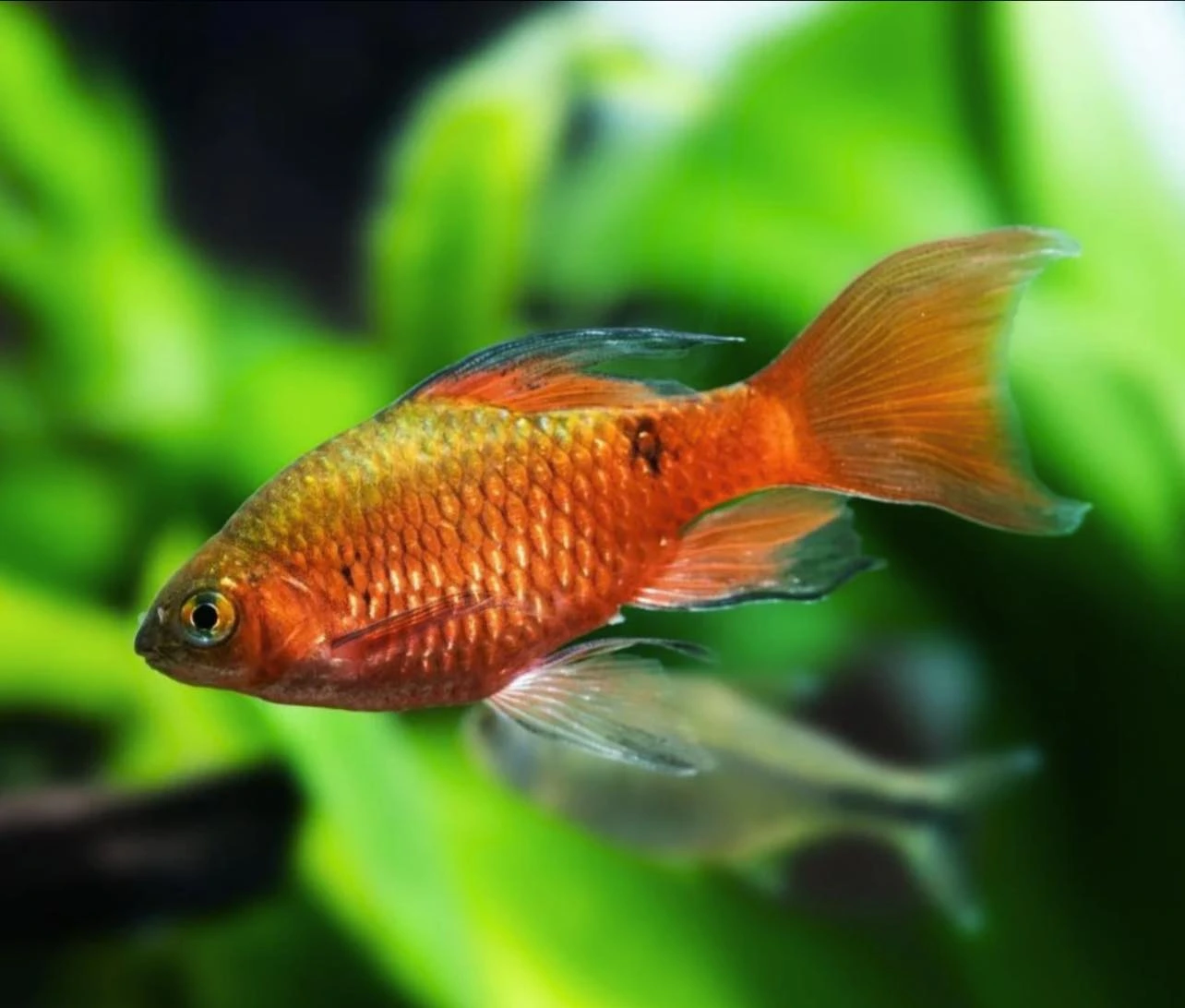
    Rosy Barb

    Pethia conchonius

    One of the toughest community fish available and comfortable in the same cooler water, which is why it appears on so few warm-tank lists and belongs on this one. It is fast, thick-bodied and completely unbothered by territorial displays. Keep six or more and expect them to strip soft plants — this is a fish for a hardscape tank rather than a delicate aquascape. Feed at the surface and nothing sinks into contested ground.

    Min tank 30 gallons+
    64-77°F
    pH 6.57.5
    10 cm (3.9")
    Peaceful
    Beginner
    Three Zebra Danios swimming near aquarium plants

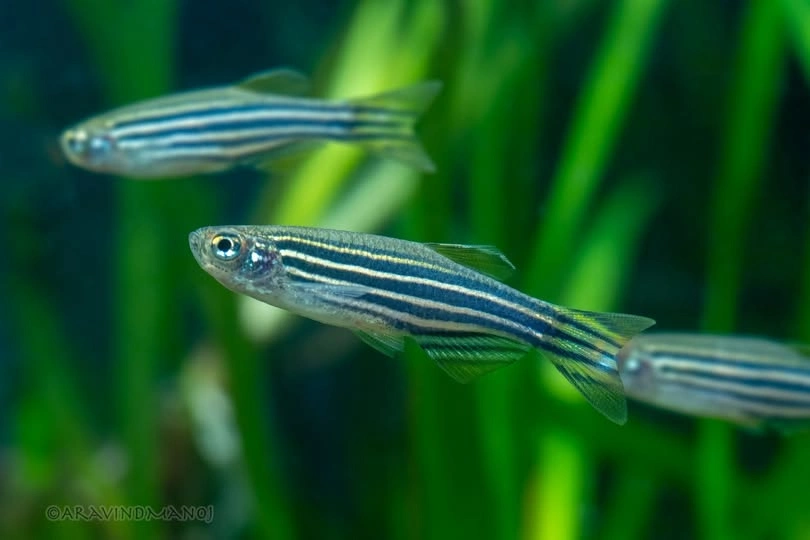
    Zebra Danio

    Danio rerio

    Permanently in motion across the top of the tank and effectively impossible for a bottom-dwelling fish to corner. It tolerates the low end of the tropical range better than almost anything else in the hobby and adds movement that draws shy fish out. Keep eight or more; a small group turns nippy toward each other and toward slower tank mates. A safe, cheap way to make the upper water look occupied.

    Min tank 15 gallons+
    64-79°F
    pH 6.57.5
    5 cm (2")
    Peaceful
    Beginner
    Harlequin Rasbora swimming in the middle of an aquarium

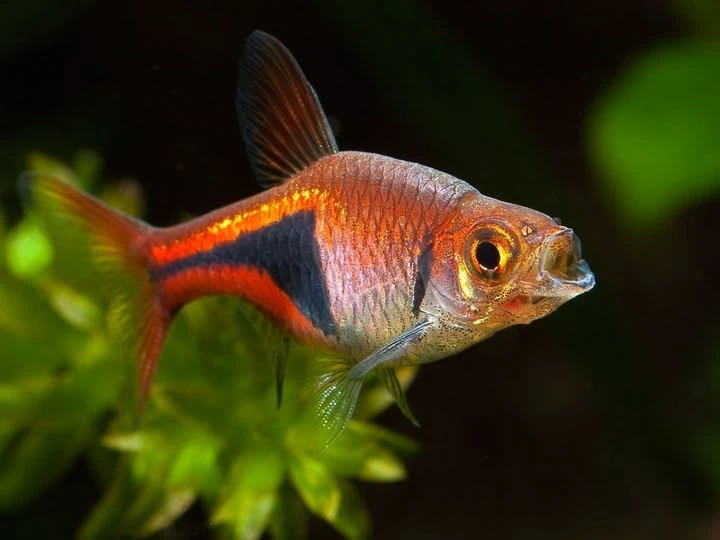
    Harlequin Rasbora

    Trigonostigma heteromorpha

    Holds midwater in a tidy shoal and rarely drops toward the substrate, which is what keeps it off the shark's agenda. At 4 cm it is on the small side for this tank, but its habit of staying high and shoaling tightly means it is neither pinned nor pursued. Keep ten or more so the group is confident enough to stay in the open. Feed at the surface and it never competes for sinking food.

    Min tank 15 gallons+
    72-81°F
    pH 67.5
    4 cm (1.6")
    Peaceful
    Beginner
    Three spot gourami swimming in an aquarium

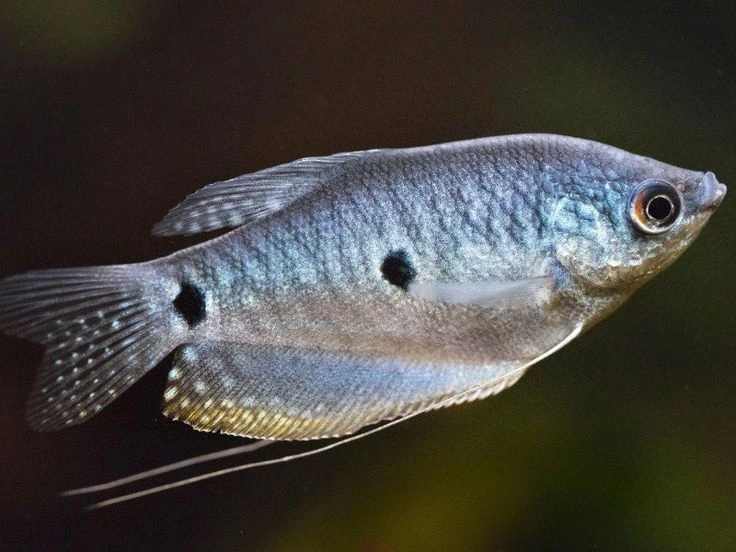
    Three Spot Gourami

    Trichopodus trichopterus

    A surface-breathing labyrinth fish of 12 cm that is far too large to be intimidated and far too high in the tank to be relevant to a floor territory. It brings its own mild territoriality, which stays at the top and does not overlap with the shark's claim below. Keep one, or a male with two females, and provide some still surface among the floating plants. Robust enough that the occasional rush from the substrate goes unnoticed.

    Min tank 40 gallons+
    72-82°F
    pH 68.5
    15 cm (5.9")
    Semi-aggressive
    Beginner
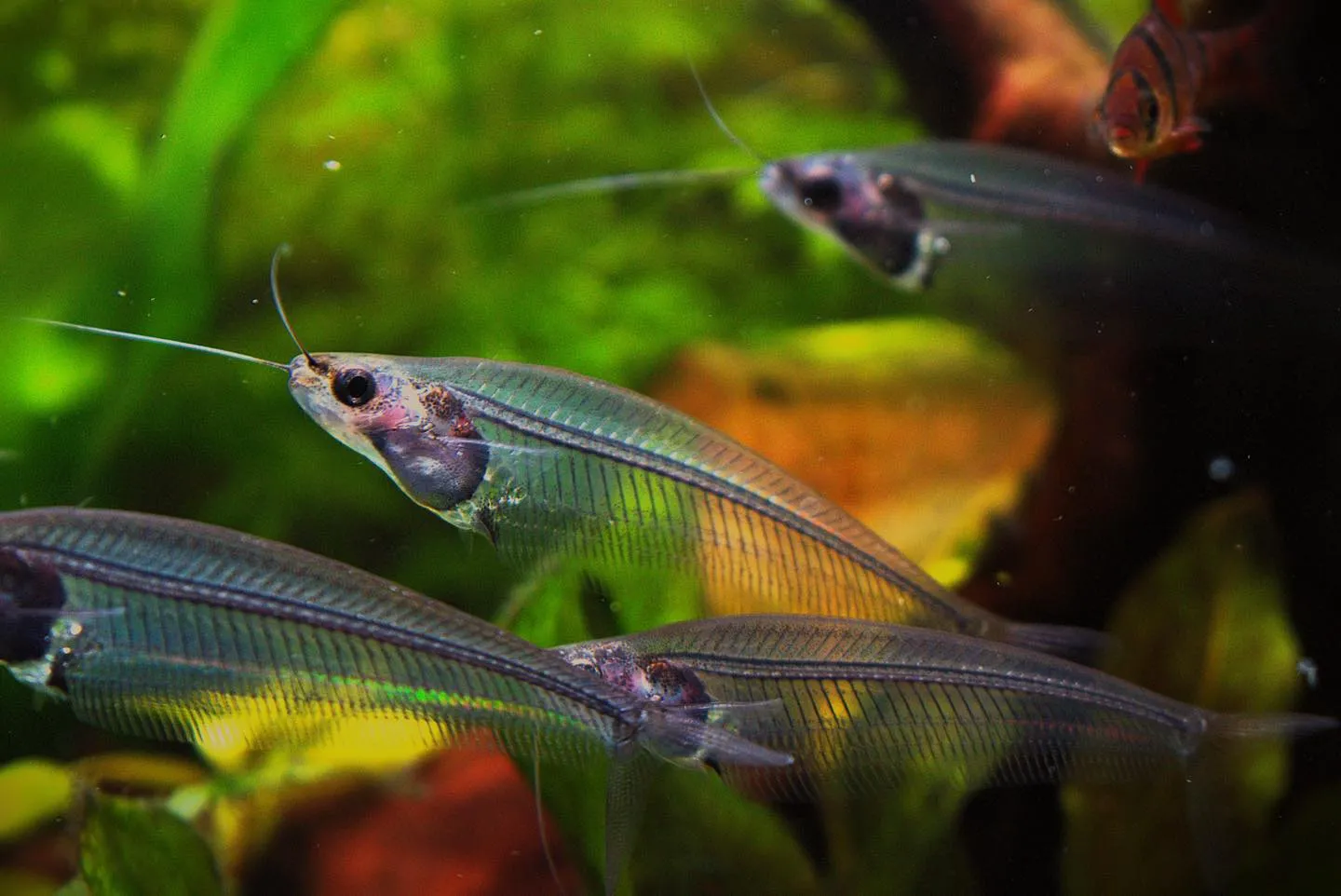
    A school of glass catfish swimming together in an aquarium

    Glass Catfish

    Kryptopterus vitreolus

    An unusual choice that works because it hovers in midwater in a group rather than resting on the bottom like most catfish. Transparent, calm and entirely non-territorial, it gives the shark nothing to react to. It does need a group of six or more, gentle flow and a shaded area, and it is a poor eater in a tank with fast competition, so feed deliberately. Its silhouette bears no resemblance to a shark, which is the point.

    Min tank 30 gallons+
    75-82°F
    pH 6.57.5
    8 cm (3.1")
    Peaceful
    Intermediate
    Upside down catfish swimming upside down in an aquarium

    Upside Down Catfish

    Synodontis nigriventris

    Nocturnal, gregarious and inverted under wood or leaves rather than sitting on the sand, so it occupies a niche the shark does not defend. Their active hours differ enough that the two mostly avoid each other outright. Keep four or more and give them a dedicated overhang at the opposite end from the shark's cave. Feed after lights-out so they are not competing with daytime fish for sinking food.

    Min tank 30 gallons+
    72-82°F
    pH 67.5
    10 cm (3.9")
    Peaceful
    Beginner

    Species to avoid

    Rainbow shark swimming in an aquarium

    Rainbow Shark

    Epalzeorhynchos frenatum

    Avoid — fights to a finish

    Same genus, same floor territory, same intolerance, and the red tail is the more determined of the two. The fighting is sustained rather than ritual and normally ends with a dead or badly damaged fish within days. Volume and hardscape do not fix this pairing; separate tanks do.

    Min tank 55 gallons+
    75-82°F
    pH 6.57.5
    15 cm (5.9")
    Semi-aggressive
    Intermediate
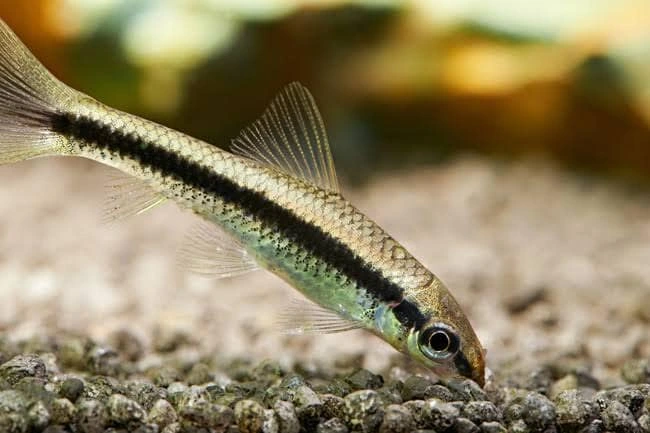
    Siamese Algae Eater foraging for food at the bottom of an aquarium

    Siamese Algae Eater

    Crossocheilus oblongus

    Avoid — same body shape

    Long, slim and permanently working the substrate — the outline that triggers the shark's territorial response most reliably after another shark. The SAE gets chased off the surfaces it is there to graze and spends its day hiding. A poor use of a genuinely good algae eater.

    Min tank 30 gallons+
    75-79°F
    pH 6.57.5
    15 cm (5.9")
    Peaceful
    Beginner
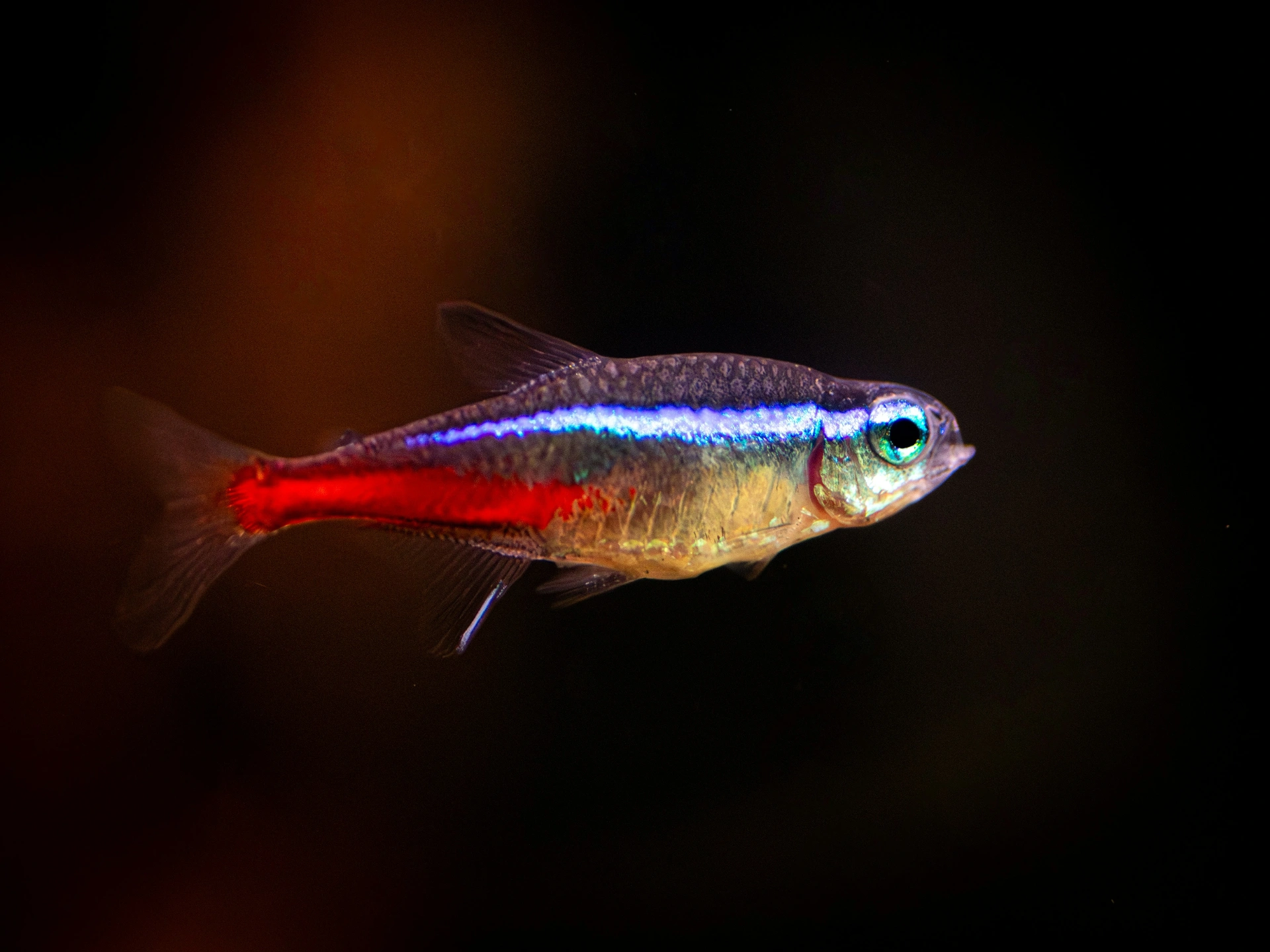
    Single neon tetra swimming in a dark aquarium

    Neon Tetra

    Paracheirodon innesi

    Avoid — harried into corners

    Small, slow and inclined to sink toward the lower half of the tank once settled, which puts it inside the defended zone repeatedly. The shark does not eat them; it simply keeps them moving until they stop feeding. Losses appear over months and get blamed on something else.

    Min tank 10 gallons+
    68-79°F
    pH 57
    3 cm (1.2")
    Peaceful
    Beginner
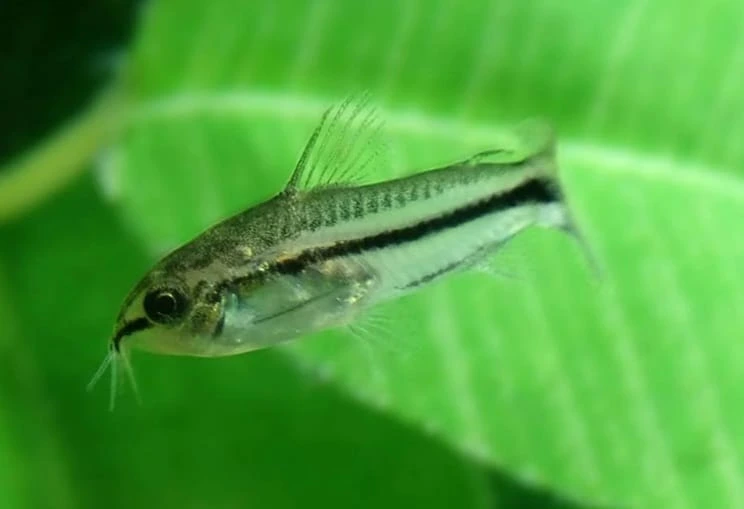
    Single pygmy corydora swimming in an aquarium

    Pygmy Corydoras

    Corydoras pygmaeus

    Avoid — too small for the floor

    A 2.5 cm bottom-dwelling group in a tank whose floor is owned by a fish six times its length. They cannot forage where they need to, and the sinking food they rely on lands in contested territory. Even full-size corydoras are a compromise here; these are not viable.

    Min tank 15 gallons+
    72-79°F
    pH 67.5
    2.5 cm (1")
    Peaceful
    Intermediate
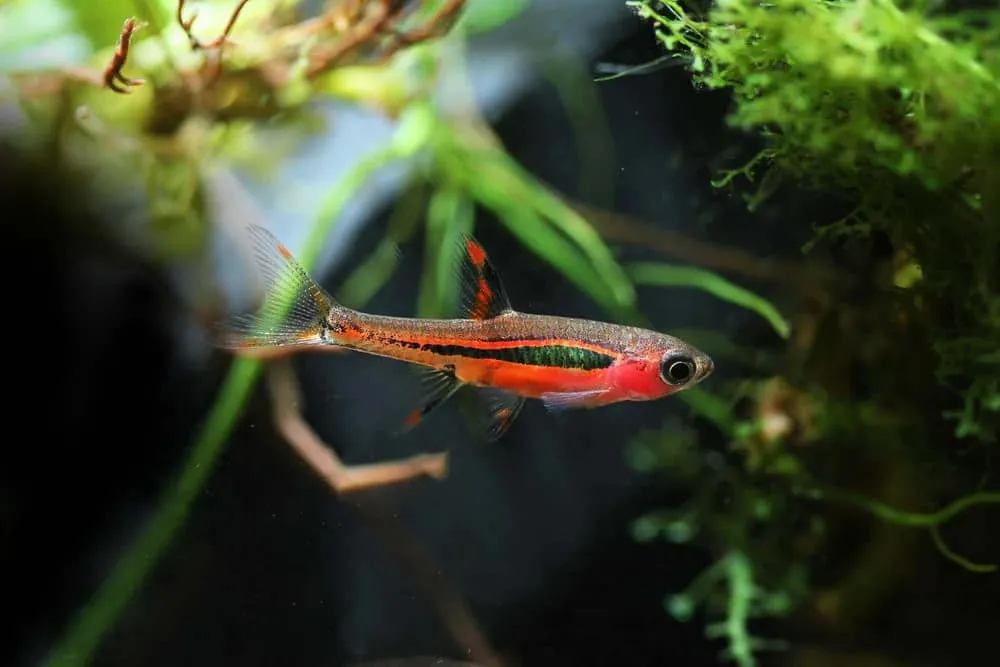
    A single chili rasbora swimming in an aquarium

    Chili Rasbora

    Boraras brigittae

    Avoid — far too small

    A 2 cm nano fish belongs in a quiet planted tank, not one built around a large territorial bottom fish. It is small enough to be genuinely at risk in a corner, and it needs the still, warm water that this tank does not provide. Keep it somewhere else entirely.

    Min tank 5 gallons+
    73-82°F
    pH 47
    2 cm (0.8")
    Peaceful
    Intermediate
    Blue discus swimming in an aquarium

    Discus

    Symphysodon aequifasciatus

    Avoid — wrong temperature range

    Discus need 28–30 °C and immaculate, still water; a red tail shark sits at 22–26 °C in a briskly filtered tank. There is no temperature at which both are properly kept. Add to that a slow, disc-shaped fish sharing space with a charging bottom-dweller and the behavioural mismatch is as clear as the thermal one.

    Min tank 70 gallons+
    82-90°F
    pH 5.57
    20 cm (7.9")
    Peaceful
    Advanced
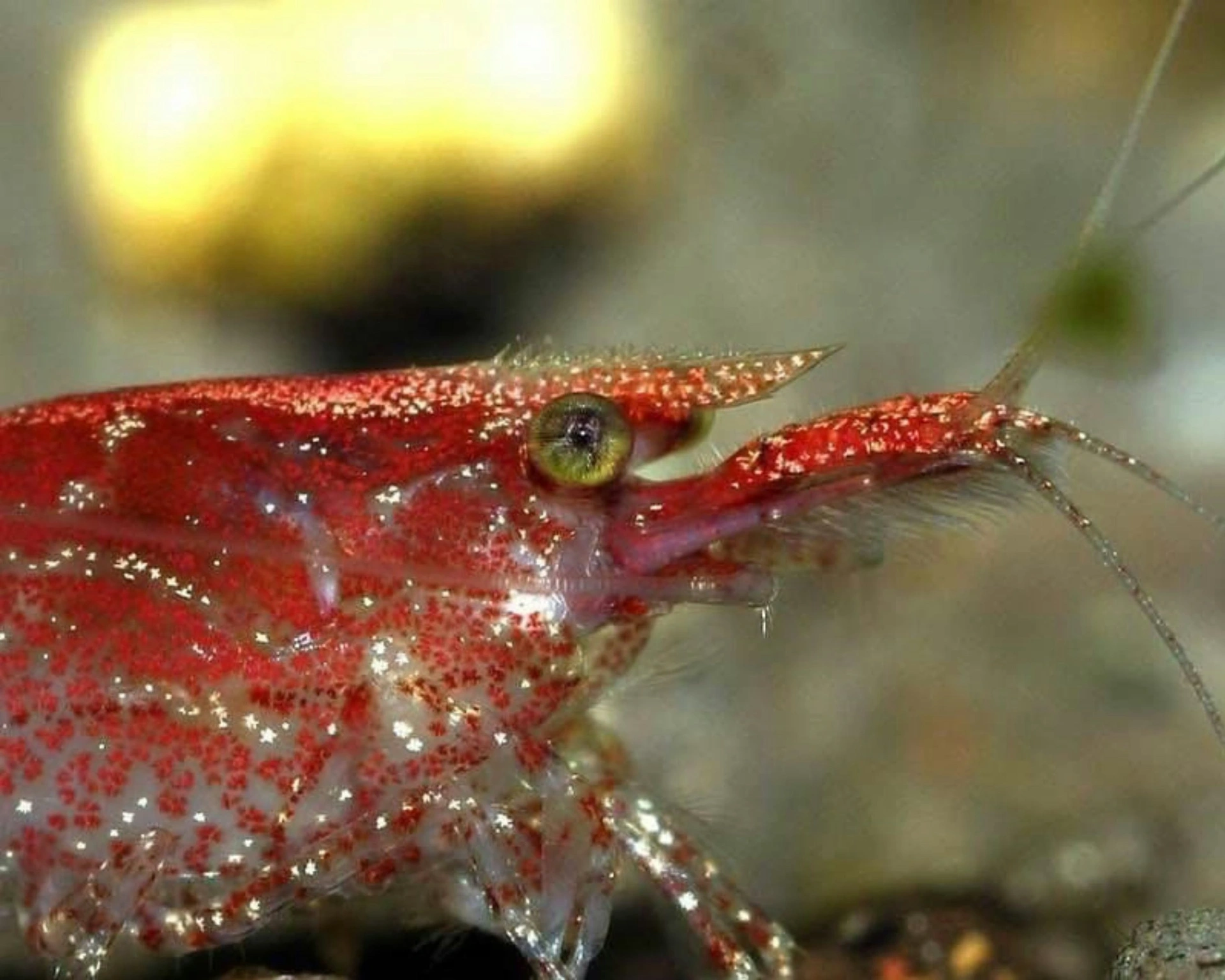
    Close up of cherry shrimp at the bottom of an aquarium

    Cherry Shrimp

    Neocaridina davidi

    Avoid — eaten or displaced

    Dwarf shrimp graze the same substrate and hardscape the shark patrols, so adults get picked at and juveniles disappear. Even a heavily mossed tank produces a colony that never grows. Shrimp belong in a tank without a large territorial floor fish.

    Min tank 5 gallons+
    64-82°F
    pH 6.58
    3 cm (1.2")
    Peaceful
    Beginner

    Depends on the individual

    Two that can work on the floor if the tank is long enough and the layout is broken up properly.

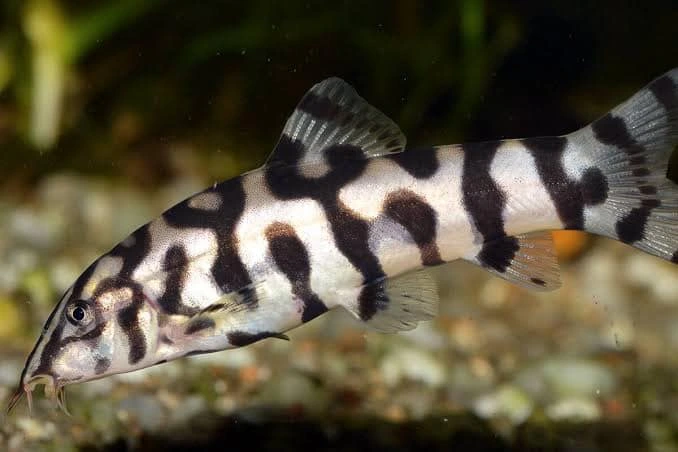
    Yoyo loach swimming in an aquarium

    Yoyo Loach

    Botia almorhae

    Condition: Only from 75 gallons, in a group of five with its own hardscape zone

    A confident botiid that will not be bullied — the risk here runs in the other direction, since a group of yoyo loaches can crowd a shark out of its own cave. In a long tank with two separated wood piles both parties keep to their end and the noise stays at the level of posturing. In 55 gallons it becomes a nightly dispute over one cave. Never try it with fewer than five loaches, because an under-grouped botiid redirects its energy at whatever else lives on the floor.

    Min tank 40 gallons+
    75-82°F
    pH 67.5
    13 cm (5.1")
    Semi-aggressive
    Intermediate
    Clown pleco laying at the bottom of an aquarium substrate

    Clown Pleco

    Panaqolus maccus

    Condition: Only with wood at the opposite end of the tank

    Small, armoured and nocturnal, it feeds on driftwood after dark when the shark is inactive, which is what makes the pairing plausible at all. The conflict is over cover rather than food: both want an enclosed space and there is usually one good one. Provide a second wood pile well away from the shark's cave and the pleco settles in without incident. If you find it wedged behind the filter every morning, the layout has failed.

    Min tank 20 gallons+
    75-86°F
    pH 67.5
    9 cm (3.5")
    Peaceful
    Beginner

    Compare at a glance

    Odessa Barb20 gallons64-79°F67.55 cm (2")BeginnerPeacefulGood
    Rosy Barb30 gallons64-77°F6.57.510 cm (3.9")BeginnerPeacefulGood
    Zebra Danio15 gallons64-79°F6.57.55 cm (2")BeginnerPeacefulGood
    Harlequin Rasbora15 gallons72-81°F67.54 cm (1.6")BeginnerPeacefulGood
    Three Spot Gourami40 gallons72-82°F68.515 cm (5.9")BeginnerSemi-aggressiveGood
    Glass Catfish30 gallons75-82°F6.57.58 cm (3.1")IntermediatePeacefulGood
    Upside Down Catfish30 gallons72-82°F67.510 cm (3.9")BeginnerPeacefulGood
    Yoyo Loach40 gallons75-82°F67.513 cm (5.1")IntermediateSemi-aggressiveConditional
    Clown Pleco20 gallons75-86°F67.59 cm (3.5")BeginnerPeacefulConditional
    Rainbow Shark55 gallons75-82°F6.57.515 cm (5.9")IntermediateSemi-aggressiveAvoid
    Siamese Algae Eater30 gallons75-79°F6.57.515 cm (5.9")BeginnerPeacefulAvoid
    Neon Tetra10 gallons68-79°F573 cm (1.2")BeginnerPeacefulAvoid
    Pygmy Corydoras15 gallons72-79°F67.52.5 cm (1")IntermediatePeacefulAvoid
    Chili Rasbora5 gallons73-82°F472 cm (0.8")IntermediatePeacefulAvoid
    Discus70 gallons82-90°F5.5720 cm (7.9")AdvancedPeacefulAvoid
    Cherry Shrimp5 gallons64-82°F6.583 cm (1.2")BeginnerPeacefulAvoid

    Not sure if your combination works?

    Drop your tank size and shortlist into the stocking calculator to check bioload, swim-level balance and compatibility flags.

    Frequently asked questions

    What fish can live with a red tail shark?

    Robust mid-water and surface fish in the 22–26 °C range: odessa barbs, rosy barbs, zebra danios, harlequin rasboras, three-spot gouramis, glass catfish and upside-down catfish. The rule is simple — stock the upper two-thirds of the tank and leave the floor to the shark.

    Can two red tail sharks live together?

    No. Two mature red tail sharks fight over the same territory until one is killed or badly injured, and the same applies to a red tail kept with a rainbow shark. One specimen per tank, without exception in home-sized aquariums.

    Is a red tail shark more aggressive than a rainbow shark?

    Yes, noticeably. Both defend the bottom of the tank, but the red tail claims more ground, pursues further and gives up later. A stocking list that just works for a rainbow shark is usually too optimistic for a red tail.

    What size tank does a red tail shark need?

    Our database sets 210 litres, roughly 55 gallons, as the minimum. Length and layout matter more than volume — the same 55 gallons broken into several hardscape zones behaves like a much larger tank from the shark's point of view.

    Can a red tail shark live with corydoras?

    Full-size corydoras in a group sometimes hold their own in a 75 gallon or larger tank with separated hardscape, but it is a compromise rather than a good pairing, and pygmy species are not viable at all. If you want an active bottom group, choose a different centrepiece fish.

    Why is my red tail shark chasing everything?

    It has matured and claimed the floor, and most likely the layout lets it see the entire tank from its cave. Rearranging the rock and wood into separate zones with visual barriers resets the territory and shortens every chase. Adding more mid-water fish also spreads its attention rather than concentrating it.

    Do red tail sharks eat algae?

    They graze some, but they are omnivores rather than dedicated algae eaters and will not keep a tank clean. Do not buy one as a cleanup fish — and note that the obvious alternative, the siamese algae eater, is one of the worst possible tank mates for it.